The United States, in its 15-point peace plan, demands an end to Iran’s nuclear program and the Strait of Hormuz to be reopened to global trade. According to an Iranian official, Iran would not allow President Trump “to dictate the timing of the war’s end,” providing a list of its own terms, including reparations for damages, a recognition of Iranian sovereignty over the Strait of Hormuz, an end to sanctions and a wider cease-fire for the region that protects Hezbollah, the Lebanese armed group backed by Iran.
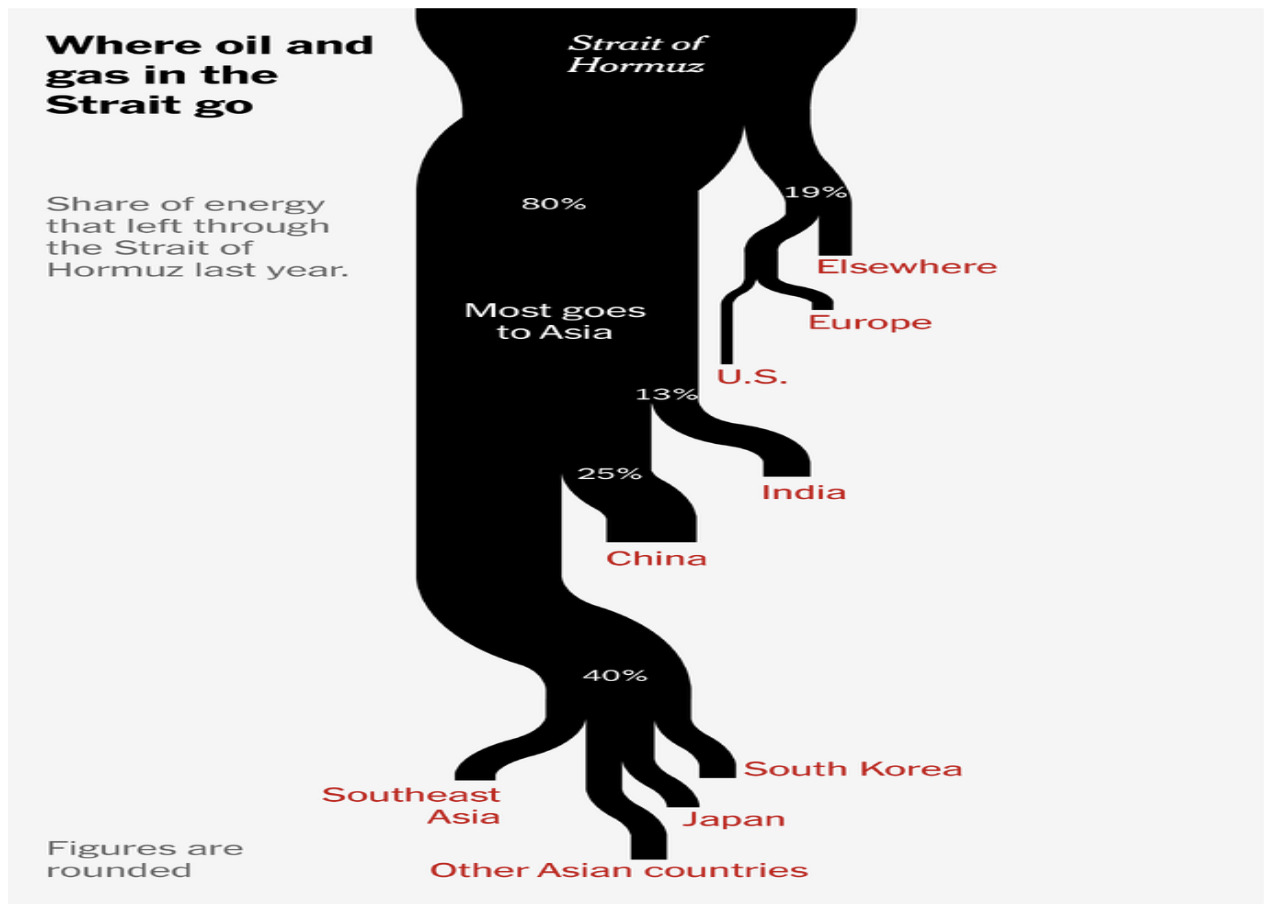
The Strait of Hormuz is at the center of any negotiations because its effective closure is holding hostage supplies that account for a fifth of the world’s oil and gas consumption. The United States wants safe passage through the strait for all supplies, including oil and LNG from Saudi Arabia and Qatar. Iran is allowing “nonhostile” ships, with its permission, to safely pass through the strait, documenting that decision in a letter to the U.N. and the International Maritime Organization. Iran is now working to advance a law to formalize charging ships a toll in exchange for safe passage through the Strait of Hormuz.
Asia, which relies more heavily on oil, gas, fuel, and fertilizer from the Middle East than other regions, is the most vulnerable to supply disruptions. Reuters reports that the most acute shortages are in oil derivatives such as naphtha, sourced predominantly from the Persian Gulf and used in refineries across Asia to produce the plastics and other petrochemicals needed for almost every manufactured product. Prices for some fundamentals, such as plastic and rubber, are hitting records.
U.S. Effects of the Iran Conflict
U.S. gasoline prices are averaging almost $4 a gallon across the nation, but in California, a gallon of gas costs nearly $6, as its onerous policies against oil and gas, taxes and environmental fees, and its boutique fuel requirements raise the state’s gas price almost $2 over the national average. That is still lower than gasoline prices in Europe, where drivers pay about 2 euros a liter, or $8.77 a gallon — more than double the average U.S. price. U.S. diesel prices average over $5 a gallon, hurting the trucking industry’s profits and raising the prices of all commodities transported to retail outlets. The price of jet fuel has almost doubled since the start of the conflict, prompting airlines to add a fuel surcharge to ticket prices. Jet fuel is generally airlines’ highest cost after labor, accounting for 20% of expenses or more.
The U.S. Postal Service plans to impose a temporary 8% surcharge on packages to offset rising fuel and transportation costs, taking effect on April 26, and is less than one-third of what its competitors charge for fuel alone. Its competitors, like FedEx and UPS, had already raised their fuel surcharges due to rising fuel costs. Before the USPS price increase takes effect, it must be reviewed and approved by the Postal Regulatory Commission, an independent agency that oversees the post office.
There are signs of renewed interest in electric vehicles after their sales lagged due to the removal of the EV tax credit last September. According to the U.S. car buying service CarEdge, search traffic for electric vehicles has increased by more than 20% as oil prices approached $100 per barrel. There are more than 70 fully-electric models available in the United States across a wide range of prices, and the public charging network has expanded, once a major deterrent. The new interest comes after Ford, Honda, and G.M. shuttered new EV plants and took billions in write-downs. Volkswagen and other automakers are planning to bring out more affordable EV models this year, partly due to breakthrough lithium-iron-phosphate batteries, which allow low-cost production and fast charging, but by then oil prices and thus gas prices may be at a much reduced level.
To boost domestic supplies and temper rising fuel costs, the Environmental Protection Agency (EPA) has issued a temporary 20-day emergency fuel waiver that will allow nationwide sales of gasoline with higher ethanol blends, beginning on May 1. According to the EPA, the waiver will allow refineries to produce E15 gasoline, which is blended with 15% ethanol, and “remove all federal impediments” to selling E10 gasoline blended with 10% ethanol across the country. The waiver is a temporary relaxation of Clean Air Act regulations and is an attempt to provide cheaper gasoline before the summer driving season begins. The delay to May 1 is to allow enough time for refineries to prepare for the change.
Conclusion
The United States and Iran have exchanged peace plans while hostilities continue that show a wide disparity among the proposals. The United States wants an end to Iran’s nuclear program and the Strait of Hormuz to be reopened to global trade. Iran’s 5-point proposal includes reparations for damages, a recognition of Iranian sovereignty over the Strait of Hormuz, an end to sanctions, and a wider cease-fire for the region that protects Hezbollah. Meanwhile, the U.S. economy is adjusting to rising prices for gas (averaging almost $4 a gallon), diesel (averaging over $5 a gallon), and jet fuel (around $5 a gallon). The higher prices have renewed interest in electric vehicles, according to CarEdge. To boost domestic supplies and temper rising fuel costs, the Environmental Protection Agency (EPA) has issued a temporary 20-day emergency fuel waiver that will allow nationwide sales of gasoline with a 15% ethanol blend, beginning May 1.