
We’d appreciate your input on a few questions about environmental and energy policy. This brief survey should only take one minute to complete.
Your responses will help us better understand different perspectives on these important issues. All responses are confidential.
Welcome to Dispatch Energy! Today, I take a look at the oft-heralded story of the dramatic drop in greenhouse gas emissions in the United Kingdom under the 2008 Climate Change Act. The lessons are mixed. While the U.K.’s emissions reductions are indeed large, the country remains far off track for achieving its long-term targets, which have become even more aggressive in the 17 years since the law was passed. A closer look shows that the U.K.’s headline numbers are not quite as impressive as might be thought, as the country has relied on offshoring energy-intensive economic activity and other actions that take emissions off the national scorecard. Overall, the U.K. does not offer a model for emissions reductions that might be exported elsewhere.
Writing for the Financial Times this week, Martin Wolf offered a characteristically clear-eyed column on the United Kingdom’s commitment to reaching net-zero greenhouse gas emissions by 2050. Wolf’s argument: The U.K.’s headline emissions progress is less impressive than it looks. Much of its early success reflects the offshoring of energy-intensive manufacturing, and the U.K. economy remains overwhelmingly dependent on fossil fuels, with low-carbon electricity accounting for only 13 percent of total energy consumption in 2024 despite years of effort. Wolf is skeptical about the pace and political durability of the energy transition.
A Complex Climate Equation
Unpacking Britain’s gains, both real and illusory, can offer valuable insight into how countries pursue their long-term emissions goals. A paper I published 16 years ago provides a methodology for evaluating the targets and timetables of the U.K. energy transition. My article, published in Environmental Research Letters, argued that the country’s Climate Change Act was on course to fail. Specifically, the emissions targets required rates of decarbonization—reductions in greenhouse gas emissions per unit of economic output—that were practically implausible. Sixteen years of data later, the picture is more complicated than a simple “I told you so,” but the core arithmetic of decarbonization of the U.K. economy has not improved.
My 2009 analysis used the Kaya identity, a framework that decomposes greenhouse gas emissions into population, per capita income, the energy intensity of the economy, and the carbon intensity of energy. Since no government seriously proposes cutting emissions by shrinking the economy or the population, climate policy is a bet on one variable: reducing emissions per unit of gross domestic product or, in short, decarbonization.
The Kaya framework allows us to deduce the future annual rate of decarbonization implied by a given emissions target, given plausible assumptions about future economic growth. That implied rate can then be compared to what has actually been achieved historically.
Since its enactment in 2008, the U.K.’s Climate Change Act has been modified. In 2019, the original 80-percent-by-2050 target was replaced with a legally binding commitment to hit net zero in the same time frame. In 2021, the government codified a new climate timeline requiring a 78 percent reduction in greenhouse gas emissions from 1990 levels by 2035. These are much more aggressive targets than the ones I analyzed in 2009.
And the U.K. has seen its emissions drop dramatically. According to official figures, greenhouse gases emitted within the country—known as territorial emissions—in 2024 were 371 million metric tons of carbon dioxide (CO2) equivalent, which includes a basket of greenhouse gases, not just CO2. Those figures represent a decrease of 54 percent below 1990 levels. Britain’s Office for National Statistics reported that economy-wide greenhouse gas intensity fell from 560 to 160 metric tons of CO2-equivalent per million pounds of economic output between 1990 and 2023, an average annual rate of improvement of 3.8 percent. That rate of decarbonization is roughly double the historical baseline that I cited in my 2009 paper, and suggests a real acceleration from the baseline trend.
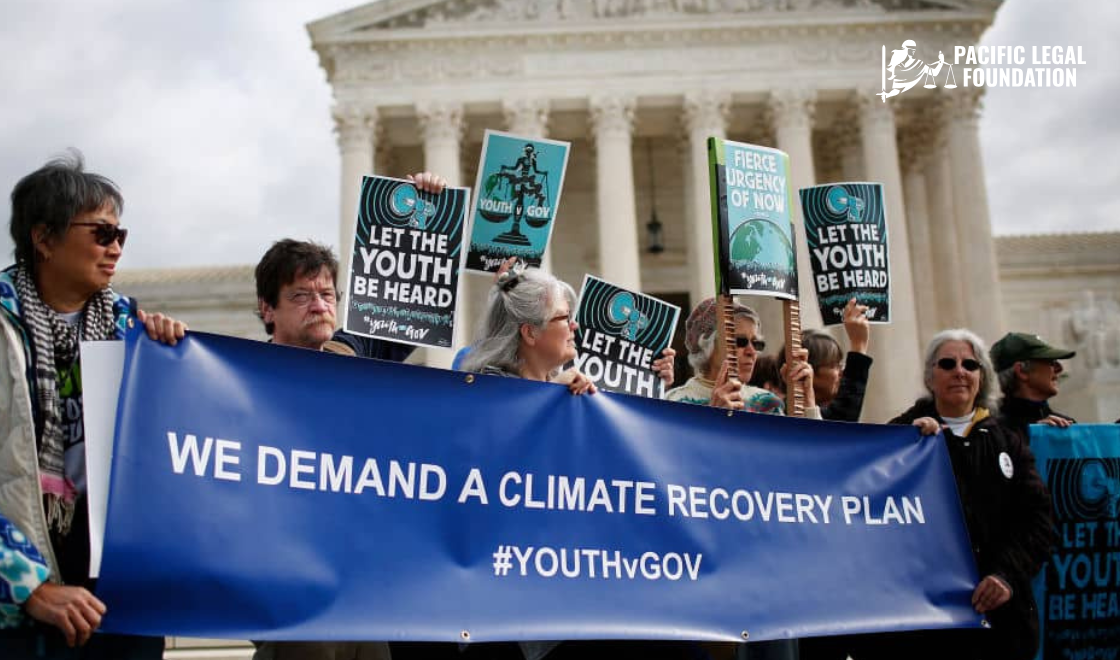
Youth climate change lawsuit doomed to fail
A federal court has set an April hearing date in a lawsuit brought by youth plaintiffs against the Trump administration. Relying on a “butterfly effect” theory, the youths claim the administration violated their due process rights by contributing to climate change.
Pacific Legal Foundation filed an amicus brief in opposition, arguing the suit ignores a foundational principle of common law: a party can only be held responsible for harm if their actions directly and foreseeably caused it.
But this progress is not all that it may seem. First, as Wolf rightly notes, a focus on territorial emissions flatters the trend. Consumption-based emissions—the U.K.’s actual global footprint, including imports—have fallen only about 20 percent since 1990, compared to 54 percent on a territorial basis. As Wolf notes, a substantial portion of the apparent gains reflects the offshoring of energy-intensive production. The updated Kaya analysis below uses territorial figures because those are what the legal targets track.
Second, the territorial progress was overwhelmingly driven by the lowest hanging fruit: starting with the displacement of coal with gas in the 1990s, followed by a rapid buildout of wind and solar through the 2010s. The last U.K. coal power station closed in October 2024. That transition is complete. The power sector, once the dominant source of U.K. emissions, is now fifth on the list. But as Wolf’s analysis shows, the broader economy remains heavily dependent on fossil fuels, which represented 75 percent of primary energy in 2024, with transport, heating, and industry still largely unelectrified.
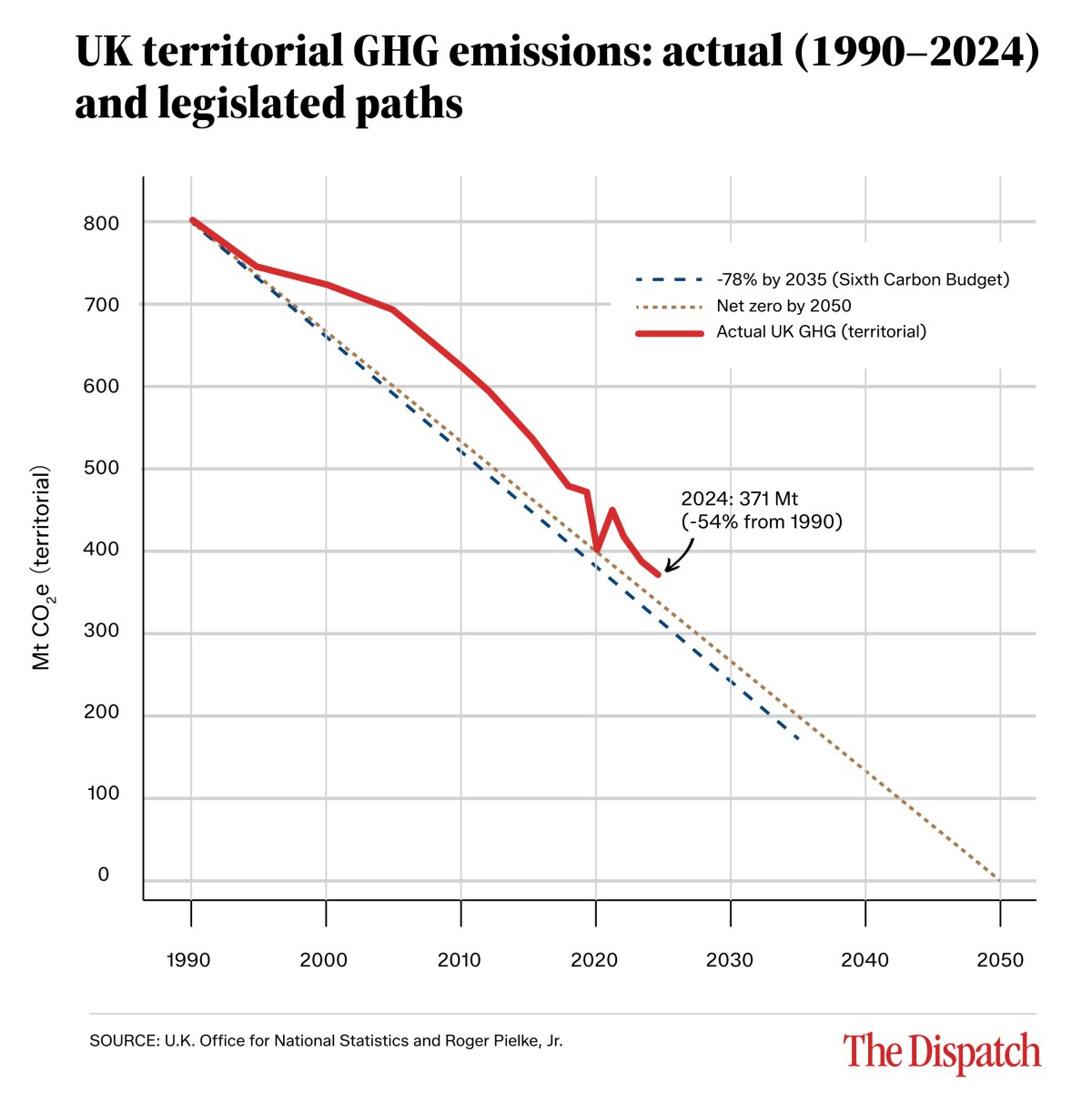
The graph above shows actual U.K. territorial greenhouse gas emissions from 1990 to 2024 alongside the required paths to the 2035 and 2050 targets. The progress is visually striking—and so is what still needs to happen for Britain to achieve its ambitious goals. Getting from 371 million metric tons of CO2-equivalent today to 177 million metric tons by 2035 requires cutting 194 million metric tons in 11 years, or roughly 18 million metric tons per year on average. The reduction from 2023 to 2024 was about 13 million metric tons. Therefore, the required pace of annual reductions going forward is about 40 percent faster than the recent trend, starting from the point at which the easiest reductions—switching off coal—have already occurred.
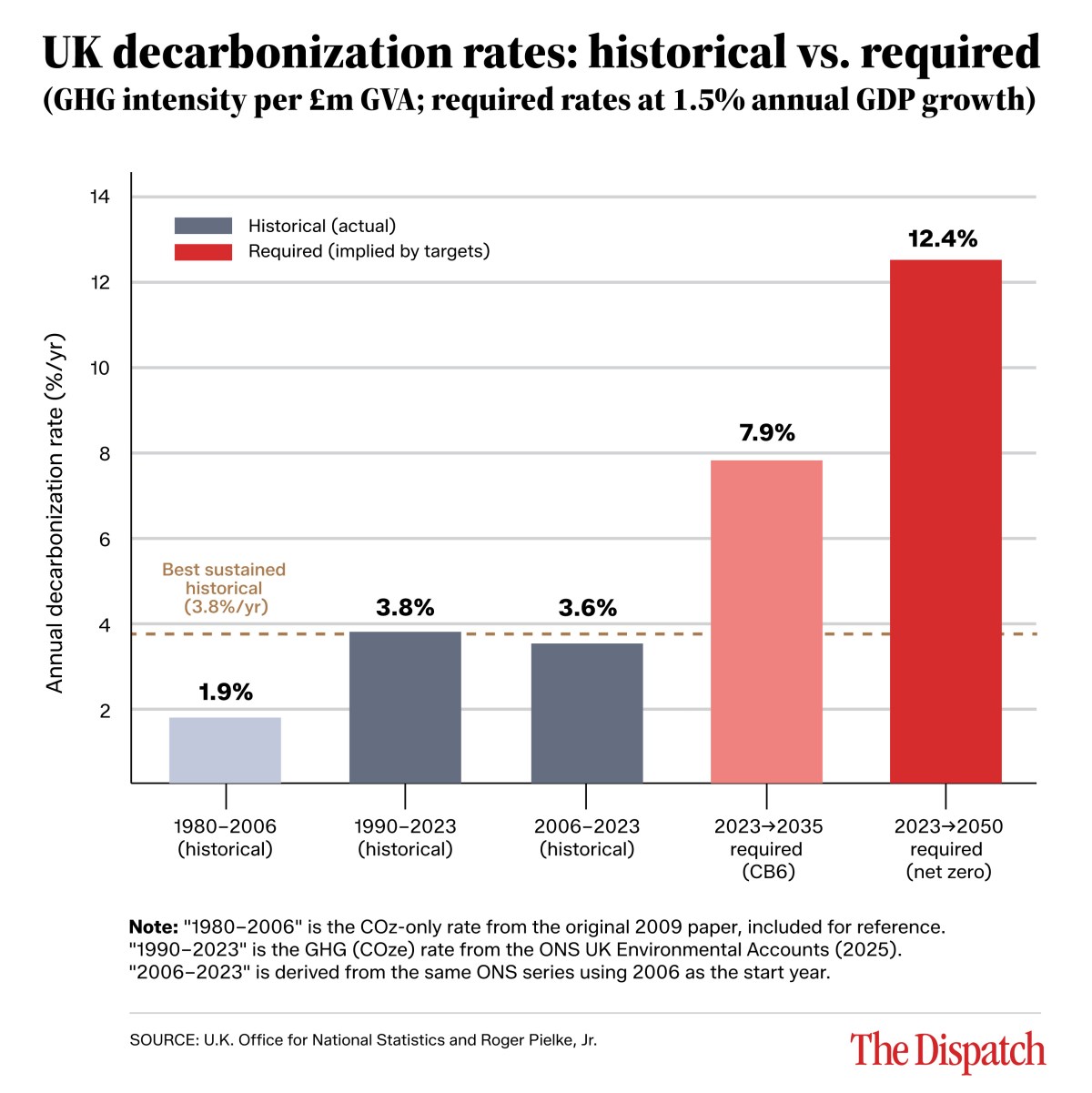
This chart translates those required emissions cuts into annual decarbonization rates and compares them to what the U.K. has actually achieved. The bars show the numbers plainly: The required rates going forward are far greater than the best sustained rate the U.K. has ever achieved—and that best rate was powered by a one-time structural transition that is now finished.
The required decarbonization rates are what the Kaya identity implies for an emissions reduction target and date, plus an assumption about future GDP growth rates. What the framework cannot tell us is whether those rates are achievable, which depends upon policy, politics, and technology. Consider that in 2009, solar power cost roughly 40 times what it does today. Offshore wind costs have fallen by 70 percent or more. Few anticipated such gains.
But as Wolf’s piece makes clear, the U.K. still faces significant obstacles in meeting its current targets. Accelerated decarbonization has to come from the sectors that are—as he documents—still overwhelmingly fossil-fuel dependent and largely unelectrified: transport, buildings, industry, and agriculture. These require not just cheaper, and in some cases, new technologies, but also the large-scale replacement or retrofitting of physical capital stock—homes, vehicles, industrial processes—at a pace and scale that has no historical precedent. The U.K. Climate Change Committee’s 2025 progress report puts it bluntly: 39 percent of the policies and plans needed to hit the U.K.’s 2030 climate target carry “significant risks, or insufficient or unquantified plans.”
My 2009 paper argued the Climate Change Act of 2008 was designed backwards, with targets coming before a feasibility assessment. That structural critique still applies, and the current targets are considerably more aggressive than they were in 2009.
The 54 percent territorial emissions reduction from 1990 is real, but taken alone, it is distorting on three counts: It excludes the emissions embedded in U.K. imports (consumption-based emissions have fallen only about 20 percent since 1990 by that measure); it excludes the emissions from electricity generated abroad and imported via interconnectors, which count against the generating country’s totals rather than the U.K.’s; and it excludes the CO2 from burning wood for electricity, which under standard accounting conventions is treated as zero in the energy sector—meaning the Drax power station, the U.K.’s single largest CO2 emitter at 13.3 million metric tons in 2024, does not appear in the headline total.
In 2026, the challenge the U.K. faces in reducing emissions has become harder, not easier: The targets have been tightened, the required decarbonization rates are higher than in 2009, and the remaining task is concentrated in the sectors most resistant to rapid change. The math has not improved.
Some countries, like the United States, also have low-hanging fruit in legacy coal generation whose retirement and replacement would reduce emissions. For other countries, coal remains synonymous with security of supply, especially now that natural gas supplies are facing severe disruption. More broadly, the offshoring of economic activity, slow economic growth, dependence on energy generated abroad, and other off-budget supply are not generalizable strategies for emissions reductions. The U.K.’s gains are notable. But they are also unique.
Policy Watch
- Last month, the Trump administration finalized the reversal of the Environmental Protection Agency’s 2009 greenhouse gas endangerment finding, calling it the “single largest deregulatory action in U.S. history.” It didn’t take long for environmental groups to file lawsuits challenging the repeal. The finding had served as the legal foundation for federal climate regulation under the Clean Air Act for 17 years. But there is little evidence that U.S. administrations of either party have meaningfully altered the rate of decarbonization of the American economy, and the debate over the endangerment finding, however resolved, probably won’t change that. As my fellow Dispatch Energy contributor Alex Trembath recently wrote, durable action on energy and climate will require bipartisan collaboration through Congress.
- This year, the European Union’s Carbon Border Adjustment Mechanism, which imposes carbon costs on imports from countries without comparable carbon pricing, moves into full implementation, covering steel, cement, aluminum, fertilizers, electricity, and hydrogen. This system is arguably the most consequential new climate policy instrument in the world right now—it is designed to prevent the exact offshoring of emissions that, as this analysis notes, has warped the accounting of Britain’s emissions reduction progress since 1990. Whether it achieves this goal without triggering trade retaliation is a central question for 2026 and beyond.
Innovation Spotlight
- Global electric vehicle sales exceeded 20 million units in 2025, representing about 1 in 4 new cars sold worldwide and up 20 percent from 2024. China now accounts for about 63 percent of global EV sales, and in the second half of 2024, EVs made up more than 50 percent of new car sales in the country for the first time. The trend is driven in large part by the growing availability of affordable and desirable EV options. Battery pack prices have fallen from more than $1,000 per kilowatt-hour in 2010 to around $117 per kilowatt-hour today, according to BloombergNEF. The contrast with the heating sector is instructive: Transport electrification is advancing rapidly in leading markets, while home heating—which accounts for roughly 18 percent of U.K. emissions and a similar share in most European economies—remains a much harder problem.
Further Reading
- The International Energy Agency’s (IEA) 2025 Global Energy Review—the most comprehensive recent accounting of where the world actually stands on its emissions reduction goals—found that global CO2 intensity per unit of economic output decreased by only 2.1 percent in 2024, slightly lower than the average of the previous decade. Energy intensity reduction slowed to just 1 percent in 2024 after averaging 2 percent annually from 2010 to 2019. To put those numbers in context: The IEA’s own net-zero scenario requires cutting global emissions by roughly 55 percent by 2035. The U.K.’s average annual decarbonization rate of 3.8 percent since 1990—the best sustained rate among large economies discussed in the analysis above—is roughly double the current global pace. The IEA’s net-zero scenario requires the world to decarbonize at a rate of 9 to 10 percent per year—more than two and a half times the U.K.’s best rate, and more than four times what the world is actually achieving today.
Pacific Legal Foundation has been fighting for freedom since 1973. We sue the government on behalf of farmers, fishermen, teachers, nurses, and entrepreneurs—Americans from every corner of the country and from every walk of life—and we win.