During the Biden administration, security risks tied to a powerful Middle Eastern state sent alarm bells ringing across American intelligence agencies. But unlike the attention placed on longtime adversaries like a uranium-enriching Iran, these alarms were sounding against an important U.S. ally: the United Arab Emirates.
What worried foreign policy analysts were the close ties the UAE had built with Chinese companies as it sought to diversify its economy into high-tech sectors like AI and crypto. These ties, intelligence agencies worried, could pose a diffusion risk—meaning the danger that sensitive U.S. technologies exported to the UAE could make their way, whether intentionally or accidentally, into the hands of the Chinese.
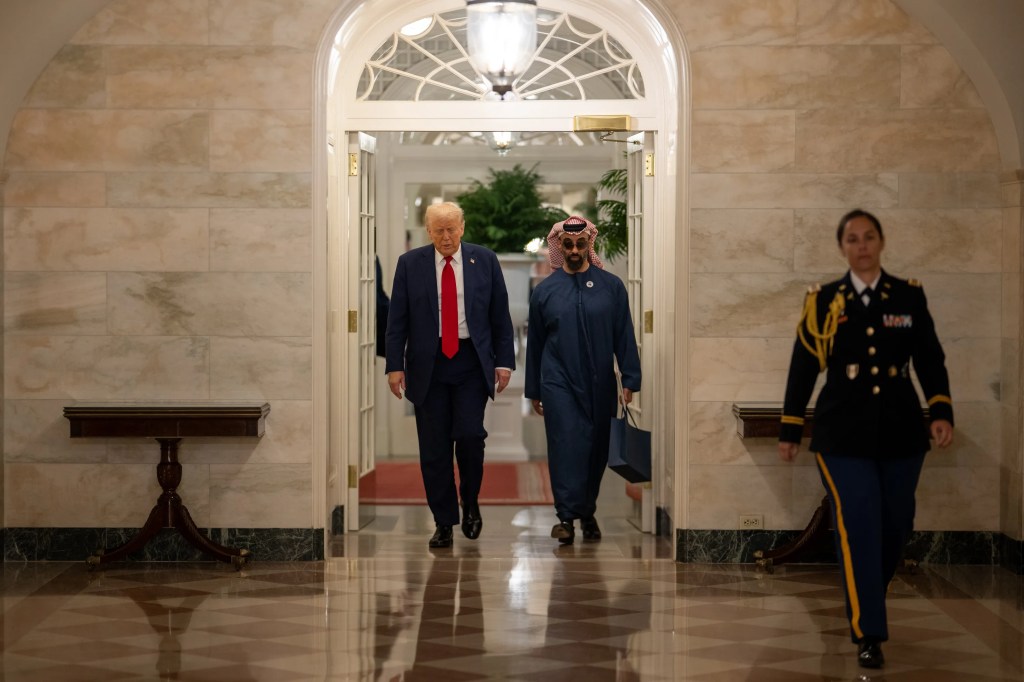
U.S. intelligence agencies were particularly concerned about the extent to which Tahnoon bin Zayed Al Nahyan—an Emirati royal who serves as national security adviser, earning him the nickname the “Spy Sheikh”—and G42, a state-backed AI investment firm Tahnoon chairs, were linked to U.S.-sanctioned Chinese companies like Huawei and BGI Genomics, according to a November 2023 New York Times article. The CIA also produced a classified profile of G42 CEO Peng Xiao, a Chinese-born businessman educated in the U.S. who renounced his American citizenship after becoming an Emirati citizen.
Those concerns have taken on a new urgency. Tahnoon and G42 have since forged deep financial ties with the Trump family, while the White House has agreed to export some of America’s most sensitive AI chips to the UAE—a convergence that has raised questions about whether Emirati influence is shaping U.S. tech policy.
In January 2024, Rep. Mike Gallagher, who chaired the House Select Committee on the Chinese Communist Party, wrote a letter to Secretary of Commerce Gina Raimondo asking her to investigate whether it could be risky to export advanced AI chips to G42. In the letter, Gallagher cited Xiao’s former leadership position with a subsidiary of the Emirati spyware and surveillance firm DarkMatter, and said that Xiao “operates and is affiliated with an expansive network of UAE and [China]-based companies that develop dual-use technologies and materially support PRC military-civil fusion and human rights abuses.”
G42 pushed back against allegations that it posed a security risk to U.S. technology, writing in a statement at the time that “we have pursued a commercial strategy since 2022 to fully align with our U.S. partners and not to engage with Chinese companies.” A month earlier, Xiao told the Financial Times that G42 was actively phasing out servers and networking infrastructure that it had sourced from Huawei, and that the company was broadly pulling back from relationships with Chinese firms. “For better or worse, as a commercial company, we are in a position where we have to make a choice [between the U.S. and China],” Xiao told the Financial Times. Several months later, that decision appeared to be paying off. In early 2024, G42 reached a deal with the Biden administration to divest from its investments in Chinese companies like ByteDance and JD.com in exchange for continued access to U.S. chip technology.
But while G42 was cutting its direct ties with China, the broader Emirati investment apparatus helmed by Tahnoon was not. In July 2024, Bloomberg reported that International Holding Company—an Emirati conglomerate also chaired by Tahnoon—had created a new investment vehicle called Lunate to absorb G42’s China-focused 42XFund. Both Xiao and Tahnoon, and the UAE as a whole, remained closely tied to China despite divestment efforts, according to Jodi Vittori, a Georgetown University professor who studies corruption and illicit finance. “[Xiao’s] still got close ties with China,” she told The Dispatch. “You still have money from Chinese nationals, you still have Huawei contracts in the country in very public spaces. … Tahnoon himself still has ties to China.”
Those ties aren’t limited to specific individuals or leaders, either—they’re deeply rooted in the UAE’s economy. “The Emiratis have been, for a while now, China’s most important economic relationship in the region,” Grant Rumley, a senior fellow at the Washington Institute for Near East Policy and expert in Middle East security, told The Dispatch. “It’s where most Chinese direct investment goes. It’s where a majority of Chinese shipments to the region, to Africa, to Europe, transit through. I think it’s also the largest incubator for Chinese businesses in the Arab world. The ties there are just enormous.” This relationship, Rumley explained, is why so much attention has been paid to the risk of giving entities in the UAE access to sophisticated AI chips. “A long-running debate in U.S. policy circles has been what level of risk we’re taking by sending sensitive technologies or military platforms to a country that also has such an extensive relationship with China,” said Rumley.
China has long sought to obtain U.S. technology through various legal, illegal, and extralegal methods, and particularly technologies related to AI—an industry where it is struggling to compete with leading U.S. companies. “[China] has developed an outstanding mechanism to monitor and acquire cutting edge technology,” William Hannas, lead analyst at Georgetown University’s Center for Security and Emerging Technology and a former analyst at the CIA, told The Dispatch. “China did not invent technology transfer … but they certainly have figured out ways to do it better than anybody else.”
In its final days, the Biden administration had attempted to address those concerns directly. In January 2025, it issued what became known as the AI diffusion rule—a sweeping export control framework designed to restrict the flow of advanced chips to countries where the risk of diversion was deemed too high. “We have no ability to monitor how chips are used. So the best way to make sure that the chips aren’t used against you is to make sure that they’re in infrastructure that is owned and operated by providers who you trust at very high levels,” Chris McGuire, who served as the deputy senior director for technology and national security at the National Security Council from 2022 to 2024 and helped design the Biden administration’s AI diffusion rule, told The Dispatch. “The leverage point for the U.S. government is that we control who gets the chips. But once someone has them, we basically have to trust that entity to not do things to undermine us.”
The UAE was among the countries affected. But the Trump administration rescinded the rule just months later, and by May, had agreed to a deal allowing the UAE to import around half a million of Nvidia’s advanced AI chips per year, roughly 20 percent of which would be provided to G42. According to the Wall Street Journal, that deal was initially held up by administration officials concerned about national security, but was eventually approved by the Trump administration alongside a similar deal with Saudi Arabia.
But the chip deal wasn’t the only transaction between Tahnoon’s network and entities in the Trump orbit during that period. The Wall Street Journal reported earlier this year that, shortly before Trump’s inauguration, a firm controlled by Tahnoon purchased a 49 percent stake in a crypto company partially owned by the Trump family. The company, World Liberty Financial (WLF), did not announce the sale publicly at the time, and both Xiao and Martin Edelman, G42’s general counsel, were added to WLF’s board. Several months later, Emirati state-backed investment firm MGX, which is also chaired by Tahnoon, used a stablecoin created by WLF to make a $2 billion investment into the cryptocurrency exchange Binance. That deal turned the Trump family’s fledgling crypto venture into a major global player and is likely generating tens of millions of dollars in interest for the Trump family.
“In every sort of influence vector that you can imagine, the UAE is a big player, if not the biggest player.”
Ben Freeman
“This is unlike anything we’ve ever seen in American history,” Casey Michel, director of the Human Rights Foundation’s Combating Kleptocracy Program and an expert on foreign influence, told The Dispatch of G42’s investment into WLF. “It’s one of a far broader constellation of foreign influence, foreign investing, and foreign lobbying scandals [for the Trump administration] that have extremely clear not only corruption concerns, but national security concerns as well.” But importantly, Michel also emphasized that the UAE spending big to get on the good side of U.S. decision makers isn’t in itself surprising—it’s part of a decades-long effort to burnish its influence and connections with the West. “The Emiratis have created what, in my opinion, is far and away—even before the last few years—the most successful foreign lobbying and foreign interference playbook we have seen over the last decade,” Michel said.
The scale of that influence playbook is staggering. “They do everything,” Ben Freeman, director of the Democratizing Foreign Policy program at the Quincy Institute, told The Dispatch. “In every sort of influence vector that you can imagine, the UAE is a big player, if not the biggest player.” Freeman often describes the UAE’s influence using an iceberg analogy. At the visible tip of the iceberg are the foreign lobbyists, public relations firms, and consultants that the UAE pays to lobby the U.S. government on its behalf. According to Foreign Agents Registration Act data, the UAE has spent anywhere from $13 million to $32 million per year on U.S. lobbying efforts since 2020, retaining high-profile lobbying shops like Akin Gump, the Camstoll Group, the Glover Park Group, and Brunswick Group. But Freeman said that visible lobbying is only the beginning. “When you start to go below the water, that’s where the UAE’s influence really takes off,” he said.
For example, the UAE was the largest foreign donor to U.S. think tanks from 2019 to 2023. According to data recorded by the Quincy Institute, the UAE donated more than $16 million to influential foreign policy think tanks like the Middle East Institute and Atlantic Council during that period. Emirati money has also flowed to U.S. universities, which have received at least $1.8 billion in gifts and contracts from the UAE since 2014, according to Department of Education data that is likely incomplete.
According to Michel, the UAE has become a destination for illicit financial activities like money laundering and sanctions evasion—a reality that has made cultivating its image abroad as a luxury business hub all the more important. “People get generally sucked into this image that the UAE has created for itself, and hired people to create for itself, as this great destination with regional stability,” Michel said. “In reality, it is a kleptocratic dictatorship, just like many others in the region.”
But building a global reputation is only half the equation. To diversify its economy away from an overreliance on oil, the UAE has also placed an enormous wager on a specific industry it believes will define the next era of the global economy: artificial intelligence. “The UAE leadership has prioritized artificial intelligence to a degree that’s unmatched by basically any other government in the world, and they have the resources to become a significant player,” Chris Miller, a professor of international history at Tufts University and expert on AI chips, told The Dispatch. “They have both invested substantial sums via their sovereign wealth funds in a number of leading U.S. AI firms, and also put a lot of money into trying to build large data centers in the UAE and, via G42, an AI company that they hope will be a global player.”
That effort to become a regional AI powerhouse makes access to advanced chips essential to the UAE’s efforts at diversification. “If so much was resting on having the chips G42 needed to be sold to [the UAE], then a lot would need to be done to ensure that was facilitated,” Christopher Davidson, an academic who studies Gulf capitalism, told The Dispatch. According to experts on the region, G42, Tahnoon, and the broader Emirati investment apparatus are incredibly sophisticated and have been essential to the UAE’s efforts to become a regional power. “The UAE is very sophisticated, they’re not doing things haphazardly. It’s all part of a larger effort, all of this stuff is connected,” Freeman said. “There’s a lot of bad things we can, and I will say, about the UAE, but one thing folks have to give the UAE credit for is having this great economic foresight. I think they have a better crystal ball than anyone in the Middle East has had, maybe with the exception of Israel, when it comes to economic growth and stability. They’re making all the right investments.”
For the time being, that economic foresight appears to be paying dividends. Not only does the UAE now have approval from the Trump administration to import the world’s most advanced AI chips—it also now has direct financial influence over one of the Trump family’s most profitable businesses. Even as the UAE’s chip deal moves forward, however, the Trump administration is reportedly drafting new regulations that would require American approval for AI chip shipments anywhere in the world—a sign that the debate over who gets access to the most powerful AI technology is far from settled.
But regardless of shifting global restrictions, the UAE’s success in securing chip exports thus far is testament to the effectiveness of its influence playbook—at least when applied to the Trump administration. “If you believe that AI is the future, then what they’re doing, the way they’ve threaded the needle on this—having some of these ties to China, and yet at the same time bringing in these extraordinary Western investments to their country like the Nvidia chips deal and being able to have such deep, strong ties with the Trump administration to make that deal happen—this is the epitome of what the UAE influence machine has been driving for years, if not decades,” Freeman said.