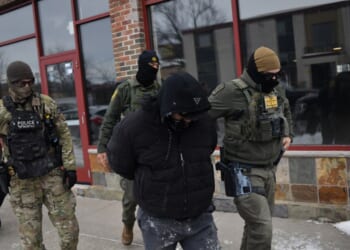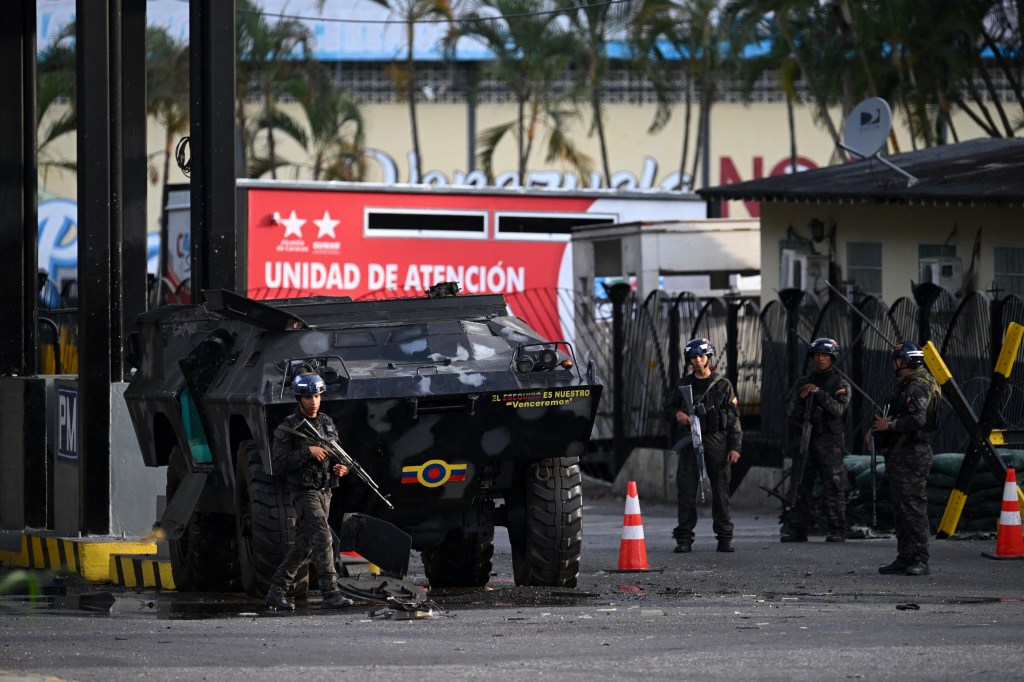
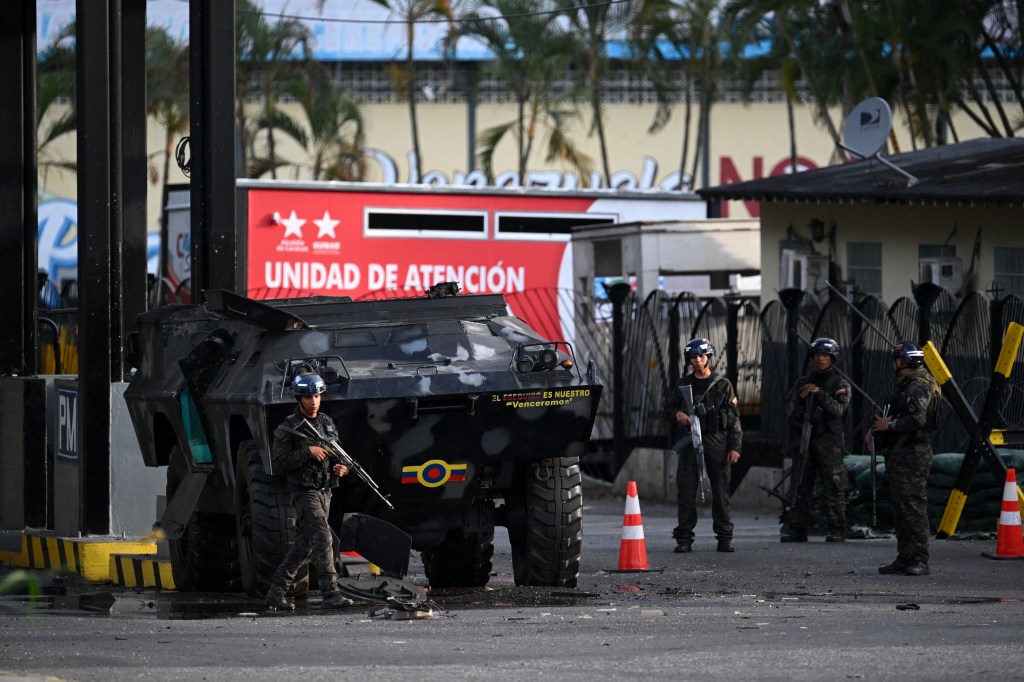
The White House maintains that this was a law enforcement operation assisted by the U.S. military rather than an outright act of war—which is one of the reasons administration officials have provided for not seeking congressional authorization prior to the raid. (U.S. legislators are set to be briefed this evening.) But residents of Caracas felt like they were at war, with airstrikes and explosions rocking the city overnight Friday. Venezuelan authorities say that at least 80 people were killed in the attack, though 32 of those were Cuban military personnel performing unspecified missions in the country.
With Operation Absolute Resolve, the U.S.’s intentions were clear: arrest Maduro and his wife. But observers are still guessing at precisely what the White House plans to do next.
During a Saturday press conference following the operation, Trump provided few details on the next steps for Venezuela. “We’re going to run it, essentially, until such time as a proper transition can take place,” he declared, warning that the U.S. was “not afraid of boots on the ground.” He also said the administration would prioritize accessing Venezuela’s vast oil deposits, and that American oil companies would “go in, spend billions of dollars” investing in the country’s oil infrastructure and ensure that money flows back to both the United States and the Venezuelan economy.
Though Venezuelans living abroad have celebrated Maduro’s removal, Carlos Gabriel Torrealba Mendez—a researcher and Venezuela expert at the Universidad Nacional Autónoma de México who was present in Caracas—told TMD on Sunday evening that residents are cautious and the city has a strangely quiet atmosphere: “The streets are calm, there are long lines at gas stations and supermarkets, and for now, there is no significant military presence in the streets.” Less than 48 hours after the strikes, flights from Caracas had resumed, which Mendez called “simply incredible given the gravity of recent events.”
A transition has already taken place within the Venezuelan regime. Delcy Rodriguez, the former vice president, has assumed leadership of the government and was designated as acting president by Venezuela’s Supreme Court. Trump claimed on Saturday that Rodriguez had agreed to cooperate, but later that day, Rodriguez called for Maduro’s “immediate liberation.” Trump told The Atlantic on Sunday that if she did not cooperate, she would “pay a very big price, probably bigger than Maduro.”
Venezuela’s exiled democratic opposition—led by 2024 Nobel Peace Prize winner María Corina Machado—would seemingly be the obvious contender to lead the country. Machado said Saturday that Edmundo González—who was recognized by the U.S. as the legitimate victor of Venezuela’s 2024 presidential election, and was backed by Machado—“must immediately assume his constitutional mandate and be recognized as Commander-in-Chief of the National Armed Forces by all the officers and soldiers who comprise it.”
Trump was dismissive of Machado in his remarks over the weekend. “I think it would be very tough for her to be the leader,” he said, going on to claim that she and the democratic Venezuelan opposition don’t “have the support within or the respect within the country.” But González enjoyed widespread support in polls leading up to the 2024 election, with Machado claiming after the election that González won 70 percent of the vote. New elections—without Maduro’s thumb on the scale—could put that legitimacy to the test.
Trump may, however, have been referring less to the opposition’s popular support than to its ability to win over members of the Venezuelan military. “[Machado] very clearly and very importantly, is not liked by the military establishment,” Francisco E. Gonzalez, a professor of Latin American politics at Johns Hopkins School of Advanced International Studies, told TMD. Absolute Resolve removed Maduro, but his forces and supporters still run the country’s institutions, and Gonzalez argued that Machado is unlikely to be able to quickly bring the military and security services under her control.
But even if that is true, the White House’s proposed alternative does not seem especially stable either. “If they’re saying that Delcy Rodriguez is a possibility, they have not given this the thought that it requires,” Carrie Filipetti, the executive director of the Vandenberg Coalition and the former Deputy Special Representative for Venezuela at the State Department, told TMD. “She is 100 percent incapable of being the leader of Venezuela. She has no legitimacy whatsoever.”
Even so, Alejandro Velasco, a professor of Latin American history at New York University, told TMD that most Venezuelans will probably stay off the streets, even if they loathe the regime. “They’ve learned that over the past 10 years, through crisis, through mobilizations, through repression, and now added impetus of potential bombs coming from abroad, that no one’s going to stick their heads out,” he said.
With Rodriguez leading the country and the regime essentially intact minus Maduro, the Venezuelan military will likely assume a central role. Francisco Mora, the former U.S. Ambassador to the Organization of American States, argued that Rodriguez would serve as the intermediary for ongoing negotiations between U.S. Secretary of State Marco Rubio and the actual power brokers in the regime: Padrino Lopez, the Minister of Defense, and Diosdado Cabello, the Minister of the Interior and head of the powerful internal security services. Lopez and Cabello, along with other members of Venezuela’s leadership, face indictments from the Department of Justice, just as Maduro did. “If they can keep power, money, and a life without jail, without prison time, that’s victory,” Mora told TMD.
If a deal with top regime figures is unacceptable to the U.S., Mora said that a decision to intervene further would need to come soon, as many of the ships and sailors deployed to the Caribbean have been on active duty for more than six months. During his Saturday press conference, Trump warned that his administration is “ready to stage a second and much larger attack if we need to do so.”
Venezuela isn’t riven with the same ethnic and religious divisions that made governing countries like Iraq a difficult task, and the military has a strong interest in maintaining some control, Velasco said. But Venezuela has many armed groups—including organized criminal groups, pro-regime militias known as collectivos, and the ELN, a Colombian-Venezuelan guerrilla force—and the country’s stability could deteriorate if the U.S. intervenes more decisively. “It all comes back to how politically deft Rodriguez and her people can be in navigating this knife’s edge” between gratifying the U.S. and not seeming like puppets, Velasco said.
Official U.S. diplomatic recognition of Rodriguez would be the most concrete sign that the White House is planning to work with the remainder of Maduro’s regime. As Geoff Ramsey, a Latin America expert at the Atlantic Council, told TMD, “Whoever sits in the throne in Venezuela immediately receives access to hundreds of millions of dollars in unfrozen assets,” if the U.S. were to recognize him or her as legitimate. But Rubio seemed to suggest over the weekend that full recognition is unlikely.
“Ultimately, legitimacy for their system of government will come about through a period of transition and real elections,” he said Sunday on ABC News’ This Week. He added that the U.S. was “running the direction” of policy in Venezuela, and told NBC News on Sunday that existing U.S. sanctions on Venezuelan oil shipments would serve as “crippling leverage” to ensure “we see the changes we need to see.”
What exactly those changes will be and what form the new government of Venezuela will take remain unanswered. “We are in sort of uncharted territory here,” Mora said. “It’s too early to say how this is all going to play out, and every scenario should be, I think, considered.”