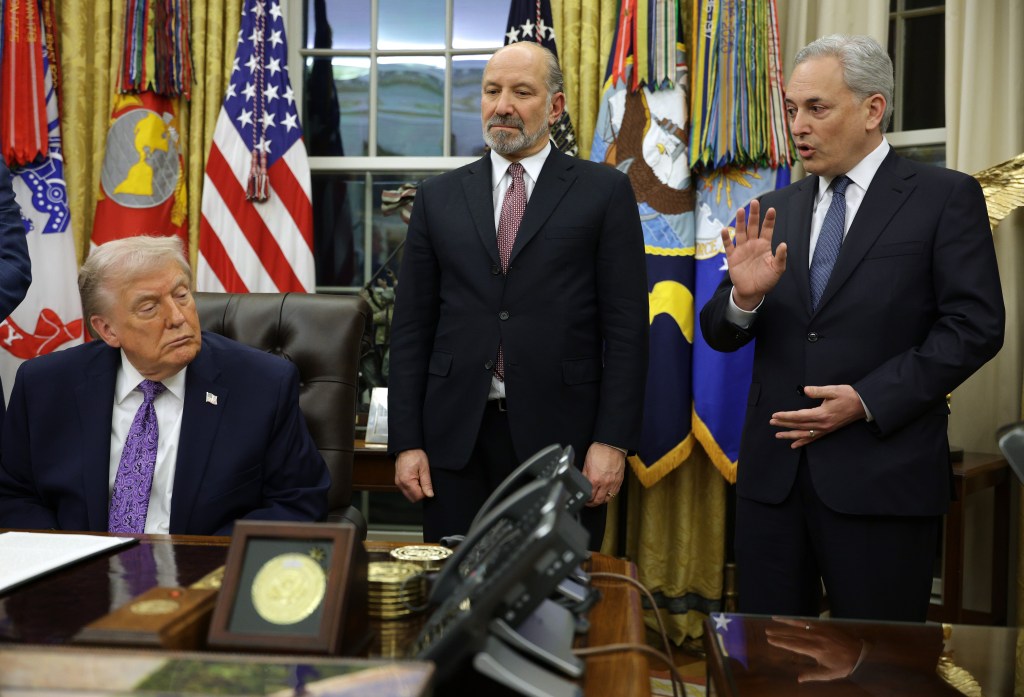
More than 50 Republican lawmakers across 22 states signed a letter earlier this month addressed to President Donald Trump saying they were “deeply concerned” about recent White House efforts to shut down state AI regulation in states.
In December, Trump signed an executive order calling for the future establishment of a single national standard for AI policy to avoid a patchwork of state regulations and centralize AI governance by challenging “onerous” state laws using legal and financial means (though the order’s legal teeth remain weak). But with no national AI regulations in place, Republican lawmakers across the country are getting antsy. “There’s a real groundswell of support within the Republican Party over protecting the ability to safeguard people from AI harm,” said Chris MacKenzie, vice president of communications at Americans for Responsible Innovation, a technology policy advocacy group that helped coordinate the letter.
The White House is preparing for another effort on federal AI policy—reportedly announcing its new AI policy framework today—with the hopes of pushing a legislative package through Congress. Yet the administration has so far had limited success when it comes to implementing national policy, having tried and failed twice to push through legislation aimed at preventing states from regulating AI.
Meanwhile, tension among Republicans is rising.
“To sit there and have things like executive orders, saying, ‘Hey, you can’t legislate in this space unless we say it’s ok, is blatantly unconstitutional, and frankly it’s offensive,” Louis Blessing III, a Republican state senator from Ohio and who helped organize the letter, told The Dispatch. He believes that despite other Republicans holding similar views, many are scared to speak out against the administration, Congress, and Big Tech. “I think they are afraid of a massive onslaught, from frankly, some very wealthy people,” he said.
What triggered the letter was the White House’s pressure on Utah’s Republican lawmakers to kill the Artificial Intelligence Transparency Act last month. Sponsored by Utah state Rep. Doug Fiefia, a former Google employee, the bill aimed to make powerful AI models more transparent and accountable, with provisions including requiring certain tech companies—such as OpenAI, Anthropic, and Google DeepMind—to publish safety and child protection plans, whistleblower protections, and other information.
After the bill unanimously passed a committee in the Utah House in late January, the White House got involved. The White House Office of Intergovernmental Affairs sent a letter to Republican Utah Senate Majority Leader Kirk Cullimore Jr., saying the White House was “categorically opposed to Utah HB 286, and view it as an unfixable bill that goes against the Administration’s AI Agenda” but reportedly without offering a reason why. The bill never made it to the floor for a vote.
“There was a level of heavy-handedness that the White House showed with its memo to Utah—one sentence! Not even explaining their reasoning, just stepping on that law outright, that violated some of the important principles of federalism for some of these lawmakers,” said MacKenzie.
Fiefia, the bill’s sponsor, described the failure to get the bill through as “disappointing,” and pointed to the challenges of a lack of any current national regulation. “I understand that there is a need and a want for a federal standard and I support it, but in the absence of it, there is a need to protect my constituents in Utah and their families,” he told The Dispatch. “There are clear risks here, and the public protection, so I can’t sit back and do nothing while Congress fails to act.” He pointed to studies from the Institute for Family Studies, a conservative family policy think tank suggesting that a significant majority of voters in Utah support AI regulation. “There is a way to regulate while also allowing AI to innovate, but doing nothing is not the answer,” he said.
A similar story played out in Florida. After Republican state Sen. Tom Leek introduced an AI Bill of Rights, right-wing outlet The Daily Signal reported that the White House contacted Florida Speaker of the House Daniel Perez and his staff members to oppose it. The bill’s wide range of measures included forcing companies to disclose when users are interacting with AI, banning government agencies from contracting with AI firms linked to foreign adversaries, and requiring parental consent for the use of AI companion chatbots. While Republican Gov. Ron DeSantis spent months pushing the bill, Perez opposed it, arguing that AI regulation must occur at a national level. The bill failed to pass by the time the legislative session ended in Florida last week.
When Trump first announced his executive order on creating a national framework for AI policy, DeSantis reportedly implied that the order was introduced following concerns about bills emerging from Democratically controlled states such as California and Colorado rather than red states like Florida. “When it was introduced, a lot of the justification around the executive order was to stop ‘woke’ blue-state AI regulations, but what we have seen is that it is actually deterring red states from regulating AI,” said Jared Hayden, a policy analyst at the Institute for Family Studies.
Clear dividing lines have emerged within the Republican Party on AI regulation. David Sacks, Trump’s AI adviser and the former COO of PayPal, helped shape the executive order that explicitly calls for a national regulatory framework that is “minimally burdensome.” Republicans such as Texas Sen. Ted Cruz have similarly pushed for deregulation. Yet other Republican senators such as Marsha Blackburn of Tennessee and Josh Hawley of Missouri—alongside DeSantis—remain outspoken critics of the AI industry, citing concerns including child safety and energy use.
The absence of any federal standards on AI is a headache for both groups.
Blessing, who told The Dispatch that he finds the Trump administration’s heavy-handedness “offensive,” noted that he might think otherwise if there were a national regulatory framework in place by now.
But even more tech-aligned Republicans who support preempting state AI regulation with federal laws are growing frustrated with the current vacuum. “It’s every state for themselves,” Adam Thierer, a senior fellow at the R Street Institute, a free-market think tank. “There’s just not a lot of federal leadership in terms of a national approach, despite the fact that the president has come up with a very pro-innovation AI Action Plan.” That policy blueprint was released last July and sets out the Trump administration’s strategy for maintaining U.S. dominance in AI. It explicitly emphasized “removing onerous regulations” to accelerate innovation.
Thierer fears what he describes as “the rise of the AI Articles of Confederation Era” in which state bills continue to multiply, making it difficult for smaller AI companies to navigate a complex terrain of legislation. He pointed to how regulations aimed at chatbots invoke a wide array of definitions for what a chatbot may be. While states like Nebraska define it based on the underlying technology used, Tennessee and Michigan have defined it based on its capabilities, and other bills focus on how the system is being marketed.
There have also been delays in some of the provisions put forward in Trump’s December executive order—including the Commerce Department missing its deadline to publish a list of state AI regulations it considers overly burdensome. The Federal Trade Commission has also missed a deadline to issue a related AI policy statement.
“There is a real effort to make AI a partisan issue, and in my mind it’s a bipartisan issue,” Fiefia, the Utah state representative, said. “This is something that is going to affect all of us, and if we can’t put our heads together and come up with bipartisan solutions, it will become an issue that nobody acts on, and in turn our citizens and constituents are hurt.”