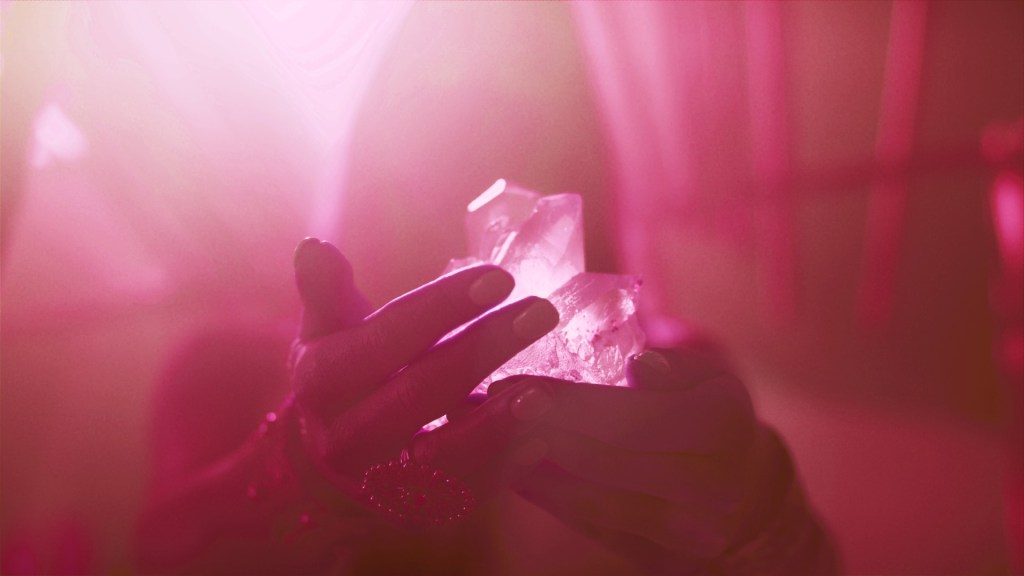
In 2021, the body of New Age spiritual leader Amy Carlson was found mummified. Her eyes were missing from her corpse, her face was covered in glitter, and her skin was blue from ingesting large quantities of colloidal silver, which she thought was a remedy for all ailments. She had died from alcoholism and anorexia weeks earlier. Her followers had wrapped her body in a sleeping bag strung with Christmas lights—they had been waiting for “galactic beings” to come and collect her. Carlson was one of many online influencers who specialized in spiritual themes and conspiracy theories—a crossover that has come to be known as “conspirituality.”
In her new book, The Conspiracists, California researcher Noelle Cook takes us into the murky depths of conspirituality and shows how these beliefs hijack people’s lives. Her research focuses on one of Carlson’s online followers, a woman named Yvonne. At around the same time Yvonne was following Carlson, she also participated in the January 6 Capitol riot. For her role in the attack, Yvonne was sentenced to 2 1/2 years in prison. A fellow January 6er named Tammy, who was also convicted and sentenced, is also profiled. The result is a highly readable case study of female vulnerability in middle age and how easily that vulnerability can be captured by online cults.
Along with their conspiritual beliefs, Yvonne and Tammy share a number of similarities. Both women are in their 50s. Their histories are marked by significant trauma, including molestation or rape as children and abuse in intimate relationships when they were adults. Cook describes their conspiratorial beliefs as an elaborate coping mechanism: It is easier to endure despair when one can enter a fantasy world online, particularly one that casts the believer as an active participant in the eternal struggle between light and dark. In this sense, conspirituality offers meaning, community, and purpose.
What is striking about Cook’s portrait of Yvonne and Tammy is how little conventional politics actually colors their views. Despite having stormed the Capitol on January 6, both women appear relatively uninterested in politics outside of sharing memes about Democrats on Facebook. Their primary commitments are spiritual rather than ideological. Donald Trump functions less as a political leader than as a deity within a broader New Age cosmology. And one is left with the impression that neither woman would have been particularly interested in politics at all had online communities not adopted Trump as a symbolic figure.
And despite being described as “right-wing,” their beliefs are not conservative in any meaningful sense. Yvonne and Tammy do not adhere to traditional religion, nor do they conserve families, homes, or institutions. They are instead immersed in a belief system populated by “starseeds,” “Ascension into 5D,” the “divine feminine,” “soul contracts,” and other New Age concepts. Such ideas gained popularity in the 20th century alongside feminism, environmentalism, and alternative medicine—movements that have never been associated with the right.
But in 2020, a cultural shift took pace. “The pandemic ultimately served as a superspreader of conspiracy theories,” Cook writes. Reflecting on the Conscious Life Expo, a New Age conference she attends in 2023, Cook observes that a program once dedicated to nutrition and environmentalism was now dominated by anti-vaccine and anti-government activism. “COVID drove both men and women to conspiracism … Men were more likely than women to see COVID as a Chinese bioweapon, a byproduct of 5G technology, or a hoax cooked up to make Donald Trump look bad,” while women were more interested in conspiracy theories involving children. While QAnon can be traced back to 2017, Cook argues that women were the reason it exploded during the pandemic. Indeed, far more women than men arrested for involvement in January 6 traced their political awakening to QAnon and its mission to “save the children.”
Women like Yvonne and Tammy are very rarely represented in mainstream media, sympathetically or otherwise. Not only because their beliefs are bizarre, but because they belong to a cognitive underclass: people without higher education, without stable jobs, without clear social roles, and without cultural or institutional power. Those at the bottom of the social hierarchy—financially, socially, and culturally—are seldom listened to or represented honestly. For presenting these lives without condescension or exploitation, Cook should be applauded. She avoids the easy temptation to dismiss or ridicule Yvonne and Tammy’s incoherent and often malign views. Instead, Cook focuses on the humans beneath the surface-level identities, revealing people in pain who are searching for hope, community, and a way to cope with a world in which they struggle to thrive.
At the same time, the book’s admirable neutrality leaves certain questions unanswered. While trauma clearly plays a role in shaping Yvonne and Tammy’s worldview, it cannot fully explain it. Many people experience abuse without embracing conspirituality, just as many conspiracy theorists do not have histories of abuse. Nor is it easy to reconcile Cook’s description of Yvonne as “extremely bright” with her lack of judgment.
And if trauma is granted an explanatory role in accounting for why people come to believe in conspiracy theories, then substance use must be considered as well. Tammy is described as going into rehab for drinking and later becoming a meth addict, while Yvonne speaks openly about taking magic mushrooms as part of her spiritual “work.” Years prior, Yvonne was dishonorably discharged from the Marines after being caught selling cocaine (she was also a user). Neurological explanations for belief in conspirituality are given short shrift by Cook, but we know that cannabis, cocaine, and methamphetamine use are all implicated in substance-induced psychotic disorder, with heavy users at greatest risk. To be clear: Belief in conspiracy theories or New Age spirituality on its own is not evidence of psychosis. But when combined with heavy or sustained drug use, it becomes difficult to separate an unconventional worldview from psychological disintegration.
Much like the drugs that induce psychosis, conspirituality itself also functions like an addictive substance. When under its spell, the capacity to enjoy ordinary life gradually narrows. Relationships with people who are not “users” or “followers” fray, and the world outside the obsession loses its pull. People addicted to online worlds—whether video games, online activism, or elaborate fantasy belief systems—often experience the same contraction of life, retreating into spaces that promise meaning and transcendence while quietly turning away from everything else.
Empathy may be one of the only methods by which conspiracy theorists can be reached, and Cook’s patience and compassion are essential to that task. But empathy alone is not sufficient. These belief systems are not benign. Amy Carlson—Yvonne’s original New Age guru—appeared on Dr. Phil less than a year before her death. During the episode, Carlson is shown locking a child in a dark cupboard as punishment. When the child emerges hysterical, she continues to confine him for longer and longer periods in the dark space. The footage shows that the child doesn’t calm down, and no other adults in the room intervene.
There is a bitter irony running through The Conspiracists that Cook hints at, but ultimately fails to explore. Tammy is a follower of QAnon, a movement obsessed with the protection of children. Yet in earlier years, her own alcoholism leads to her children being removed from her care and placed into foster homes—where they end up being sexually abused for years. Yvonne speaks of the “divine feminine” and of love being the highest value, yet also insists on having “no attachments,” including to her own family. Yvonne’s guru—Carlson—also abandons her own children to become “Mother God” on the internet, and to live a lifestyle where, according to one of her followers, she was “high from the moment she woke up to the moment she went to bed.”
This retreat from adulthood is not limited to parenting responsibilities. Tammy and Yvonne express no remorse over their participation in the January 6 riot. On the contrary, they both express denial, believing that they will “ascend to the 5th Dimension” before they are sentenced. In this context, conspirituality serves to shield both women from reflecting on their own destructive behaviour.
Cook goes to great lengths to explain that Yvonne and Tammy have latched onto conspirituality because of trauma. But there are other culprits lurking within Cook’s analysis: the Big Tech companies that engineer algorithmic rabbit holes, the grifters and cult leaders who exploit the vulnerable. Influencers make millions from women like Tammy and Yvonne, offering the illusion of moral purpose while leaving their followers more isolated from reality, and from people who actually care for them. In the modern attention economy, personal suffering is not alleviated—it is monetized.
What it means for democracy when large numbers of people retreat into online fantasy worlds also remains underexamined. Cook’s antidote is patience and compassion, but arguably these virtues are not enough. When belief systems lead to real-world harm, such as child abuse and neglect, participating in violent riots, and excusing or promoting heavy drug use, the question is no longer merely one of understanding, but of responsibility. Of course, the internet did not invent delusion, paranoia, or magical thinking, but it has enabled delusions to go viral. Just as we commit resources to fighting infectious diseases, we must also contain viruses of the mind.