If you will indulge my revisiting an old theme for a new purpose: There is a reason—a bad, dumb, bureaucratically self-serving reason—that U.S. gun control efforts are mainly focused on sporting goods shops and the people who do business with them. The reason is that these are law-abiding people rather than law-breaking people—and it is a hell of a lot easier to enforce the law on the law-abiding.
Licensed firearms dealers generally have fixed addresses, regular hours of operation, and business records, and their whole business model is based on remaining in good standing with federal regulators—which makes them very easy to regulate. Black-market gun-traffickers, on the other hand, do not have fixed addresses or regular hours of operations, and only the most incompetent of them have business records, because their whole business model is based on evading federal authorities—which makes them much more difficult to regulate. People who do business with licensed dealers are by definition a law-abiding bunch, and the share of currently incarcerated criminals who committed their crimes while in possession of a firearm obtained through a licensed retailer is vanishingly small—less than 2 percent. Criminals usually get their guns through criminal channels—because they are criminals. Investigating, arresting, and convicting them takes a great deal of very difficult and often thankless work. But the guy down at Bob’s Bait ’n’ Tackle ’n’ Guns? You can make an appointment to see that guy.
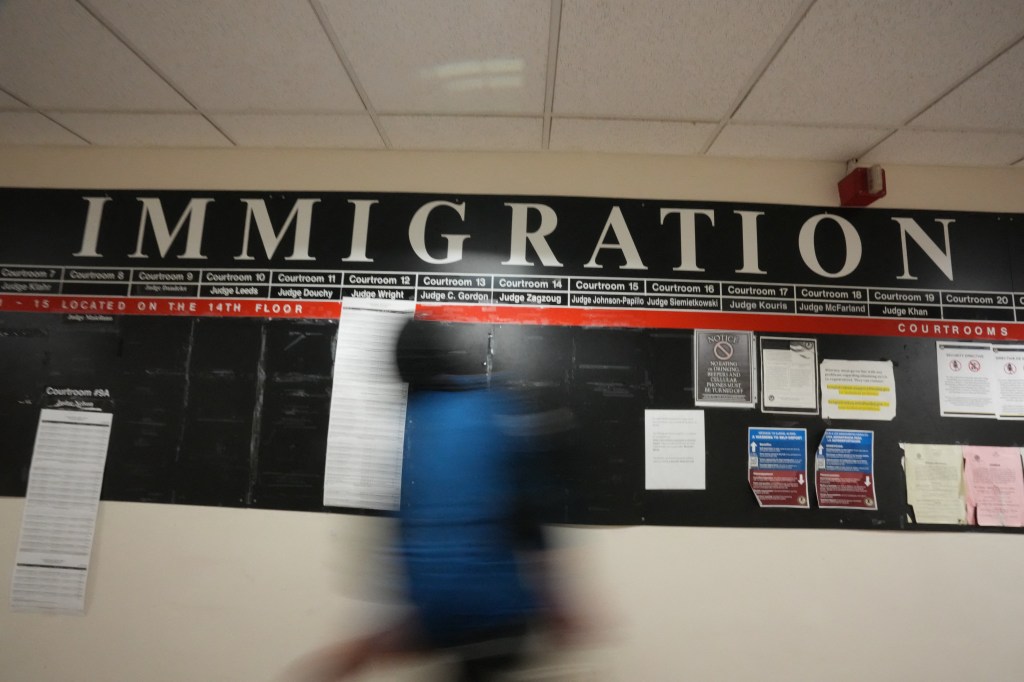
You can also make an appointment to see an immigrant waiting for a green card. Which is why the Trump administration has started arresting them—chasing down Guatemalan gangsters illegally present in the United States is hard, but arresting nice British ladies going in for their green card appointments is easy.
U.S. immigration law is a mess, morally and practically. One of the quirks of the green card process is that it involves what is called an “adjustment of status” period, when the green card applicant goes from being present in the United States on some kind of visa or other legal arrangement (such as a visa waiver) to being present, if all works out, as a permanent resident. In some cases, an immigrant’s previous status is immediately changed in some significant way: For example, an immigrant present on a work visa may not be able to work under the old visa while waiting for a green card. Sometimes, there is no immediate effect from the change in status, as in the case of those here under most visa waivers or under tourist visas. In all cases, the applicant is unable to leave the United States without obtaining an extraordinary permission—otherwise, the would-be immigrant will be judged to have “abandoned” the application, and will have to go back to square one.
This results in some ambiguity: If you are (e.g.) a Canadian who enters the United States under a visa waiver and then gets married and applies for a green card, you can be pretty sure that your visa-waiver status is going to expire (it lasts only six months) before your green card is processed. If you are a British subject, you would have only 90 days. In practice, people awaiting green cards have been treated as though the status-adjustment period were in effect a status of its own: If you entered the country legally, did the right paperwork, followed the procedure, etc., you weren’t treated as though you had violated the law by remaining in the country after your tourist status would have expired while awaiting a final green-card decision. That doesn’t necessarily mean you are going to get the green card: You may be denied and have to leave the country. But—because we had not until recently gone full Kafka—we did not treat people as though they were violating our immigration laws because they were following our immigration laws.
Now, the Trump administration has its agents arresting green card applicants as they show up for their final meeting. These are not “the worst of the worst” as Donald Trump likes to put it: One was a British mother with her 4-month-old baby in her arms. (The New York Times has the whole ugly story.) These people were not accused of having entered the country illegally or of violating U.S. immigration law in some way other than following a legal process that takes a long time and creates ambiguities. Some of them were shipped off to detention centers.
Why are federal agents arresting these people? Because they are the easiest people to arrest—even if it is not clear that they are, in fact, violating the law: One woman was about to be deported without a hearing when the government changed its mind, gave her a green card, and released her—and you will not be surprised to learn that this came as the result of a federal lawsuit and some good work by competent lawyers.
What about the people without such resources? Immigration lawyer Andrew Nietor tells the Times that the government’s strategy seems to be one of exhaustion and terror, to persuade these law-following immigrants “to give up and abandon their cases and accept the foreign spouse’s deportation.”
Some strategy: Abuse the weak, the vulnerable, and the law-abiding—chasing down the actual malefactors is too much work. As my colleague Grayson Logue reports, the government is today arresting and deporting relatively fewer people with criminal records and a larger share of those without criminal records.
When I have a mind to let loose, I am pretty good with a vitriolic denunciation. But, sometimes, it is enough to simply restate the facts of the case. Res ipsa loquitur.