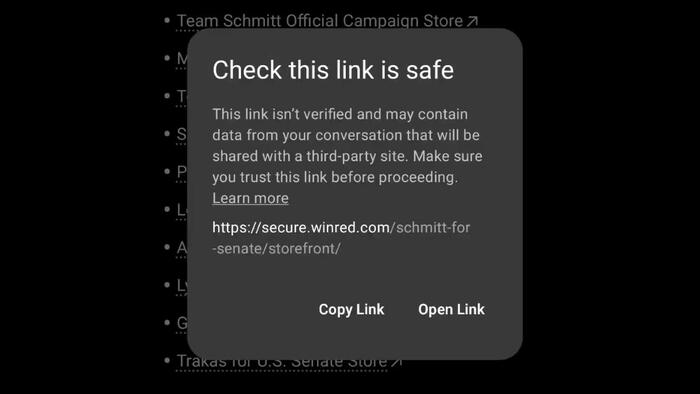
OpenAI claimed Friday that a so-called technical glitch was the culprit behind ChatGPT slapping safety warnings on links to affected links to WinRed, the leading online fundraising platform for the Republican candidates. Unsurprisingly, ActBlue, the main Democrat fundraising platform, did not trigger a similar warning.
The issue was flagged in an X post by Mike Morrison, an eagled-eyed digital marketer, when he asked ChatGPT to produce links from WinRed and ActBlue.
“WILD. ChatGPT universally marks [WinRed] links as potentially unsafe,” Morrison told his followers. “Of course ActBlue links are totally fine.”
WILD. ChatGPT universally marks @WinRed links as potentially unsafe.
Of course ActBlue links are totally fine. pic.twitter.com/DXzPuwSP80
— Mike Morrison 🦬 (@MikeKMorrison) March 20, 2026
When ChatGPT provided links to GOP-affiliated stores hosted on WinRed, it appended a warning urging users to check whether the link was “safe,” adding that it may contain data from your conversation that will be shared with a third-party website. Morrison said that the OpenAI chat bot did not replicate the same warning for the Democrat fundraising platform.
WinRed CEO Ryan Lyk blasted the blatant bias, calling it “election interference.”
This is election interference. @OpenAI @sama https://t.co/xMGOt2v9Hv
— Lyk – WinRed.com (@RyanLyk) March 20, 2026
An OpenAI spox scrambled to save face for the company, telling the New York Post in a statement that “this shouldn’t be happening and it’s getting remedied.”
OpenAI was so jilted by getting caught (errr, finding the bug), that another press person from the AI behemoth issued a longer statement attempting to cover it’s behind.
“As soon as we saw the post, we reached out to the individual and looked into it,” OpenAI’s Kate Waters said in a statement to the Post. “This wasn’t about partisan politics. The model generated some website links that weren’t in our search index yet for both WinRed and in one instance for ActBlue, and our systems flagged them as AI-generated as part of our standard safeguards.”
“The issue is now in the process of being fully resolved,” Waters added. “The company added later that “this issue is related to how URLs are discovered.”