On December 22, 2025, to muted fanfare, President Donald Trump announced a new Navy shipbuilding vision for the nation.[REF] A President personally engaged and driving an invigorated shipbuilding revival represented a historic moment for the Navy.
The Navy’s next budget—which was due in February—and the associated 30-year shipbuilding plan required by Congress, which is likely to follow in April, should reveal additional details with respect to what the President calls the “Golden Fleet.” But despite the absence of these documents, and knowing the current state of the Navy and associated shipbuilding programs, it is possible to estimate what is needed to build this fleet and identify the shipbuilding challenges that lie ahead. A key insight comes from the Navy’s Fighting Instructions, which details a hedge strategy that points to greater near-term use of unmanned platforms.[REF] The goal of this new enterprise must be twofold: to prevent repeating the mistakes of past naval shipbuilding programs while meeting the threats facing the nation as laid out in the recent National Security Strategy and supporting National Defense Strategy.[REF]
At the same time, the President has made clear in his “Restoring America’s Maritime Dominance” executive order that he intends to promote the growth of the nation’s maritime industry.[REF] This is a task of national security importance, but it is beyond the capacity of the Navy alone and requires a national maritime initiative of the sort that has long been advocated by The Heritage Foundation and is embodied in the Maritime Action Plan (MAP) released by the Trump Administration on February 13, 2026.[REF] Building the Navy’s Golden Fleet will send important demand signals to American and treaty ally shipbuilders to invest here and participate in a generational naval program that complements the wider reindustrialization of America.
In short, the Golden Fleet must be an actionable plan that both meets the China threat and supports a national maritime industrial revival.
Scoping the Required Fleet
The Navy conducts periodic fleet design analyses to assess whether its shipbuilding and capability development can meet and stay ahead of the threat. Given the speed of China’s naval modernization and growth as reported in the Pentagon’s annual Military and Security Developments Involving the People’s Republic of China reports and The Heritage Foundation’s Index of U.S. Military Strength, it is a race that the nation is not winning.[REF] The Navy’s most recent fleet design, the Battle Force Ship Assessment and Requirement (BFSAR), which was released in June 2023, stipulated a manned fleet of 381 warships augmented by 134 unmanned platforms.[REF] This is the best benchmark to use in assessing the Golden Fleet even though, like other previous fleet designs, it fails to specify a delivery timeline informed by the threat. Moreover, not all previous plans were determined by the threat. The 2016 Navy Force Structure Assessment executive summary, for example, specified that the Navy needed a fleet of 459 warships, but budget concerns resulted in 355.[REF] As of March 2026, because of persistent contrary budget priorities, the Navy had only 17 more ships than it had in September 2016, while the fleet of an increasingly belligerent China had grown by more than 100 and now numbers 474 warships.[REF]
One thing is of paramount importance: Budgets must not be allowed to predetermine either the size of the Golden Fleet or its required delivery schedule. The primary consideration, tempered by a realistic plan for building up our industrial capacity, must be what is needed to counter the threat from China.
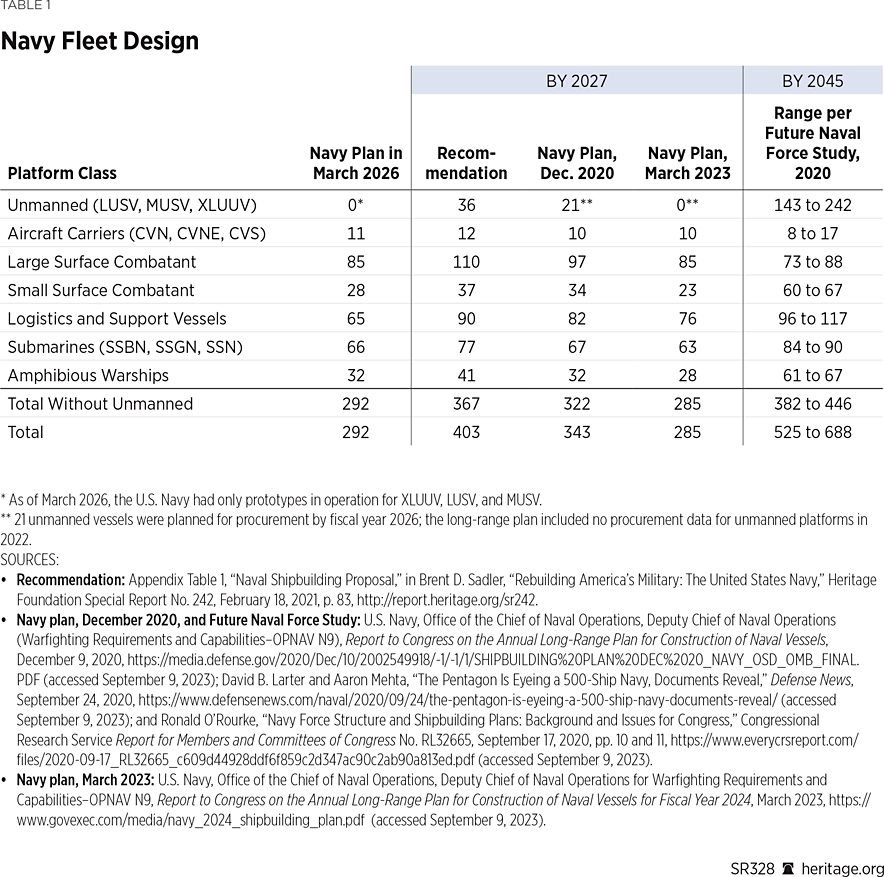
While the details with respect to the final numbers and classes of warships required for the Golden Fleet are not yet clear, it is possible to assess what will be required. The author’s 2023 book U.S. Naval Power in the 21st Century, for example, stipulates a new model Navy consisting of 575 manned and unmanned platforms comprised of several new classes of warships (unmanned missile corvettes, destroyer tenders, etc.).[REF] A recent Janes article based on interviews with those who are familiar with the Golden Fleet plan provides some insights into the Navy’s likely next fleet design:[REF]
- Aircraft carriers: Reduced from 12 to nine (with seven carrier air wings instead of nine).
- Small combatants: Unchanged at 73 (not counting 100 medium unmanned surface vessels (MUSV)).
- Large surface warships: Reduced to 67 (likely not counting potential battleships).
- Ballistic missile submarines (SSBN): Unchanged at 12 ballistic with potential for more as guided missile submarines (SSGN).
- Attack submarines: A potential reduction from 66 to 54.
- Large amphibious warships: Reduced from 31 to 27 (not counting landing ship medium amphibious warships or LSMs).
- Fleet oilers (T-AO): An unspecified increase.
If these numbers are accurate, there clearly are significant implications for shipyard orders and long-term infrastructure investments, as well as questions for Congress, as several legislated fleet minimums are violated, most concerningly the minimum of 11 aircraft carriers and minimum of 31 large amphibious warships.[REF] Aside from drawing congressional scrutiny (and resistance), the larger questions are whether the Golden Fleet (1) can deliver increased firepower at sea to deter China and (2) can direct needed investments to grow the shipbuilding industrial base so that it can build and then sustain the fleet required well into a prolonged new Cold War?
The track record so far amassed by Congress, the executive branch (the Navy), and industry does not exactly inspire confidence.
New Designs to Meet a Critical Mission: Deter China in Peace, Win in War
Much of the news since the Golden Fleet’s unveiling has been speculation regarding the potential return of battleships to the Navy’s fleet. The ensuing discussions have focused rightly on what capabilities ships will need to meet required missions and defend against likely threats, as well as where and how they will be built and at what cost. These are key details, but other classes of ships and alignment with other national maritime efforts also need to be considered. Specifically, pursuit of the Navy’s new fleet should align with and support the U.S. Coast Guard’s Force Design 2028—an aggressive cutter-building program—while fueling a national maritime industrial revival directed by presidential executive order.[REF] With these issues in mind, both existing and several new shipbuilding programs announced at the December 22 and subsequent events reflect certain definite needs.
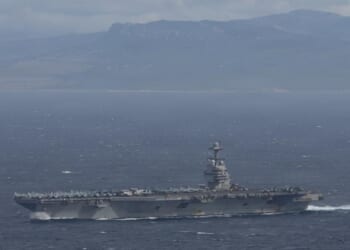
Battlecruisers. President Trump made much of the return of “battleships” to the U.S. Navy, but these ships are not going to be just updated versions of the Iowa-class brought back to service during President Ronald Reagan’s tenure. The lead ship, to be called Defiant, will provide air and missile defense for carrier strike groups, a role filled today by aging Ticonderoga-class cruisers and in a limited way by the third flight iteration of the Arleigh Burke–class destroyer,[REF] and employ long-range hypersonic missiles to suppress ground defenses ahead of or support the conduct of carrier air strike operations.[REF] By merging these two capabilities with limited armor, large weapons magazine capacity, robust command and control, and emphasis on speed, the Defiant more closely approximates the definition of a battlecruiser.
Speed is critical for a warship that is designed to safeguard the carrier. In the 1960s, the Navy built several nuclear-powered cruisers that could keep up with and protect nuclear-powered aircraft carriers (all Navy aircraft carriers are nuclear powered and can sustain high speeds indefinitely) and were both powered and sized to serve as air defense command ships.[REF] The need to sustain high speeds makes nuclear propulsion a natural design choice, but given the long lead time involved in designing and constructing a new nuclear warship, the first iteration of Defiant will be conventionally propelled.[REF]
The Gerald R. Ford–class carrier’s A1B nuclear power plant produces 700mw of electrical power and is the most likely candidate to power a later nuclear-powered battlecruiser iteration. Using a currently produced nuclear power plant simplifies the hull design in a battlecruiser’s initial iteration, but forestalling another major design change to include nuclear propulsion in the first of the ships avoids extended delivery delay and allows production of A1B to increase while still meeting needed delivery timeline for the Ford-class program.
Moreover, to defend against the threat of long-range ballistic missiles and swarms of unmanned platforms, the fleet must operate in a dispersed way that emphasizes power-hungry high-energy systems: radar, communication, lasers, electromagnetic rail guns, and massive data processing to turn data from a wide array of manned and unmanned platforms into actionable data by a numbered fleet commander (Seventh Fleet).[REF] This is how the Golden Fleet is envisioned to operate and fight as laid out most recently by the Chief of Naval Operations in a January 15, 2026, C-NOte to the fleet.[REF]
Mission: The battlecruiser will provide air and missile defense of the carrier strike group, command and control of a dispersed numbered fleet (manned and unmanned platforms), and suppressing long-range fires in support of carrier air operations. The lessons being learned in the war with Iran indicate that the ability to command and control wider naval operations, to include dispersed unmanned platforms, necessitates a command ship role beyond the air defense role that is currently being considered.
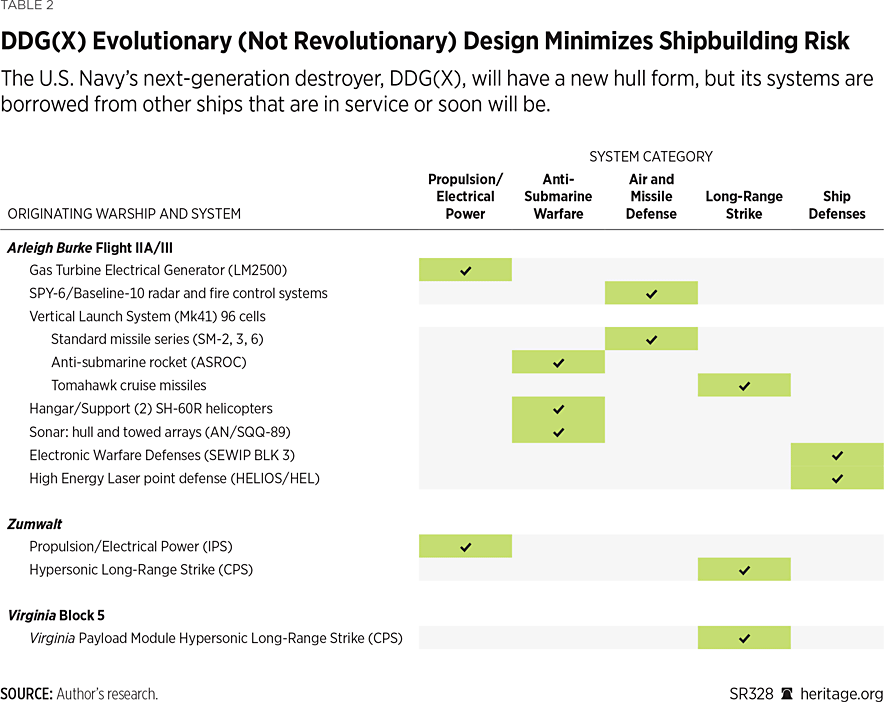
Destroyers. Launched before the fall of the Berlin Wall, the Arleigh Burke–class destroyer is the nation’s oldest naval shipbuilding program. As of January 2026, it was into its fourth iteration, called flight III, and 76 ships were active in March 2026.[REF] These destroyers provide missile and air defense and hunt submarines using an array of sonar systems and embarked helicopters. However, without additional room onboard, their design precludes further adaptions to a changing threat environment and technological advances. The Navy plans to continue to procure flight III destroyers at a pace of two per year through fiscal year (FY) 2029.[REF]
By most accounts a successful build program, the Arleigh Burke class had an inauspicious beginning. The most remarkable oversight, driven by cost-cutting, was the absence of a helicopter hanger, a feature that is key to sustaining two helicopters and critical for the ship’s anti-submarine mission. First, the flight deck was modified to allow for rearming with torpedoes; then a hanger for two helicopters was added from flight IIA (DDG 79) onward.[REF] This and other modifications resulted in delays and significant cost overruns that (as expected) nearly ended the program in the early 1990s—unfortunately, a recurring problem with new classes of warships.[REF]
Another example is the Zumwalt-class destroyer program. Construction began in 2008, but the program actually was conceived in 1995 when the threat environment was more focused on unopposed littoral operations. Initially, the ship was intended to replace the Arleigh Burke and Ticonderoga classes with a build plan of 32 warships to support ground forces ashore with long-range fires using novel electromagnetic railguns. Later efforts to modify the design to become a replacement for the Ticonderoga-class cruisers failed as the Navy layered excessive requirements that effectively killed a platform that was needed to replace aging destroyer and cruiser designs. Unable to adapt to the post–Cold War era and beset by cost constraints and program overruns, the plan was reduced to three ships in 2010.[REF] The Navy is currently installing long-range hypersonic missile systems, paired with its advanced multi-function radar, on its three Zumwalt-class destroyers.[REF] A new power generation and distribution system (Integrated Power System), along with the radar and hypersonic weapons, provides a baseline from which the new battlecruiser can be modestly improved and built.
Mission: The destroyer’s mission is twofold: anti-submarine warfare and air and missile defense. The Arleigh Burke–class flight III, which is still in production, represents a design bridge to the more capable Trump-class battlecruiser.
Frigates. The Navy’s last frigate, the Simpson, was decommissioned on September 29, 2015. Since then, the Navy has had to rely on its operationally limited Littoral Combat Ships, further burdening the overworked fleet of destroyers. To correct this deficiency, in April 2020, Fincantieri Marinette Marine won a contract to design and build up to 10 new Constellation-class frigates.[REF] The initial plan was to build 62 at two shipyards. However, uncertainty regarding weapons and sensors and the inclusion of stringent naval survivability design standards resulted in significant modification of the baseline European design, which in turn resulted in delays and cost overruns.
This reality hit home when the Secretary of Navy’s 45-day shipbuilding review unveiled in April 2024 revealed that the program was three years behind schedule.[REF] In November 2025, it was announced that the program was being canceled. After almost six years, with $800 million invested by Fincantieri in the shipyard, 3,750 workers hired, and 88 percent of the design work completed, and factoring in the costs incurred in constructing the first two frigates, the result was a loss of almost $3 billion.[REF] Even greater is the loss of time needed to fill an urgent need for a frigate-class warship and its associated shipbuilding capacity.[REF] Realizing this, Secretary of the Navy John Phelan has announced that a modified version of the U.S. Coast Guard’s National Security Cutter (NSC) will replace the Constellation as the Navy’s frigate.
In shipbuilding, fast or cheap solutions are about as easily found as unicorns, and the NSC, with its limited battle damage resilience and operational constraints, is no exception to this rule. When the Coast Guard halted work on the 11th NSC in November 2024, construction was reportedly only 15 percent complete.[REF] Actual work, however, had slowed much earlier. Design modifications that will be needed to fulfill the NSC’s proposed limited anti-submarine mission include adaptations for sonar sensors (towed or over-the-side unmanned platforms) as well as expanded hangar space for anti-submarine helicopters, berthing for the larger crew required for anti-submarine warfare operations, bigger aviation fuel tanks for sustained naval operations, and the ability to store and handle torpedoes safely.[REF] Also, because parts meant to build the NSC have likely been scavenged to keep existing cutters operational, a supply base survey and critical path analysis will have to be conducted.[REF] The Navy expects this cutter program to fill its frigate gap by 2028, but the Coast Guard has been signaling the end of the program for years, and the program could encounter serious supply chain problems.[REF]
One outcome that could benefit both the Navy and taxpayers—having both shipyards remain active with Marinette building Constellations and Pascagoula building modified NSCs—aligns with the Navy’s original plan to have two shipyards producing frigates.[REF] For now, a race between Fincantieri and Huntington Ingalls Industries (HII), with Fincantieri finishing its contracted two Constellation frigates and HII restarting and modifying NSC production, could focus resources and shipbuilders on delivering a needed class of warship while expanding the nation’s shipbuilding capacity.
Mission: Frigates escort vulnerable merchant and military logistics vessels primarily to defend against a submarine threat. They also provide limited air defense against drones and manned aircraft. As currently envisioned, the Constellation class will carry 32 vertical launch cells for air defense as well as anti-ship missiles. Both the NSC as modified for the Navy and the Constellation would include submarine sensors and support helicopters with anti-submarine capability.
Submarines. For many years, Indo-Pacific Command, which is responsible for all military operations in a potential Pacific war, and its commanders have relied on the superiority of America’s submarines. Admiral Samuel Locklear, for example, testified before Congress in 2015 that “in my AOR [area of responsibility], they are essential to any operations that I have, both in peacetime and in crisis and contingency.”[REF] This advantage, achieved after decades of work and at great expense, cannot be maintained without continued investment.
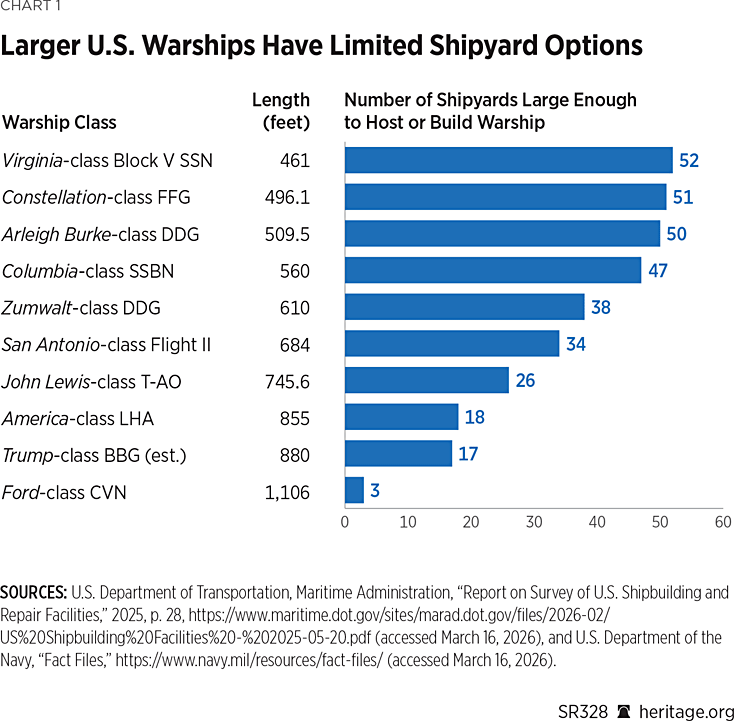
Given the rapidly modernizing and growing Chinese submarine fleet, the American submarine force must retain a technological advantage (most notably in acoustic silencing to avoid detection) and superior processing of sensed data to enable more rapid identification and targeting of hostile undersea threats.[REF] The design of the next-generation American submarine, the SSN(X), will therefore emphasize the torpedo room and capabilities to operate in concert with unmanned platforms.[REF] Meanwhile, shipyards have had to adjust to building and repairing the larger submarine hull form with bigger dry docks and larger cranes for the largest being built: the Columbia-class strategic missile submarine (SSBN) and the longer Virginia-class Block V with hull extension to accommodate additional missile tubes.
To sustain and grow the nuclear attack submarine force to its long-standing goal of 66 boats, the SSN(X) needs to begin putting to sea by the mid-2030s, but because of tardy design work and industrial capacity investments—to meet a need that could have been addressed a generation ago—the boat will not arrive until after 2040.[REF] At the same time, the “optimal pathway” of an Australia–United Kingdom–United States (AUKUS) initiative announced in September 2021 is guiding the rotational basing of U.S. nuclear submarines at Australia’s HMAS Stirling beginning in 2027. Under this initiative, a nuclear submarine enterprise (production-sustainment-operation) will be established in Australia, and construction of an AUKUS-class submarine will begin sometime after 2040.[REF] To address current stresses on the U.S. nuclear submarine industrial base, a key element of this plan was the investment by Australia to expand domestic U.S. shipbuilding capacity. Payments already made to this end totaled approximately $1 billion USD as of March 2026.[REF]
However, given the long lead times needed for workforce growth, expansion of production, and construction of shipbuilding facilities, and despite sustained investment and political pressure, expectations of immediate improvement are unrealistic. Without more effective congressional oversight and incentives that reward commercial shipbuilders for investing in infrastructure and workforce—for example, tax structures that grant full expensing of capital investments and contracting mechanisms such as Shipyard Accountability and Workforce Support (SAWS) that enable such investments—just doing more of the same with more money is a recipe for unmet expectations.[REF] To ensure delivery timelines, detail design for SSN(X) is needed now, and production should begin early in 2030; it is anticipated that production of the AUKUS-class submarine will begin in the early 2040s.[REF] Finally, to prevent the need for new dry docks, the SSN(X)’s dimensions should not exceed those of the Columbia’s or Virginia Block V’s.
Aside from the SSN(X), and ostensibly a similarly designed AUKUS class, the top priority in naval shipbuilding is still production of a ballistic missile submarine (SSBN) to replace the Ohio class by 2028. America’s nuclear strategic deterrence is based on a significant second-strike capability provided by SSBNs at sea, but a 2010 nuclear posture review that assumed an excessively benign strategic environment placed the Navy on a path of failure: too few SSBNs with too few missiles too late.[REF] Because the Navy knew that the Ohio class would begin to age out of service in 2026, Columbia-class boats have been its number one shipbuilding priority since 2013.[REF] Yet the first Columbia submarine was only 60 percent compete and one year behind schedule as of October 2025.[REF] To meet the changed strategic environment, which includes expiration of the Strategic Arms Reduction Treaty (START) in February 2026 and the Intermediate-Range Nuclear Forces (INF) Treaty in August 2019, more missile tubes will be needed from the fifth Columbia-class boat onward, more than the 12 boats currently planned, to include a new guided missile submarine (SSGN) variant, will have to be produced.
A significant amount of the Navy’s long-range strike capacity has relied on cruise missiles launched by four of the oldest repurposed Ohio-class submarines. These SSGNs carry a total of 616 cruise missiles, which is roughly equivalent to the firepower of 20 Arleigh Burke destroyers or 15 block V Virginia-class submarines with a payload module added. However, unless they operate in conjunction with large unmanned vessels or other surface warships, the Navy’s currently contracted 12 block V Virginia submarines represent a strike capacity deficit.[REF] The last Ohio-class SSGN is slated to decommission in 2028, and the Navy is likely to receive its first block V boat, the Oklahoma, in late 2027 at a time when two SSGNs will already have been decommissioned.[REF] In a best-case scenario, the Navy would see a loss in strike firepower in early January 2028 that equates to a deficit of 268 missile tubes. This math has driven the Navy to explore extending the 42-year service life that all of these submarines exceeded in January 2026.
Mission: For the Virginia-class and future SSN(X), the primary mission is anti-submarine warfare; for the Ohio-class SSGNs (backstopped by block V Virginia-class submarines), it is strike; for current and future SSBNs, it is strategic deterrence.
Aircraft Carriers. The Navy operates two classes of aircraft carriers, both of them nuclear powered: the older Nimitz class and the newest Ford class. Construction began in 2009, with the Ford’s first combat deployment in 2023 to support Israel in its war with Hamas. In November 2025, the Ford supported combat operations against narco-Cartels’ smuggling boats, and in January 2026, the carrier was employed in operation Absolute Resolve, which extracted President Nicolas Maduro from Venezuela.[REF]
In hindsight, incorporating many unproven and new systems into the Ford design delayed the ship’s delivery with ensuing cost overruns, but with several deployments completed, lessons are being incorporated that should help to improve production timelines. Electromagnetic catapults (EMALS), an advanced landing system (AAG), and new weapons elevator design (AWE) may lead to high sortie rates, safer weapons handling, and a wider array of aircraft that can be operated.[REF] On January 28, 2026, the second Ford-class carrier, the John F. Kennedy, began sea trials—a major milestone on the path to its delivery in March 2027.[REF] By most accounts, the Ford class is transitioning to a stable design with commensurate supply chains and workforce; assuming predictable budgets and effective shipyard operations, this should result in faster delivery times and reduced costs.
However, current production periods range from three to eight years, which is not conducive to stable shipyard operations and will cause fewer than the congressionally mandated 11 carriers to be produced by 2037.[REF] Moreover, analysis done by The Heritage Foundation since 2019 has consistently pointed out that a fleet of 13 carriers is required.[REF] In later analysis, a carrier fleet of 15 is recommended to address the need for more naval airpower given the evolving China threat.[REF] That analysis highlights the need for additional naval air power, which in turn means new classes of carriers, such as an escort carrier (CVNE) and a smaller conventionally powered anti-submarine variant (CVS), that could be built at different shipyards.[REF]
Mission:Ford-class and Nimitz-class (CVN) conduct sustained long-range naval aviation combat strike operations. Escort carriers (CVNE) provide screening and defensive air power to protect naval fleets. Beyond the range of air or surface threats, anti-submarine patrols would be conducted by light carriers (CVS). The air wings for each of these carriers would be tailored to the threat and mission tasked: A CVNE air wing, for example, would consist of short-range fighters augmented by a larger portion of unmanned aircraft; a CVS small air wing would consist predominately of rotary-wing or tilt-rotor aircraft.
Submarine and Destroyer Tenders. Submarine tenders (AS in naval terms) played a vital role in World War II by being able to repair, rearm, and resupply anywhere in the world. Commander Richard Bowers’ November 1953 article “Servicing the Silent” offers a vivid description of how these ships served as mobile bases with a multitude of engineering shops ready to return a war-weary ship and crew to service.[REF] Today, the Navy operates just two of these ships—the Emory S. Land and Frank Cable—capable of nuclear maintenance, rearming, and resupply to sustain a small but vital submarine fleet in the Western Pacific.[REF] Both were built in the late 1970s and are operating well past their original design service life, but modernization since their commissioning has kept them relevant and vital to Western Pacific submarine operations from Diego Garcia to Australia and Guam.[REF]
Designs for replacements are under contract worth a total of $99.92 million, but construction of the first ship must be completed by 2029 when decommissioning of the current tenders begins.[REF] According to long-range plans, the Navy has consistently intended to build only two of these ships,[REF] but the number should be increased to ensure that a too-small nuclear submarine force can remain forward deployed to sustain required operational tempo and presence well into the future. Moreover, the demand for submarine tenders will grow as AUKUS matures and the forward rotational U.S. submarine presence stands up in Stirling, Australia, beginning in 2027.
Additionally, the Navy has been developing options to rearm the vertical launch systems (VLS) of its cruisers and destroyers while at sea. Without this capability, warships must be taken offline while they transit to secure ports to rearm. This dynamic, which was in play during recent combat operations in the Red Sea and efforts to defend Israel from Iranian missile barrages, is unacceptable for a Pacific war.[REF]
The Navy is currently testing two techniques for rearming VLS at sea: the Transferable Reload At-sea Method (TRAM) and Large Vessel Interface Lift On/Lift Off (LVI Lo/Lo).[REF] The most recent test, which further refined and validated TRAM’s utility, was conducted in July 2025 during the U.S. Large Scale Exercise; during the same month, Australia and Canada practiced their own technique of at-sea rearming during Talisman Sabre.[REF] This renewed interest in rearming surface warships at sea is reviving interest in bringing back the destroyer tender (AD); the last of four Yellowstone-class destroyer tenders was decommissioned in 1996.[REF]
Both the Yellowstone-class and Emory S. Land tenders sustain warships that are forward deployed near combat zones, but they differ in that AS must include nuclear repair capacities while destroyer tenders must have the ability to conduct at-sea VLS rearming. It therefore should not be surprising that the same shipyard that built the Yellowstone ships (General Dynamics NASSCO) is offering to build a destroyer tender using the same hull form that is used for its already contracted AS(X).[REF] The Navy will need to rearm at-sea to maximize the salvo rate of long-range strikes and sustained missile and air defense that its surface fleet of destroyers currently provides. In the exposed expanse of the Pacific, its fleet of destroyer tenders must operate from secure logistic hubs deep in the region.
Mission: Submarine tenders primarily conduct nuclear maintenance and battle damage repairs, rearming, and replenishment. Destroyer tenders, in addition to sustainment of warships, provide the unique ability to conduct VLS rearming at sea.
Oilers. At a January 13, 2026, Surface Navy Association event, Secretary of the Navy John Phelan reminded his audience that “[y]ou cannot deter a numerically superior adversary across the vast distances of the Indo-Pacific without logistics, speed, scale, and depth.”[REF] This is affirmed by a preliminary finding in The Heritage Foundation’s ongoing Tidalwave project: “Fleet Oiler Force: The thin, aging, and low-survivability CLF [combat logistics force] inventory likely makes at-sea fuel replenishment the primary throttle on sustained naval operations.”[REF] Earlier analysis in 2019 indicated that the Navy’s logistics deficit was as large as 20 tankers adapted to support naval operations with consolidated cargo replenishment (CONSOL) gear.[REF] This assessment predates the 2022 closure of the Red Hill Bulk Fuel Storage Facility in Hawaii, which added greater demand for tankers to move fuel from the West Coast and act as afloat storage given the limited secure bulk storage facilities available in the Pacific.[REF]
To support naval vessels in combat, the Navy relies on a fleet of oilers operated by the Military Sealift Command. These ships are optimized for at-sea underway replenishment operations. Since 2016, the Navy has contracted with General Dynamics NASSCO to build 17 of an intended 20 John Lewis-class oilers.[REF] However, recent analysis and simulation conducted by The Heritage Foundation point to a required wartime fleet of 40 oilers—20 additional ships at a cost of $570 million each for a total of $8.5 billion.[REF] With three hulls of the class yet to be contracted, consideration should be given to beginning construction of those ships as soon as possible at a second shipyard to increase shipbuilding capacity.
Mission: Oilers conduct underway fuel replenishment for warships and associated naval air wings; a secondary role is to provide fuel to forward bases, to include land-based air forces.
Large Unmanned Surface Vessels. At the January 2026 Surface Navy Association’s annual symposium, the Chief of Naval Operations, Admiral Daryl Caudle, introduced the concept of a “hedge strategy” that would be incorporated in the Golden Fleet’s force design:
What [the] hedge avoids is a brittle single-purpose force that is either overbuilt for high-end fights and then underused day to day, or optimized for low-end crises and then gets overmatched when it counts.… The hedge strategy accepts fiscal, industrial and operational realities. It still demands a Navy that is lethal, agile, responsive and flexible. It balances cost-effective, scalable, risk-worthy mass with the most advanced multi-mission platforms we can build and sustain.[REF]
Soon after delivering this speech, Caudle released his fourth C-Note, “The Way We Fight,” laying out in more detail what the new fleet design is intended to deliver.[REF] While a forthcoming “Hedge Strategy” may provide more insight, it is clear that the C-NOte’s reference to “non-traditional attack vectors” likely includes the use of unmanned platforms. There is therefore an urgent need to backfill the loss of at-sea firepower from the imminent decommissioning of the SSGNs and the remaining seven Ticonderoga-class cruisers and the beginning of the Arleigh Burke destroyers’ retirement by 2030: a total loss of 1,940 launch tubes for long-range strike missiles (and for surface warships’ air and missile defenses). For too long, the speed of decommissioning has been outpacing the rate of shipbuilding, making alternative weapons platforms necessary. Given the shorter build time (one year versus more than three years for large manned warships) and wide availability of shipyards able to build them, a prime candidate to hedge against this diminishing firepower is the large unmanned platform (LUSV).
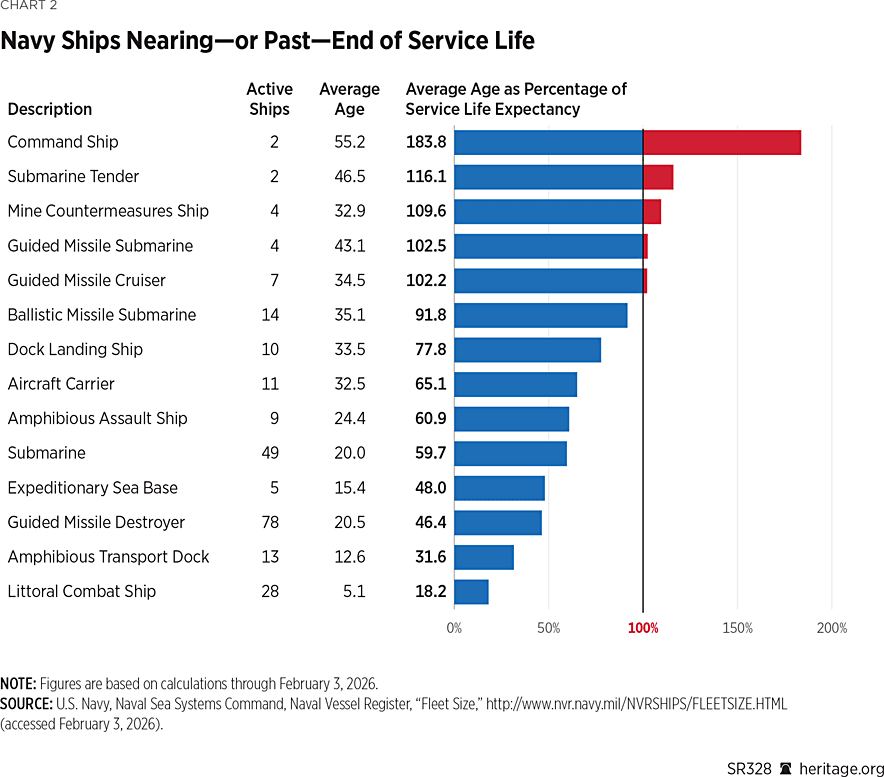
Thankfully, there is a proven basis for swift action to get firepower to sea in the Western Pacific: the September 2021 launch of an SM-6 missile from a modular launcher on the unmanned surface vessel Ranger.[REF] An independent feasibility study conducted at the University of Michigan indicates that this vessel could carry and employ safely as many as four mark-143 armored box launchers containing a total of 16 Tomahawk cruise missiles.[REF] The Navy is exploring a range of possible unmanned sensor platforms for an array of small to large craft operating on the surface and undersea.[REF] However, the larger surface variants show the greatest promise as long-range strike or air and missile defense weapons platforms.
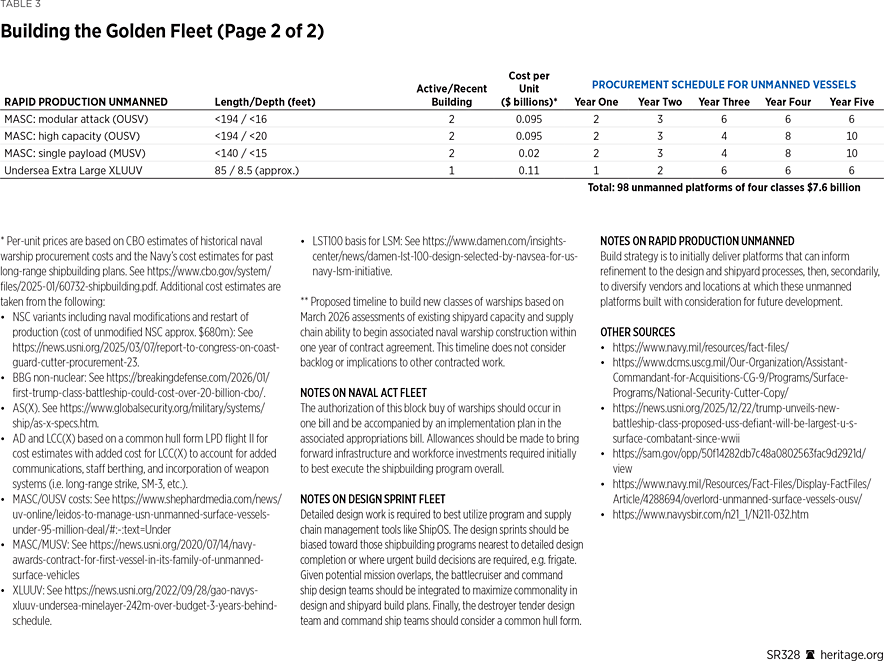
With this in mind, the Navy solicitated Area of Interest (AOI) for a new Modular Attack Surface Craft (MASC) that would effectively consolidate medium and large unmanned platform programs into one program. The AOI specifies power, endurance, and load capacity for three variants: modular attack, high-capacity, and single payload.[REF] Frustrated by the slow progress of this effort, the Secretary of the Navy directed a 30-day sprint to reorganize unmanned program offices and accelerate procurement; this new office was to be stood up within 60 days after the sprint (by December 3, 2025).[REF]
Mission: Large, unmanned surface platforms serve as an adjunct weapons platform in concert with a manned overwatch warship, primarily with long-range strike weapons such as Tomahawk cruise missiles. Secondary missions include sensor platform and logistics (cargo transport).
Amphibious Warships. The Navy is building two classes of large amphibious warship to move Marine Air–Ground Task Force (MAGTF) onto opposed beachheads. The first is the America-class amphibious assault ship (LHA), which resembles a World War II aircraft carrier and the second iteration of which will add capacity to embark landing craft from a well deck.[REF] F-35B fifth-generation fighters make it a lethal power projection platform—a so-called lightning carrier, albeit with limited strike range and sustained combat air operations.[REF] The second is the smaller but capable flight two San Antonio– class amphibious transport dock (LPD).[REF]
A third class of amphibious warship, the Landing Ship Medium (LSM), will soon go into production.[REF] Based on a Dutch LST100 design, the LSM is intended to move and sustain smaller Marine Corps units in the hostile littorals of the First Island Chain—an area in which, “as the [recent National Defense Strategy] directs, we will erect a strong denial defense.”[REF] The FY 2026 shipbuilding budget sought to procure nine LSMs;[REF] the 2023 BFSAR stipulates a required total of 18 based on an unreleased 2022 Amphibious Force Requirements Study.[REF] To sustain the required minimum numbers of large amphibious warships, two LHA and three LPD must be delivered by 2030, and as of March 22, 2026, funding was being held up by Congress.
Mission: In accordance with the U.S. Marine Corps’ Force Design 2030, these ships will perform the following tasks: LSM will provide mobility for fires, sensors, command and control, and sustainment across contested littorals; LHA and LPD will comprise amphibious ready groups (ARG); and marine expeditionary units (MEU) will sustain a constant at-sea presence of three MAGTFs.[REF]
Shipyard Capacities and Stable Production Lines
How and where the U.S. Navy plans to build its fleet are particularly important considerations. especially in view of the time that will be needed to recapitalize shipbuilding infrastructure and to design and build the larger modern fleet that is needed to meet today’s maritime threats. But the Navy, shipbuilders, and Congress often disagree as to how this should be accomplished. One way to bridge this divide would be to coordinate ship orders across various agencies (the Navy, Coast Guard, Maritime Administration, and National Oceanic and Atmospheric Administration) under a comprehensive national shipbuilding plan. The Administration’s Maritime Action Plan, which was published on February 13, 2026, finally provided needed insights to guide investment plans ahead of expected ship orders and new incentives.[REF] Unfortunately, however, the plan does not specify exactly how to ensure that commercial and naval ship orders maximize maritime industrial capacity growth.
A national shipbuilding plan must direct orders to shipyards that are optimized for construction of specific ship designs while also sustaining long-term maritime reindustrialization. So far, simply throwing money at the problem has not worked. In June 2025, Brett Seidle, the senior Navy civilian acting as acquisition executive, defended the $9 billion appropriated for submarine industrial base development since 2018 as money well spent: “Those efforts have been about workforce, hiring and retention. They have been about supply chain resiliency, modernization of the yards, strategic outsourcing [and] infrastructure issues.”[REF] Despite this, and despite an infusion of funds from Australia as part of the AUKUS initiative, management and resourcing have not reversed the downward slide of submarine construction, which stands today at a rate of just under 1.1 submarines per year when it must be 2.33 per year (and above 3.0 per year with the added demand from AUKUS during the next decade).[REF] Given the tentative reduction in submarine numbers associated with the Golden Fleet plan, limited production could be accepted as realistic for some time: This should be resisted by Congress, and demands for increased production should be pursued in a future industrial plan.
Building the Golden Fleet and pursuing a naval shipbuilding revival will require embracing industrial and budget realities today but not acceding to these contemporary constraints indefinitely. Doing this in turn will require both patience (shipbuilding and infrastructure expansion take years to accomplish) and commitment to the following foundational principles of sound shipbuilding:[REF]
- Do not change too much in a new class of ship; evolutionary change is cost-effective. In ship design, three components generally make the ship: the hull, propulsion, and installed systems. Changing any one of these components is manageable in a new ship class, but changing all three comes with an elevated risk of cost overruns and production delays as was seen with the Ford-class and Zumwalt-class in the early 2000s.[REF]
- Build ships with room to grow. Allowing for excess tonnage for future growth has resulted in designs that are cheaper to build, easier to operate, and easier to maintain. For example, allowing the tonnage requirements for Japan’s Kongo-class destroyer, which resembles a U.S. Arleigh Burke–class destroyer, to grow by 1,000 tons provided the space needed for future upgrades, simplified maintenance, and easier fabrication.[REF]
- Enforce strict mission design requirements. For the Oliver Hazard Perry–class frigates, strict displacement and manning constraints ensured that cost stayed within limits for large series production. Conversely, the lack of such design discipline contributed to the cost overruns and program delays that led eventually to a 20-ship reduction in Littoral Combat Ship series construction.[REF] However, strict enforcement of ill-considered requirements can also be problematic and lead to predictable delays and cost overruns.[REF]
- Early industry–Navy collaboration beginning with design can ease the challenges involved in manufacturing a new class of ship. The Navy has done this before by integrating industry into its Concept Formulation (CONFORM) program, begun in 1981. Given only 15 months beginning in mid-1985, the Navy succeeded in designing and procuring the first Small Waterplane Area Twin Hull (SWATH) ocean surveillance ship, the Victorious class.[REF]
- Setting the interval during which a class of warships are built will determine whether the shipbuilding infrastructure increases, maintains, or shrinks in capacity. A 2005 RAND study found that sustaining submarine design capacities at the existing two submarine shipyards (then Northrup Grumman Newport News and Electric Boat) would be more cost-effective than recapitalizing and training replacements in the future. The report also found that sustaining the workforce did not equate to experience without active submarine design and construction.[REF]
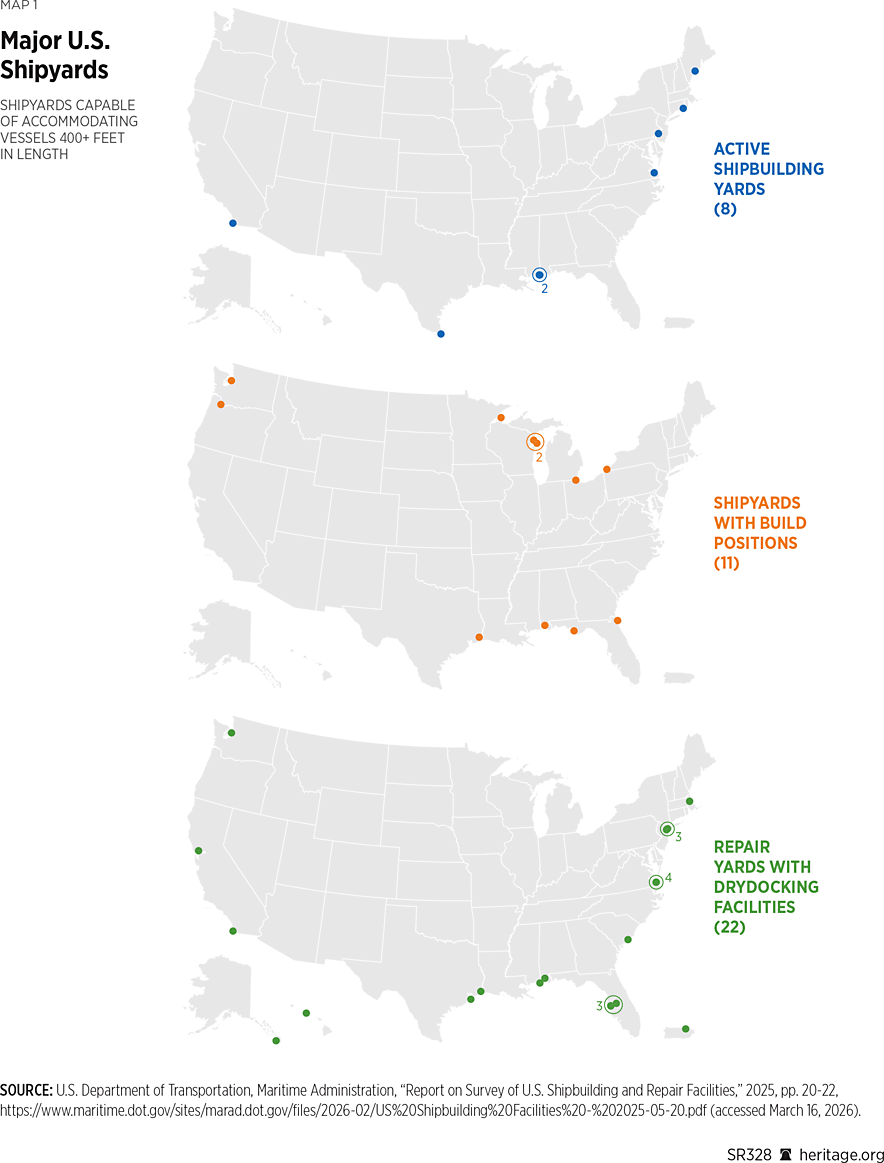
The reality is that American shipyards do not have the capacity to build warships at the scale or delivery rate that the nation requires. Correcting this, as already noted, will be a generational effort—but the nation does not have the luxury of time in meeting the threat from China. Knowing what American (and to an extent allied) shipyards can build today must inform the designs of new classes of ships as well as iterations of existing ones. Today’s naval shipbuilders are overwhelmingly in the Gulf of America and East Coast of the U.S.; only one active shipbuilder (NASSCO) is located in California.[REF]
Warship repair is similarly lopsided, especially given the increasing demand for naval presence in the Pacific to deter China. Dry dock repairs of Ford-class carriers cannot be conducted in the Pacific, and overall repair facilities for nuclear submarines are inadequate.[REF] The only Pacific dry dock capable of hosting a Nimitz-class nuclear aircraft carrier (dry dock #6 at Puget Sound, Washington) has been undergoing refurbishment (seismic strengthening because of its proximity to a fault line) and upgrades (13.8 KVa electrical systems and increased chill water capacity). The Navy is also pursuing a new Multi-Mission Dry Dock (M2D2) that is designed to accommodate the Ford class as well as all nuclear submarines.[REF] While needed, however, the Puget Sound efforts alone are inadequate; additional dry dock capacity in the Pacific capable of hosting all nuclear warships, both current and planned (for example, a future nuclear-powered battlecruiser), is urgently needed, and former naval facilities at Alameda, California, is one of several good candidates for revival.
The Navy’s non-nuclear warships typically conduct repairs and maintenance at commercial shipyards near existing fleet concentrations (for example, San Diego, California, and Norfolk, Virginia). However, as a result of delays caused by limited labor and shipyard capacity, nuclear warships also are being sent to commercial shipyards that are further afield, elbowing out cheaper repair work mostly at the expense of U.S. Coast Guard maintenance needs.[REF] Sustainment of the Navy fleet, both nuclear and non-nuclear, will not occur in a vacuum and must accommodate a growing U.S. Coast Guard cutter force and a potential 250-ship Strategic Commercial Fleet, as stipulated in the proposed SHIPS for America Act.[REF]
The Golden Fleet will include warship designs that are currently under construction, new classes of manned warships, and novel unmanned platforms. Those who are charged with building this fleet will have to place orders at existing shipyards, fund the upgrade of locations for modern naval shipbuilding, and commit to the long-term development of modern, massive shipyards—all at a time when several other military services and agencies have their own urgent shipbuilding needs.
- The Army must replace its aging fleet of large logistics support vessels (LSV) this decade; the existing fleet is already beyond its service life.[REF]
- The U.S. Coast Guard is beginning a $25 billion historic recapitalization of its too-small, aging fleet of cutters and new classes of icebreakers.[REF]
- The President has directed a commercial maritime revival, and the Maritime Administration will be hard-pressed to find enough shipyards to fill orders to meet the nation’s urgent sealift needs.[REF]
Initially, the Navy’s designs for new warships will be constrained by what shipyards can build today, but the selection of shipyards will inform capital investments so that shipyards can eventually build the required numbers of advanced warships as part of a wider maritime industrial revival. With this in mind, the following metrics should guide the selection of shipyards for construction based on the following specific warship design requirements:
- Shipyard infrastructure capacity and workshop adaptability to begin construction of the contracted design immediately.
- Workforce availability and technical competencies that are appropriate for construction of the contracted ship design.
- Local supply chain latency and responsiveness to specific parts and material requirements for new orders of shipbuilding.
- Expansion potential for larger orders as well as new ship designs.
These metrics, if followed, will inform naval shipbuilding orders that leverage existing and increased shipyard specialization and consolidation of local shipyards for increased manufacturing efficiencies. New warship designs will also require strategic investments in existing and new shipyards to build and maintain them. This is already informing the Navy’s search for a new Ford class–capable dry dock on the West Coast as well as increased nuclear maintenance capacity for the longer Virgina-class block V and Columbia-class nuclear submarines, to include new purpose-built public shipyards.
Golden Fleet Shipbuilding Strategy
The next budget for the Navy will be a down payment on its new fleet that will set in motion a new approach to naval shipbuilding. Not merely a bigger budget, but creation of new financing, contracting, and accountability tools must be employed to ensure progress and results in the form of warships delivered. Expectations must be grounded in the realities of America’s current shipbuilding industry.[REF] Also, it is not just the Navy that is relying on today’s shipbuilders; the needs of the U.S. Coast Guard and the need for a commercial shipbuilding revival are just as urgent.
An important consideration is the overseas procurement of warships. The U.S. Navy designs its ships to survive in battle and has design requirements that are written in blood, born from the lessons of the last Pacific War.[REF] Moreover, the design and fitting out of U.S. warships with critical systems rely on an associated training and maintenance enterprise. If foreign supply chains and unfamiliar shipboard systems are inserted into this naval enterprise, unexpected costs and reliance issues will ensue at a time when supply chain resilience is paramount. As evidenced by navies like those of India and Australia, introduction of too-varied foreign systems and supply chains complicates the qualification of sailors to operate them and shipyard workers to maintain them in addition to increasing supply chain vulnerabilities.[REF] For these reasons, it is advisable to avoid foreign-built warships while initially making allowances for foreign-built naval logistics, Coast Guard cutters (and icebreakers), and commercial ships. The goal, however, remains to move even these shipbuilding programs to the U.S. and restore to health the American maritime industrial base.
For now, the Golden Fleet must sustain and expand warship production, diversify construction at more shipyards, and accelerate designs of new classes of warships. According to the MAP, there are eight U.S. shipyards that can build vessels greater than 400 feet in length, but there are only 22 shipyards with adequate drydocking and 25 additional shipyards with a pier-side repair capability for ships that size.[REF] With this in mind, the following initial order strategy is recommended.
First, stabilize orders. Maximize the order of stable-design warships at shipyards that are optimized for their construction. Today, several warships are in series production, benefiting from years of workforce familiarity even with minimal iterative design changes. According to the Navy’s congressionally mandated annual 30-year shipbuilding plans stretching back over 10 years and across four Administrations, the following warships have been procured consistently:[REF]
- Ford-class aircraft carriers at an inconsistent order rate but a shipyard optimum periodicity of every four years.
- Arleigh Burke–class destroyers at a consistent rate of two per year; now building a flight III variant.
- Columbia-class nuclear ballistic missile submarines at a pace of one per year beginning in 2026.
- Virginia-class nuclear submarines at a nearly consistent rate of two per year; now building a block V variant.
- San Antonio–class large amphibious warship (amphibious transport dock) at a nearly consistent periodicity of one every two years; now building a flight II variant.
- America-class large amphibious assault warship at a periodicity of one order approximately every five years.
- John Lewis–class oilers at a historic alternating order rate of one and two per year.
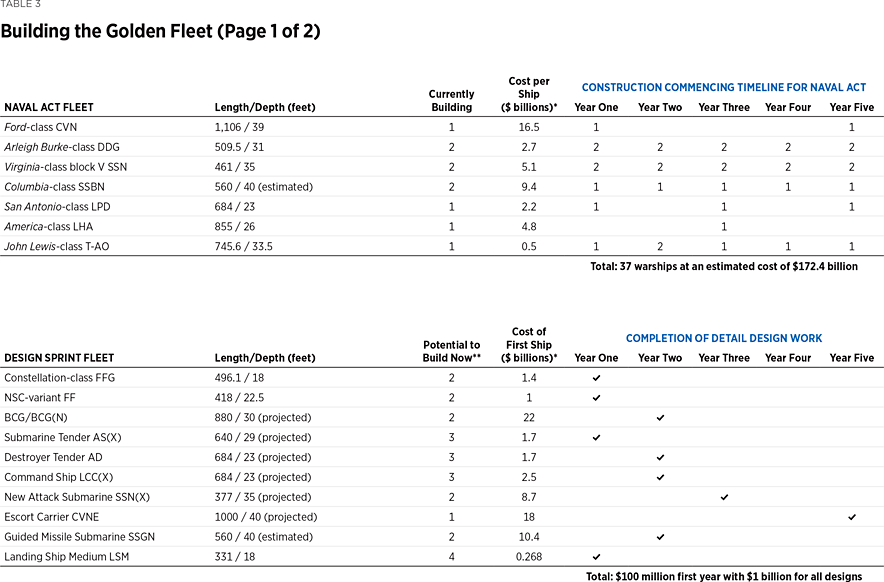
A large order of warships of stable design can provide greater predictability to shipbuilders and take advantage of economies of scale that have delivered savings to the taxpayer of 5 percent to 15 percent according to the Congressional Budget Office.[REF] Based on the most recent (March 2024) Future Years Defense Program (FYDP), such a block buy would include two aircraft carriers, 10 destroyers, 10 attack submarines, five ballistic missile submarines, three amphibious transport docks, one amphibious assault ship, and six oilers. The total cost, using Congressional Budget Office higher estimated costs based on historical cost performance, would be $172.4 billion ($155.6 billion after economy-of-scale average cost savings of 10 percent).[REF]
Such a large block buy incentivizes investments by shipbuilders to grow shipbuilding capacity. Novel contracting mechanisms such as the proposed SAWS,[REF] matched with congressional legislative incentives such as reformed tax structures, can incentivize capital investments for shipbuilding capacity rather than merely pleasing Wall Street. Likewise, greater accountability will be necessary using existing tools to place underperforming shipyards into a conservatorship, understanding that these shipyards are a national asset required for defense. Additionally, a simplified procurement plan that deals in whole-ship orders and not fractions of purchases that are too easily obscured by being spread over several budgets would make congressional oversight easier.
Second, execute a design sprint of new warships that U.S. shipyards can build today. The Navy urgently needs several new classes of warships, most notably frigates: 50 to 65 are required; in March 2026, the Navy had none. Other classes like a new nuclear attack submarine (SSN[X]), submarine tender (AS[X]), and command ship (LCC) are replacements for aging or long-running classes of warship that need a major update. The battlecruiser is a new design that is urgently needed to replace the aging Ticonderoga-class cruisers to defend carrier strike groups and provide a rapid-response long-range strike capability. Given China’s burgeoning modern fleet and expansive missile inventory, additional new classes of ship are also needed: destroyer tenders (AD); a family of large, unmanned platforms (MASC); and, potentially, an air dominance–optimized escort carrier (CVNE).
Critical to ensuring the delivery of these new classes of warships on time and within a reasonable margin of cost expectations are designs that are heavily informed by how existing shipyards operate and the limitations of their workforces. Moreover, given today’s too-limited naval shipbuilding capacity, specialization of the sort found in Groton, Connecticut, at Electric Boat (nuclear submarines) or Pascagoula, Mississippi, at Ingalls Shipyard (large amphibious warships) cannot preclude the development of additional shipbuilders at new shipyards. For example, the Navy always intended to have two shipyards producing frigates to meet its urgent requirement for large numbers of these warships. It is the need for new unmanned platforms that offers the greatest opportunity for new entrants into the naval shipbuilding sector. For the Navy, judicious risk management is required in the selection of promising new shipyards that are developing novel techniques in waterfront localities with available labor. This will be most appropriate for several new classes of unmanned ships that the Navy is looking to build within the MASC program and extra-large undersea unmanned platforms.
With these considerations and the various degrees of design maturity in mind, the following actions are recommended:
- Proceed aggressively with the Constellation-class frigate and a naval variant of the U.S. Coast Guard’s National Security Cutter. The Constellation has faced prolonged delays driven by required shipyard updates, labor limitations, and massive redesign work to meet the Navy’s needs. After six years, the redesign is almost complete, and the shipyard is seemingly about to turn the corner on capacity to accelerate the frigate as construction of LCS is completed and a Saudi Arabian corvette program matures at its Marinette shipyard. At the same time, the NSC workforce has been reassigned since work effectively stopped in 2021, and design changes are needed for the ship to meet the Navy’s minimum needs. Wrapping up design work (and likely some relief from requirements) for the Constellation and minimal modifications to NSC will require a sprint by a dedicated team of naval architects aimed at delivering operationally adequate frigates built at the Ingalls and Marinette shipyards by 2028 while laying the groundwork for a frigate that both shipyards can build as a follow-on iteration of the class.
- Accelerate design work for traditional warship classes. To ensure continuity in the building of key classes of warships (nuclear attack submarines, submarine tenders, cruiser/destroyers), new designs are needed to ensure that the Navy remains operationally relevant and lethal. Sadly, because of delays in destroyer replacement (DDG(X)) and cancellation of the follow-on to the Ticonderoga-class cruiser over a decade ago, the Navy’s design program is far behind where it should be. Naval design teams are needed to complete detailed designs for the following classes of warship, some of which (command ships) have not been produced since the 1970s):
-
Battlecruisers. Initially, the design should embrace existing systems and focus on a new hull form with room to spare for follow-on iterations to be powered by the same nuclear power plant (A1B) that is currently used in the Ford-class aircraft carriers. Bath Iron Works is building Arleigh Burke–class destroyers and built the Zumwalt-class destroyers, but waterway constraints and necessary infrastructure upgrades would limit this shipyard’s ability to accommodate construction of this larger warship.[REF] If these considerations cannot be addressed, Bath should specialize and take on more destroyer and frigate construction while other shipyards are considered. However, using familiar construction techniques and common systems installed in Zumwalt and Arleigh Burke, positions Bath to take advantage of existing supply chains for a high probability of on-time/on-cost construction.
A secondary option is Ingalls Shipbuilding, which produces amphibious warships and destroyers and is modifying Zumwalt-class destroyers to carry long-range hypersonic missiles such as Conventional Prompt Strike. However, given its added frigate workload, current backlog of orders, and workforce hiring challenges, as well as pending detailed critical path analyses and site inspections, Ingalls may not be the best choice in this case.
- Destroyer tender and command ship. Both would use a common San Antonio–class LPD flight II hull form. Huntington Ingalls Industries has done preliminary design work and offered the Navy variants of the San Antonio class that could be further refined to fulfil the missions of destroyer tender and command ship. Ingalls would be a natural choice given its current orders for San Antonio–class LPD flight II and familiarity with the ship and its associated modifications. This should be presented to the Navy with a common hull design and propulsion systems with two options: a single design that meets both command ship and destroyer tender missions, and two designs that independently fulfill the destroyer tender and command ship roles.
- Submarine tender. Although a significant portion of these ships could be built in collaboration with treaty allies like Japan and South Korea, there are sensitive issues related to the workshop and material storage required to support unique nuclear power systems and sensors that need to be considered. Given its ongoing work with oilers for the Navy and its familiarity with similar types of support ships, the National Steel and Shipbuilding Company (NASSCO) shipyard in San Diego, California, would seem to be a good choice for construction of these ships. Both of the two existing Emory S. Land–class submarine tenders were built in the late 1970s at Lockheed Shipbuilding and Construction Company’s Harbor Island shipyard in Seattle, Washington,[REF] which is now operated by Vigor Marine Group.[REF]
- Next-generation nuclear attack submarine. The SSN(X) will enable America to remain ahead of China’s and Russia’s rapidly advancing nuclear submarine technologies. Two shipyards are currently involved in nuclear submarine construction: Newport News Shipbuilding in Virginia and Electric Boat in Rhode Island and Connecticut. Because design work on the SSN(X) has progressed too slowly, production is not expected to begin until the early 2040s.[REF] Additionally, limited dry dock capacities and size in the Pacific affect our ability to sustain the longer Virginia-class block V and much larger Columbia-class ballistic missile submarines (potentially to include future iterations with additional missile tubes).[REF] The need for an adequate dry dock in the Pacific for the Ford-class aircraft carrier presents a complementary challenge.[REF] Design work for the SSN(X) should both inform and be informed by this effort to develop adequate dry-docking capacities in the Pacific for these nuclear-powered ships.
- Escort carrier. The CVNE’s design should be pursued to develop a purpose-built aircraft carrier for air dominance, leveraging unmanned aircraft that can operate well within the threat of Chinese attack along the first island chain as a screen for other military forces.[REF] This new class of carrier should be built at a shipyard in the Pacific in conjunction with development of the larger dry docks that are needed to support it, the Ford class, and future nuclear submarines. The goal is to fill a long-term operational need for added shipbuilding and repair capacity in the theater where the next major war most likely will be fought—the Pacific.
-
Third, build new classes of unmanned ships and submersibles at new shipyards that can grow to produce next-generation warships, to include eventually building large manned warships. As of May 2025, there were five major active shipbuilders in the U.S.[REF] All are under various degrees of financial strain, operating in aged shipyards, understaffed, and behind production timelines. At the same time, given China’s preparation for a confrontation by 2027, the Navy needs more firepower at sea. The only way to meet this challenge is to produce unmanned vessels capable of deploying existing weapon systems such as Tomahawk cruise missiles and SM-6 missiles. These unmanned platforms can be built faster than conventional manned warships (months versus years) at smaller existing shipyards, and their crews require less training relative to the amount of firepower put to sea.
In July 2025, the Mavy, realizing that unmanned vessels are its best hope for leveling the naval balance in Asia, issued a solicitation for participation in a new program. The Modular Attack Surface Craft (MASC) program aims to field three variants of unmanned prototype craft:
- MASC: “While carrying 25 [metric tons] on the payload deck…should achieve a minimum range of 2,500 nautical miles (nmi) while maintaining at least 25 knots, at all times, in NATO Sea State 4.”
- High-Capacity MASC: “[S]hould have the ability to carry a minimum of four (4) [forty-foot equivalent] containerized payloads that weigh 36.3 [metric tons] each and consume up to 50 kW each.”
- Single Payload MASC: ‘[S]hould have the ability to carry a minimum of one (1) twenty-foot equivalent unit (TEU) containerized payload[] that weigh[s] 24.0 [metric tons] and consume[s] up to 75 kW.”[REF]
The MASC is building on existing programs for medium and large unmanned vessels, such as the previously mentioned Ranger and the smaller Sea Hunter and Seahawk, that also have been deployed to the Western Pacific from California in recent years.[REF] A large deployable undersea unmanned vessel, the Extra Large Unmanned Undersea Vehicle (XLUUV), remains under development.
The XLUUV was begun in 2017 and remains an experimental program. In June 2025, the Navy indicated that it was seeking additional bids to produce XLUUV prototypes, but after eight years at a cost of $885 million, series production remains deferred.[REF] So far, only Boeing, which contracted in 2019, has delivered a working prototype, and Anduril Industries has offered a modified Ghost Shark unmanned vessel developed with the Royal Australian Navy.[REF] Boeing is manufacturing the XLUUV at its Huntington Beach shipyard in California, and Anduril is setting up a shipyard at Quonset, Rhode Island. Clearly, delivering the XLUUV by 2027 in numbers that can provide meaningful tactical impact to meet the threat from China will require both a greater sense of urgency and more producers. However, as of March 2026, no contracts for the MASC had been awarded.
These unmanned platforms—XLUUV and MASC—can be built at a wider array of existing small shipyards and could be the trigger for new shipyards. As orders for these platforms grow and mature, even larger and more complex unmanned platforms could be built; eventually, as pier space, graving docks, and workshops expand, larger manned ships might be included as well. However, without a clear strategic industrial plan, the shipyards currently building these platforms are too isolated or navigationally constrained for long-term growth. Anduril, Saronic, and Huntington Ingalls Industries are locating much of their construction of these craft in the bayous of Louisiana. This needs to change: The Navy needs to develop a strategic plan to guide orders and investment so that the most promising of these shipbuilding programs can mature into larger shipbuilding centers.
Fourth, implement new construction techniques and employ new financial and shipyard management approaches. For too long, the Navy and Congress have repeated the same tired approaches to shipbuilding and its resourcing, expecting different results that have never materialized. But the need to build a Golden Fleet is urgent, and a larger workforce estimated at more than 250,000 new workers over the next decade must be trained quickly to build with high levels of productivity.[REF] Quickly training shipyard workers is one side of the equation; the other is the need for ship designs that enable simpler fabrication as well as maximum use of robotic systems. In addition, according to Brett Seidle, “‘50 to 60 percent’ of new industrial base workers, recruited through the Navy’s ongoing campaigns, quit within their first year on the job.”[REF] Fortunately, several ideas are being employed in shipyards that, if brought together in a coherent manner, could significantly enhance naval shipbuilding. These ideas include:
-
Vessel Construction Manager (VCM) for better shipyard production. In 2019, in an effort to improve American shipbuilding for federal orders, the Maritime Administration issued a contract to TOTE Service as VCM to deliver National Security Multi-Mission Vessels (NSMV).[REF] The fact that this approach has functioned as desired, with the NSMV delivering on time and on budget, is attributed to the concentration of all elements of ship construction in the VCM. The Navy has begun to embrace the idea: In February 2026, it issued a request for proposal (RFP) to oversee the Landing Ship Medium (LSM) program at Fincantieri’s Marinette shipyard and the Bollinger shipyard.[REF]
Adapting the VCM model to naval shipbuilding will require managing sensitive design requirements, complex supply chains, and highly specialized workforce such as nuclear power plant material certified welders. With this in mind, the choice of the Dutch LST100 as the first LSM to apply VCM to naval shipbuilding makes sense given its mature design and associated accessible supply chain.[REF] As the Navy moves forward with the VCM and the LST100, the key to its success will be its ability to ensure adequate flexibility by the VCM with the shipyard to address engineering questions and fabrication issues quickly.
-
Artificial intelligence and virtual reality for improved worker productivity. During his keynote speech to the Surface Navy Association in January 2026, the Secretary of the Navy revealed that roughly 250,000 new shipyard workers would be needed over the next 10 years to build the Golden Fleet.[REF] Compounding this challenge is the previously noted first-year attrition rate among new hires and a workforce that a quarter of which will be eligible for retirement by 2030.[REF]
Recent analysis of existing shipbuilding and the needs of the 250,000 new workers indicates that bottlenecks in training various skills will be required, notably for welders, pipe fitters, workshop foremen, etc.[REF] More rapid training of new hires, adaptation of adjacent industry skills for shipbuilding, and improved worker productivity are being enabled with existing technologies like augmented virtual reality. This technology, made famous by the Pokemon Go game, overlays AI-informed images on actual vision to tell a worker where to weld, paint, run pipes, and identify where problems or repairs may be needed.[REF] AI is also being used to improve shipyard productivity through predictive operations notices and recommendations to foremen and recommendations to naval architects for improved, accelerated ship design.[REF]
Embracing and widely using these technologies can mitigate the impact of high turnover rates and worker inexperience and improve overall shipyard productivity. Moreover, improving the quality of shipyard work with cutting-edge technology may be the spark to attract the imagination and willingness of younger workers to control a team of robotic Laser Beam Welders.[REF]
-
Increased use of collaborative robotic systems in construction and shipyard operations. Shipbuilding requires meeting exacting quality standards and precise fabrication. Robotic systems offer a way to meet this need with a workforce that is characterized by a high turnover rate and limited technical experience. Shipbuilders have increasingly been incorporating robotic steel panel cutting and welding systems overseen and maintained by a human crew in so-called collaborative robotic (COBOT) assembly lines.[REF]
The significant up-front capital cost of robotic systems that can replicate precise welds repeatedly over long periods of time has discouraged wider incorporation of these systems in shipbuilding. However, driven by persistent quality concerns, larger naval shipbuilders like Huntington Ingalls Industries are increasingly using robotics to improve welding performance. In 2024, suspect welds on aircraft carrier and submarine projects caused delays at its Newport News shipyard.[REF] For shipyards that have embraced robotic welding systems—notably South Korean and Japanese shipyards—productivity has increased by 20 percent and is expected to improve further as AI in-process analysis and feedback are incorporated.[REF]
It is estimated that the savings from less waste and rework could represent a return on investment of as much as 200 percent over five years, making the embrace of robotic systems good engineering sense as well as smart business.[REF] Moreover, the American automobile industry’s success in growing its workforce by 116,000 while increasing salaries by 33.5 percent as it embraced robotic systems from 2014 to 2024 offers a glimpse of how American shipbuilding can benefit.[REF] It therefore should not be surprising that in December 2025, the Secretary of the Navy announced a $448 million project in a program called Shipbuilding Operating System (Ship OS) to accelerate adoption of AI and autonomous systems in naval shipbuilding.[REF]
-
Ship designs using greater modularity that can be built at more remote sites. Another method proven to increase the speed of shipbuilding production is the use of modularity. Replicating distributed production processes from the auto industry, Henry J, Kaiser was able to produce a Liberty-class supply ship in as few as four days by fabricating the ship in modules at remote factories and then bringing them to the shipyard to be assembled rapidly, freeing what would have been bottlenecks at limited pier and drydock space.[REF]
Driven in part by the need to go to where the workforce is and increase the rate of production, especially nuclear submarine production, Huntington Ingalls Industries began to toy with the idea of scaling up the use of modular construction of warships, which it called “distributed shipbuilding.”[REF] To accelerate production of Arleigh Burke–class destroyers and San Antonio–class large amphibious warships, modules of these ships are being built at outlying shipyards and then brought on barges to HII’ Ingalls shipyard for speedier fabrication. This is a proven process, but to scale it even further will require modified ship designs and construction processes to enable smaller modules that can be moved by rail, assembled in composite modules, and then moved to the shipyard for final fabrication. With the building blocks of the Navy’s next-generation warships made smaller, more factories across the nation can be employed in building the Golden Fleet and building it more rapidly.
-
Contracting and budgeting for maximum predictability and infrastructure investment. To increase naval shipbuilding capacity, orders need to be backed by assured funding that provides industry with the predictability it needs to make necessary capital investments in workforce and infrastructure. This predictability can be achieved through block buys of several ships at a time pursuant to a Naval Act.[REF] Importantly, this will require new contracting mechanisms that allow government monies that are planned for later ship orders in the block buy to be used up front to hire and make infrastructure investments; the previously discussed SAWS does this.
However, this by itself will not guarantee that supply chain bottlenecks are addressed. The Navy will have to place orders directly with suppliers—normally, the prime shipbuilders will control all contracts for components and parts needed to build warships. By using advanced procurement authorities, the Navy will need to place orders for long-lead items and stockpile those items to prevent any production bottlenecks as well as for use in wartime to repair battle damage. By doing this, the Navy will be building up a supply of replacement systems and parts that is informed by wartime needs and managed and delivered by expeditionary warehousing techniques like those being employed by Amazon.[REF]
Which components and parts are stockpiled will be informed by the findings of the Navy’s Survivability Review Groups, which assess ship designs and recommend modifications for enhanced survivability following major incidents or combat damage. Such reviews would have been done following the terrorist attack on the destroyer Cole in 2000, grounding of the nuclear submarine San Francisco in 2005, and collisions involving the destroyers Fitzgerald (2017) and McCain (2017). The Navy will also need increasingly to use advance procurement and advance construction funds to invest in and build factories to nurture new industry entrants in order to diversify producers of key defense components.[REF]
Policy Recommendations
To begin the decade-long process of building the Golden Fleet, several actions are needed today to expand the nation’s shipbuilding capacity so that it can deliver and sustain the fleet in the long term. At the same time, a bridging capacity is needed so that we can get more firepower to sea by 2027. Finally, these actions must complement the wider national maritime industrial revival. To these ends:
- The President should propose a Naval Act to Congress that is developed by the Secretary of the Navy. This act should include a block order of stable-design warships that the Navy plans to procure in the next five-year Future Years Defense Program (FYDP) and provide for higher shipyard worker salaries to attract needed workers and naval architects. To ensure accountability, it should include provisions under which underperforming shipyards can be taken into a conservatorship until performance is restored and contracting mechanisms that allow block buy funds to be used to make long-term workforce and infrastructure investments. Congress should appropriate $172.4 billion to be executed by the Navy over no more than 10 years to preclude lingering backorders.
- The Secretary of the Navy should propose a new public shipyard for nuclear maintenance in the Pacific and added dry dock capacity. This fifth public shipyard would eventually meet the nuclear repair and maintenance needs of existing and future nuclear submarines and aircraft carriers. Given the trajectory of China’s military threat, if a war in the Pacific were to occur, this shipyard would fill a critical need by repairing the nuclear fleet and returning ships to combat. Anticipating that Congress would likely request it, a sixth public shipyard should be considered outside the Pacific. To address the need for additional dry docks in the Pacific that are capable of servicing all existing and planned warships, site surveys and land acquisition should be pursued to complement the selection of a future public shipyard. For its part, Congress should appropriate initial funding to purchase needed land, conduct necessary surveys, and begin construction of additional public shipyard(s). The estimated cost would be $1.5 billion in the first year and $20 billion for each shipyard over several years.
- The Assistant Secretary of the Navy for Research, Design, and Acquisition should form design sprint teams and finalize detail design work for select warships. These design sprint teams should be collocated[REF] to enable cross-program collaboration, partner on-site with shipbuilders (to include allied shipbuilders), and include adequate modeling and design facilities (for example, model basin and CAD computers). Allowance should be made for future U.S. Coast Guard and Maritime Administration participation in cutter and commercial sealift designs that might benefit from using common components and fabrication processes. Congress should appropriate an initial $100 million to establish a design facility and execute the design sprints that culminate in detailed designs for the following:
- Frigate. To include an NSC-based design and be modified/simplified for a rapid-construction Constellation-class frigate. Should include participation of allied shipbuilders.
- Battlecruiser. Initial detail design work to be for a hull form and power distribution system adequate for eventually being nuclear powered (use of Ford-class A1B power plant);initial iteration to be conventionally powered and use existing weapon systems and sensors. A second iteration from the third hull onward to be nuclear powered with subsequent third iterations to incorporate new weapon and sensor systems. No foreign participation anticipated.
- Submarine Tender. In support of AUKUS, Australian and United Kingdom shipbuilding participation welcome; other allied shipbuilders limited to non-nuclear support portions of the design.
- Destroyer Tender and Command Ship. Both variants to use the San Antonio–class flight II as a common baseline design. Allied shipbuilder participation welcomed.
- Next-Generation Nuclear Submarine SSN(X) and SSGN(X). No foreign participation but should include all existing and potential new entrants to nuclear submarine construction.
- MASC. Consolidated unmanned design task force established with participants in the three designs solicited by the Navy With goal of ensuring commonality of construction, interoperability of systems/autonomy, and rapid delivery using existing supply chains.
- Escort Carrier (CVNE). On a not-to-interfere basis with the above design teams, development of an optimized air dominance aircraft carrier with a majority unmanned air wing. No foreign participation.
(Note: It is intended that the LSM will be built in the U.S. and be of an unmodified Dutch LST100 design. However, it is anticipated that domestic components, materials, and fabrication will necessitate some detail design modifications.)
- The President should direct the creation of a national long-range (30-year) shipbuilding plan. Under this plan, the Secretary of the Navy, Commandant of the Coast Guard, and Maritime Administrator would consolidate their shipbuilding needs to improve the management of national shipyard loading plans and increase design commonality for greater supply chain interoperability. The plan should include whole submarine construction at Electric Boat and Huntington Ingalls Industry shipyards to grow capacity and simplify the current segmented construction process, which is spread across three sites separated by more than 327 nautical miles. Congress should require that the first such comprehensive plan be provided 30-days before submission of the budget for the next fiscal year.
- The Secretary of the Navy, with the Commandant of the Coast Guard and Maritime Administrator, should form a Maritime Council. This council would build on similar work done with the Navy and its shipbuilders but would grow to include all federal agencies responsible for contracting shipbuilding as well as the associated shipbuilders (to include allied shipbuilders), key non–maritime industry leaders, and technical experts. The goal would be to facilitate the sharing of best business practices, better inform shipbuilding policy decisions, and address urgent supply chain and workforce needs.
- The Secretary of the Navy should host a Survivability Review Group and present a budget request to Congress for advance procurement orders to meet likely battle damage repair needs. Secondary consideration should be given to advance procurement and advance construction that add to supply chain resilience (new suppliers, and, geographically dispersed production). Congress should request the Secretary of the Navy to provide the Survivability Review Group’s findings no later than 30-days before submission of the budget for the next fiscal year and appropriate funds to meet this initial request.
Conclusion
Building the Golden Fleet will be a generational endeavor and beyond the demands placed on the Navy to build the Reagan-era 600-ship fleet, which grew by 73 warships from 1981 to 1987. However, there is an urgency with respect to getting firepower to sea in the Western Pacific that necessitates a “bridge” fleet based largely on rapidly deliverable unmanned platforms employing existing weapon systems. These bridging naval forces will be joined in time by more warships that are already under construction and of stable design like the Arleigh Burke destroyers and Ford aircraft carriers and by the mid-2030s will be further augmented by next-generation warships like battlecruisers. The rapidly growing Chinese threat makes both the construction of such a fleet and the timeline for its delivery matters of the greatest urgency.
Brent D. Sadler is Senior Research Fellow for Naval Warfare and Advanced Technology in the Douglas and Sarah Allison Center for National Security at The Heritage Foundation.
Appendix
Assessing Existing and Potential Shipbuilding Sites
The number of currently active shipyards listed below is limited. Therefore, construction of the Golden Fleet can be expected to require both the expansion of existing capacity and the establishment of new shipyards. Assessing the current backorders, labor limitations, and engineering competencies at these shipyards can provide a baseline for Golden Fleet orders and reveal opportunities for expanded capacity at any new shipyards that may be necessary.
Existing U.S. Naval Shipbuilding Shipyards
- Newport News, Virginia (Huntington Ingalls Industries). Specializes in construction of nuclear aircraft carriers (CVN; attack submarines (SSN); and ballistic missile submarines (SSBN).
- Pascagoula, Mississippi (Huntington Ingalls Industries). Specializes in construction of destroyers, large amphibious warships, and Coast Guard National Security Cutters.
- Mobile, Alabama (Austal USA). Specializes in construction of support ships; LCS (Independence variant); landing craft (LCU); Navajo-class towing, salvage, and rescue ships (T-ATS); and Coast Guard Offshore Patrol Cutters.[REF]
- Groton, Connecticut, and Quonset Point, Rhode Island (Electric Boat / General Dynamics). Two barge-connected shipbuilding facilities specializing in nuclear attack submarines (SSN) and ballistic missile submarines (SSBN).
- Bath, Maine (Bath Iron Works / General Dynamics). Specializes in construction of destroyers; currently building Arleigh Burke–class and Zumwalt-class vessels.
- Green Bay, Marinette, and Sturgeon Bay, Wisconsin (Fincantieri Marinette Marine). Three-site complex specializing in smaller surface warships. Currently building Constellation-class frigates and a Multi-Mission Surface Combatant (MMSC) for Saudi Arabia sharing design and fabrication lessons of the discontinued Freedom-variant LCS – the first of four MMSC was delivered in December 2025.[REF] The 3,600-ton MMSC has a range of 5,000 nautical miles, a top speed of 30 knots, and a hanger for a single helicopter (SH-60R) and drones and is armed with a 57 mm deck gun; air defense missiles (SeaRAM); anti-surface missiles (for example, Harpoon); and eight-cell mk-41 VLS.[REF] The ship’s superstructure is aluminum, which is lighter than steel but not as resistant to combat damage. Construction is constrained by several locks through which ships must transit to exit the Great Lakes; a ship’s length may not exceed 740 feet, its beam must be no greater than 78 feet, and its keel depth must be no more than 26.5 feet.[REF]
- San Diego, California (National Steel and Shipbuilding Company / General Dynamics). The only American shipyard currently engaged in both naval and commercial shipbuilding. Specializes in large auxiliary ships and currently building Expeditionary Transfer Docks (ESB) and John Lewis–class fleet oilers.[REF]
- Houma, Louisiana (Bollinger Houma Shipyards / Bollinger Shipyards). Specializes in ocean and inland vessels. Currently building the Navy’s Navajo-class towing, salvage, and rescue ship (T-ATS) and Regional Class research vessels for the National Science Foundation.[REF]
U.S. Shipyards Not Currently Engaged in Naval Shipbuilding
- Port Arthur, Texas (formerly Gulf Copper Yard / Davie Defense). On January 9, 2026, Canada’s Davie Defense announced its acquisition of Gulf Copper and Manufacturing Corporation as part of the ICE Pact project to build icebreakers in the U.S.[REF] Gulf Copper Yard has typically been engaged in repair of commercial and dry dock services, which in 2023 included refurbishment of naval museum battleship Texas.[REF] Davie Defense is upgrading the shipyard and workforce for eventual icebreaker shipbuilding while Aker Yards builds the first four of five icebreakers in Finland.[REF]
- Pascagoula and Gulfport, Mississippi (Bollinger Mississippi Shipbuilding and Bollinger Gulfport Shipbuilding / Bollinger Shipyards). Bollinger Mississippi can construct Panamax-size container ship vessels with up to 50,000 tons displacement; its operations are supported by Bollinger Gulfport facilities 40 miles to the west. In March 2025, Bollinger Shipyards was awarded a $951.6 million contract to build the Coast Guard’s Polar Security Cutter; construction will likely occur at the Pascagoula shipyard with delivery in 2030.[REF]
- Gulfport, Mississippi (Gulf Ship / Edison Chouest Offshore). Specializes in offshore oil and gas support vessels.
- Larose, Louisiana (North American Shipbuilding / Edison Chouest Offshore). Specializes in offshore oil and gas support vessels.
- Houma, Louisiana (LaShip / Edison Chouest Offshore). Largest of the Chouest shipyards; specializes in new construction of offshore oil and gas support vessels.
- Lockport, Louisiana (Bollinger Lockport / Bollinger Shipyards). Specializes in building Navy and Coast Guard patrol boats, oceangoing tugs, docking tugs, offshore supply vessels (OSV), and Multi-Purpose Support Vessels.[REF] On September 10, 2025, received a Coast Guard contract to build 10 additional Fast Response Cutters (FRC) at Bollinger Lockport;[REF] on December 29, 2025, Coast Guard announced two contracts for six Arctic Security Cutters (ASC) with Bollinger Lockport and Rauman Marine Constructions of Finland, with two ASC to be built in Finland and the first built in the U.S. to be completed in 2029.[REF]
- Philadelphia, Pennsylvania (Hanwha Philly Shipyard / Hanwha Ocean). Specializes in container ships (most recent being a 3,600 TEU completed in 2019) and product tankers (crude oil, refined petroleum, chemicals). Currently building the fourth of five National Security Multi-mission Vessels (NSMV) under a contract with the U.S. Maritime Administration for state maritime academies to use in training merchant mariners.[REF] Acquired on December 19, 2024, from Finnish shipbuilder Aker for $100 million, shipyard is pursuing upgrades to build a fleet of two LNG carriers and 10 medium-range tankers with the first to be delivered in 2029.[REF]
- Vancouver, Washington (Vigor Marine Group). Beginning in June 2024, began low-rate initial production (LRIP) of the Maneuver Support Vehicle (Light) (MSV(L) vessel, to be completed in 2029.[REF] Facilities limited to full aluminum construction of vessels less than 165 feet long. Not a suitable location for construction of larger vessels like the LST100.
Current Repair Shipyards with Naval Shipbuilding Potential
- Norfolk and Portsmouth, Virgina (Vigor Marine Group). Primary support services at two pier locations.[REF]
- Charleston, South Carolina (Detyens Shipyards Inc.). Previously a public shipyard conducting nuclear maintenance closed in 1996;[REF] now private and focused on a variety of commercial and federal ship repairs with several large dry docks and 60-ton cranes.[REF]
- Tampa Bay, Florida (Tampa Ship / Edison Chouest Offshore). Specializes in conversion, overhaul, and repair of tankers, container ships, cruise ships, etc. Consists of four graving docks for ships up to 150,000 tons and 907 feet in length, and dry dock channel is 34 feet deep.[REF]
- San Diego, California (Vigor Marine Group). Specializes in maintenance and modernization of naval vessels. No dry dock, two piers serviced by four cranes, maximum 110-ton capacity, and associated workshops.[REF]
- Mare Island, California (various owners). Mare Island public shipyard closed in 1996 as part of Base Realignment and Closure (BRAC) but still retains access to several dry docks, workshops, and significant land. Facilities that once conducted repairs of nuclear submarines now support repair of naval logistics ships and host various civilian businesses and Touro University.[REF] As of January 2026, Mare Island Dry Dock (MDD) faced insolvency with the loss of contracts to support the Coast Guard icebreaker fleet.[REF]
- Portland, Oregon (Vigor Marine Group). Specializes in repairs at three dry docks, the largest of which has a capacity 80,000 tons and is 951 feet long and 186 feet wide.[REF] Vigor is offering the yard for new construction.
- Seattle, Washinton (Vigor Marine Group). Specializes in repair of mid-size to large vessels such as offshore oil and gas vessels, large car ferries, and military warships at three dry docks, the largest of which has a capacity 22,000 tons and is 640 feet long and 115 feet wide, and 12 cranes with a maximum capacity of 150 tons.[REF] Vigor is offering the yard for new construction.
Greenfield Shipyards and Possible Unmanned Vessel Construction Sites
- Saronic. Currently developing six unmanned surface vessels, the largest to have a range in excess of 5,000 nautical miles. Raised $600 million early in 2025 to develop a shipyard (Port Alpha) optimized for production of autonomous surface vessels. In April 2025, purchased Gulf Craft’s Louisiana shipyard to begin building 150-foot Marauder, adding to its current Austin, Texas, facility that produces its Corsair 24-foot autonomous surface vessels.[REF] Has retained the existing Gulf Craft workforce and invested $250 million to support production of 50 unmanned surface vessels a year as soon as possible.[REF]
- Leidos. With a long history of working with the U.S. military, has been involved in development and rapid prototyping of the Navy’s MUSV and development of novel naval designs. Has active programs with Australia and the U.K. With expertise in design and systems integration, is positioned to enable rapid prototyping of larger platforms (for example, its forthcoming Sea Archer small unmanned surface vessel being built in Australia) using its autonomy systems.[REF]
- Palantir. Software and data company focused on providing solutions to enable man–machine teaming to include data management and control of large numbers of unmanned platforms.[REF]
- Shield AI. Focuses on autonomous aircraft, but modular autonomy systems using its EdgeOS provide potential utility.[REF] Leveraging Shield AI’s modular autonomy offers capacity for rapid scaling up unmanned surface vessel production.
- Anduril. Developing several undersea autonomous platforms from smaller seabed survey specific to its larger Dive-LD platform for a range of missions.[REF] In late 2025, partnered with HD Hyundai and Hadrian to revive the Foss Shipyard in Seattle, Washington.[REF] A prototype craft will be built in South Korea, and if it is accepted for the Navy’s MASC program, series production will be at this shipyard.
- Long Beach, California. Port is investing $1.8 billion to triple its cargo handling capacity to 4.7 million TEUs from pier to rail by 2032.[REF] Until 2020, the Navy maintained a major facility here that the Port of Long Beach now hopes to develop.[REF] As of September 2016, 400 acres had been turned over to the City of Long Beach.[REF]
- Solano County, California (California Forever). Site located on the Sacramento River with access for up to Panamax-class commercial ships and identified for industrial development by the Army Corps of Engineers decades ago.[REF] In recent years, has hosted a failed wind farm for power generation and has been proposed as a candidate for development as a maritime prosperity zone. With access to nearby latent labor, Travis Air Force base, Army MOTCO logistics pier, and large waterfront with rail access, offers long-term potential for development of a modern, globally competitive shipyard.