Authored by Emel Akan and T.J.Muscaro via The Epoch Times,
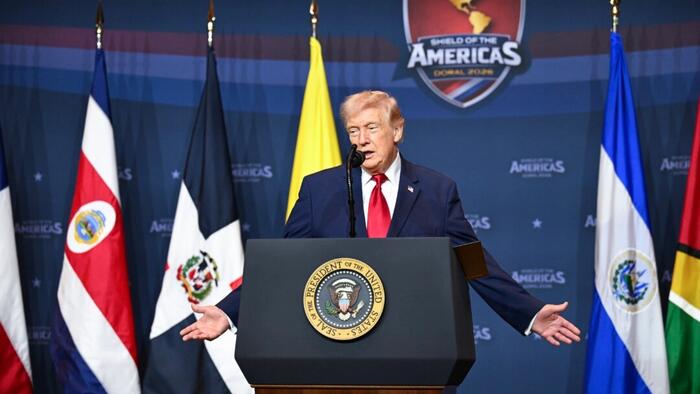
U.S. President Donald Trump on March 7 welcomed his Latin American allies to Florida for a summit focused on addressing regional issues and announced a new military coalition to combat drug cartels in the Western Hemisphere.
“On this historic day, we come together to announce a brand new military coalition to eradicate the criminal cartels plaguing our region,” Trump said as he began his remarks at the summit.
He said that the new partnership, called the Americas Counter Cartel Coalition, will leverage military resources, including the possible use of missiles, to combat the cartels.

The heads of state of Argentina, Bolivia, Chile, Costa Rica, the Dominican Republic, Ecuador, El Salvador, Honduras, Panama, Paraguay, and Trinidad and Tobago attended today’s summit, the White House said.
The event, called the Shield of the Americas Summit, is taking place at Trump National Doral Club in Miami and is the first such regional meeting to bring together, as the State Department described, “like-minded allies” in the Western Hemisphere.
“We’re going to be doing some incredible things together,” Trump told the leaders.
All countries in attendance are governed by right-wing or center-right parties, while left-leaning governments such as Brazil, Colombia, and Mexico did not participate in the summit.
On March 5, Trump announced that outgoing Homeland Security Secretary Kristi Noem will lead the effort as special envoy for the Shield of the Americas.
During his remarks, Trump criticized previous U.S. administrations for abandoning the Western Hemisphere.
“They went so far away. They went to these faraway places where they weren’t even wanted,” Trump said.
The Donroe Doctrine
In its national security strategy released in November 2025, the Trump administration made the Western Hemisphere its top priority, stating that it was a “great American strategic mistake of recent decades” to allow “non-Hemispheric competitors” to take hold in the region.
The Trump administration compared its new policy to the Monroe Doctrine of 1823, a U.S. policy that told European powers to stay out of the Americas.
After that, some media outlets began calling it the “Donroe Doctrine,” and the Trump administration adopted the term.
“It is a doctrine we will not allow hostile foreign influence to gain a foothold in this hemisphere that includes the Panama Canal,” Trump said without citing China during his speech.
Over the last two decades, China has become a dominant force in Latin America and the Caribbean, with trade surpassing $500 billion in 2024. In countries such as Brazil and Peru, China has replaced the United States as a key trading partner.
In recent years, more than 20 Latin American and Caribbean countries have joined Beijing’s Belt and Road initiative. As a result, China has secured hundreds of infrastructure projects, gaining control of assets, including ports, throughout the region.
In January, U.S. forces captured Venezuelan leader Nicolás Maduro in Caracas, effectively ending Venezuela’s relationship with China. Last week, Trump suggested that Cuba might be next.
“Cuba’s at the end of the line,” Trump said at the event, adding that the regime in Havana is negotiating with him and Secretary of State Marco Rubio.
“But, our focus right now is on Iran,” Trump said.
The summit comes amid a tense geopolitical backdrop, with the conflict in Iran entering its second week.
On Feb. 28, Iran’s Islamic leader, Ali Khamenei, and dozens of top leadership figures were killed in the U.S.–Israeli joint military operation. Since then, Tehran has launched a series of retaliatory attacks across the region.
The Hezbollah terrorist group, an Iran proxy, has networks in Latin America and, for years, used the Western Hemisphere for money laundering, fundraising, and terrorism.
US Offers Military Training
During the event, Trump signed a proclamation formally launching the new military coalition.
“Every leader here today is united in the conviction that we cannot and will not tolerate the lawlessness in our hemisphere any longer,” Trump said.
“You have some great police, but they threaten your police, they scare your police,” Trump added, referring to drug cartels.
“You’re going to use your military. In many cases, our forces have already been working closely with yours, and the United States looks forward to deepening and expanding that cooperation in the months ahead.”
U.S. Southern Command announced recently that Ecuadorian and U.S. military forces conducted joint operations against “designated terrorist organizations” in Ecuador as part of the U.S. effort to fight narco-terrorism.
The proclamation states that the United States will train and mobilize the militaries of partner nations to help dismantle cartels.
According to the proclamation, the United States and its allies should prevent external threats, including malign foreign influences from outside the Western Hemisphere.
Seventeen countries are signatories to this partnership.
The leaders attending the Miami summit are Javier Milei, president of Argentina; Rodrigo Paz Pereira, president of Bolivia; Jose Antonio Kast, president-elect of Chile; Rodrigo Chaves Robles, president of Costa Rica; Luis Rodolfo Abinader Corona, president of the Dominican Republic; Daniel Roy Gilchrist Noboa Azín, president of Ecuador; Nayib Bukele, president of El Salvador; Mohamed Irfaan Ali, president of Guyana; Nasry “Tito” Asfura, president of Honduras; José Raúl Mulino Quintero, president of Panama; Santiago Peña, president of Paraguay; and Kamla Persad-Bissessar, prime minister of Trinidad and Tobago.
Loading recommendations…