What made his remark significant, however, was how effortlessly it dismissed the moral stakes of the war. It’s one thing to argue that the benefits to the United States in disarming Iran’s regime exceed the cost of American casualties, a calculus that’s intrinsic to any military conflict. It’s quite another to treat concern about that cost as illegitimate, something only a journalist with an axe to grind against Trump would dwell on, amid the glorious death and destruction being rained on Iran from the sky.
America’s government doesn’t do morality anymore. Certainly not at home, and now no longer abroad.
The ‘Pottery Barn’ rule.
It was Colin Powell, then America’s secretary of state, who warned George W. Bush before the invasion of Iraq that the United States would be responsible for that country’s fate if it decapitated the ruling regime. You break it, you own it, he told the president, borrowing a familiar concept from retail.
That became known as the Pottery Barn rule of foreign policy. If you choose to smash some other nation, you assume an obligation to rebuild it.
There were practical and moral components to the Pottery Barn rule. Practical: Destabilizing a country by demolishing its law enforcement institutions risks all sorts of horrendous outcomes—civil war, a refugee crisis, famine, the collapse of the health system, hyperinflation, economic calamity, etc. A cataclysm of that magnitude will spread beyond the country’s borders in ways that are hard to predict. American interests might suffer.
Moral: The sky’s the limit when trying to guess how much human misery might result. People will die, potentially in great numbers. Starvation, disease, and wanton factional bloodletting are all in the offing when an intact nation dissolves into a failed state. Depending on how bad things get, its neighbors could be destabilized by the economic shocks next door or be sucked into the conflict themselves, multiplying the misery.
So before we do something silly like breaking someone else’s pottery, we had better have a plan to put it back together quickly.
The Pottery Barn rule is obviously derived from America’s Marshall Plan, nation-building’s greatest success, which converted fascist Germany and Japan into durable liberal democracies after World War II. Powell’s formulation was an adaptation for the war on terror: We “bought” and rehabilitated the Axis powers after we broke them, and we could do the same for Afghanistan and Iraq.
Except we couldn’t. Despite our best efforts, Iraq became a hell-on-Earth failed state before emerging as a shaky democracy. Afghanistan never turned the corner and is back under Taliban control. We broke them and we bought them, at a stupendous cost in lives and money, and cataclysm ensued anyway.
Donald Trump’s “America First” ethos in 2016 was essentially a response to the Pottery Barn rule. If “you broke it, you bought it” is an inviolable rule of U.S. foreign policy, then, for the love of God, let’s stop breaking things.
It was a shrewd message for a candidate who was facing a Bush in the presidential primary and a Clinton in the general election. It was also well-timed, coming less than a decade after the 2008 financial crisis reoriented voters’ priorities toward the economy and domestic concerns. The disappointments of Afghanistan and Iraq were certain to cause an electoral reckoning eventually; Ron Paul tried to trigger one as a presidential candidate in two different cycles, but it was Trump, probably for reasons of celebrity and charisma, who succeeded.
By 2024, the Pottery Barn rule was a zombie, alive and dead at the same time. The practical and moral cases for it remained intact, but nation-building had become a sufficiently dirty word in both parties that the rule was no longer necessary. America had quit its habit of breaking pottery, making the consequences of breaking it irrelevant.
The Donald Trump of 2016 treated most norms of American government as a given, and so he accepted the Pottery Barn rule on its own terms: If breaking a country meant buying it, then we wouldn’t break it. But the Donald Trump of 2026 believes that norms of American government exist only insofar as he’s willing to tolerate them, and he’s no longer willing to tolerate the Pottery Barn rule.
“You break it, you bought it”? Says who?
What we’re seeing in the war he just started is an attitude we’d expect from a guy with a history of bankrupting casinos: The United States may have broken Iran, but we’re not going to “buy” it by trying to preserve order there. Why should we? Who’s going to stick us with the bill if we refuse?
Trump will do what he likes and leave someone else holding the bag, the same amoral worldview that’s served him well his whole life. That view is now U.S. policy.
How will Americans react?
Someone else’s forever.
Maybe better than we think.
With voters exasperated by the cost of living and America trillions of dollars deeper in debt than it was in 2003, Trump’s Jacksonian approach to flattening Iran and walking away makes more sense politically than Marshall Plan 3.0. It makes more sense logistically, too: The Pentagon is having trouble intercepting Iran’s Shahed drones and is reportedly burning through its most sophisticated missile defenses in a war of attrition with the Iranian regime to see which side runs out of ammunition first. This conflict won’t go on forever because it can’t.
We’re simply not in a position to buy the pottery we break anymore. Now that Iran’s is broken, Americans will need to get comfortable with the idea of Uncle Sam running away from the “store” as the shopkeeper yells at him to come back and pay his debt.
The White House’s approach to Venezuela might make it easier. In that case, Trump did observe the Pottery Barn rule: He could have destabilized the country by ordering an all-out attack on the Maduro regime, but instead kept much of its leadership in place to maintain order. Iran is different, he might say, because the danger it poses to the United States was so great that he had no choice but to act. In other words, he accepts the principle of “you break it, you bought it” per his handling of Caracas. But if an enemy threatens America’s security, he’s not going to refrain from breaking it just because we can’t afford to buy it.
I suspect many voters will find that logic defensible—appealing, even. If Bush had taken the same approach to Saddam Hussein, how many U.S. soldiers—and Iraqis—would be alive today? Having tried nation-building and failed multiple times, Americans are primed for an experiment in lighting something on fire and seeing what happens when we let it burn.
I am very curious to see how they react if, having now dispensed with the Pottery Barn rule, a moral catastrophe unfolds in Iran. Which it might.
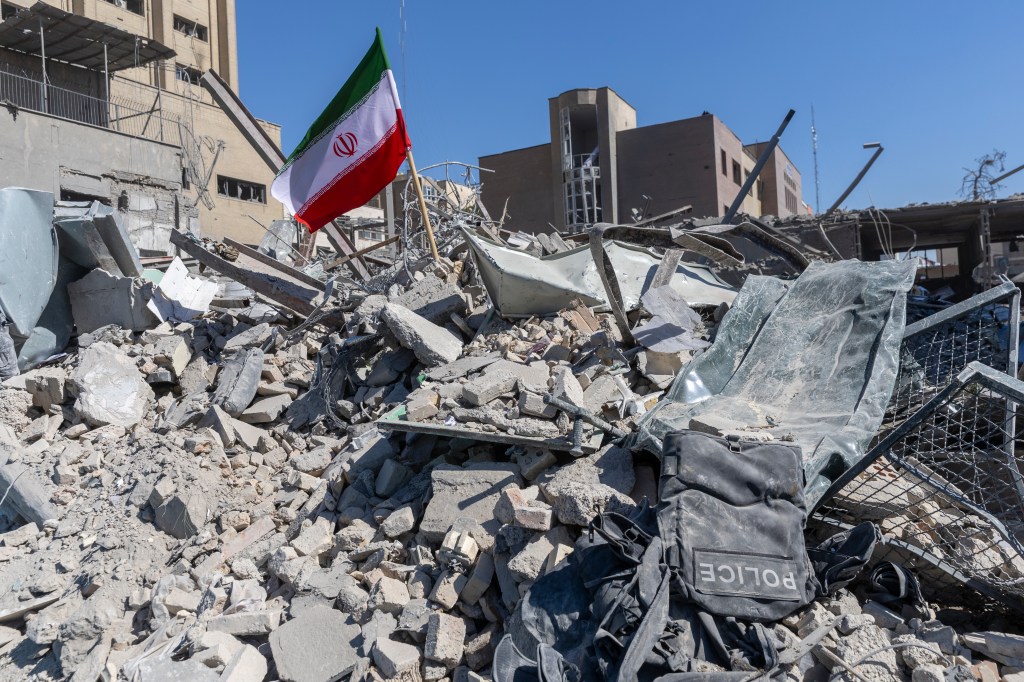
“Tehran an ‘apocalypse’ of hospitals in flames and children buried beneath rubble,” screamed a headline in Britain’s Daily Telegraph this week. The Telegraph isn’t a far-left rag, and its sources for the piece weren’t exclusively Iranian officials with an incentive to propagandize against the war. “They are striking buildings where families live,” one Tehran resident told the paper. “After each explosion, people rush to help—and then another bomb hits the same area.” Hospitals are allegedly overwhelmed, families are rationing food, and the elderly are hunting for medication, all predictable consequences of pottery-breaking.
The administration’s strongest moral justification for the war has also quietly been backburnered. On Saturday, Trump told the Washington Post that freedom for the Iranian people is all he wants, but that wasn’t on the list of war objectives that the White House released on Tuesday. The president did say in an interview today with Axios that the country’s next leader must be “someone that will bring harmony and peace to Iran,” but he also said that “I have to be involved in the appointment, like with Delcy [Rodríguez] in Venezuela.”
Rodríguez hasn’t brought freedom to Venezuela. Trump likes her because she’s a compliant puppet for the United States. It’s plausible that Iran’s new head of state will be some revolutionary regime remnant who’s similarly morally compromised, willing to do Washington’s bidding on matters like oil production and keeping the Strait of Hormuz open for shipping, but otherwise gung-ho to keep Iranians under his boot. The president can live with that. Can Americans?
Or things might go the opposite way, with Iran crumbling into civil war—with encouragement from the U.S. government. The latest cockamamie regime-change idea from the White House is to arm Iranian Kurdish paramilitary groups, some of which are based in Iraq, in hopes that they’ll wage war on Iran’s Revolutionary Guard and clear the way for a wider popular uprising. The New York Times’ sources foresee a new Bay of Pigs, though, warning that those Kurdish groups are no match for Iran’s forces, have received only small arms from the United States, and are unlikely to be greeted as liberators by the country’s Persian majority.
The ploy also has enormous potential to draw other regional powers into the war. Any uprising by local Kurds is destined to enrage Turkey, which is forever worried about armed insurrection from its own Kurdish population. Turkey, a NATO member, could end up aligning with Iran’s government to crush the threat—potentially pitting it against Israel.
Shiite militias based in Iraq might cross the border to defend the regime against a Kurdish offensive or even attack Kurdish forces in their own country to try to squelch the threat there, widening the conflict. “Any attempt to arm Iranian Kurdish groups would need support from the Iraqi Kurds to let the weapons transit and use Iraqi Kurdistan as launching ground,” CNN explained. “[It’s] very dangerous, but what can we do? We cannot stand against America,” an anxious Iraqi Kurdish official told the outlet of the White House’s plan. “We are very frightened.”
Killing, turmoil, and deprivation, quite possibly across multiple countries: The United States will have broken Iran, but we won’t have bought it, as our military assets are likely to be long gone from the region as all of this plays out. A Dispatch colleague summarized the president’s de facto position as “No more forever wars … unless it’s someone else’s forever.”
How much will Americans care if this turns out to be someone else’s, i.e. Iranians’, forever war but not ours?
Post-moral.
I’d usually have some half-clever answer to that question, but in this case I don’t.
My instinct is to say “they won’t care much, if at all,” as that’s been my read on the American people since Election Night 2024. (Even before that, honestly.) Reelecting a figure as sinister as Trump after he proved on January 6 what he was capable of amounted to a quasi-formal renunciation of moral responsibility by the electorate. Going forward, our politics would be post-moral. And there’s no room for the Pottery Barn rule in a politics that’s post-moral.
If I’m wrong about that, then I’ll probably be wrong because of the rule’s practical component, not its moral one. It won’t be Iranians dying by the truckload in a Trump-started war that Americans find too costly; it’ll be the hit they’re about to take on gas prices. They elected the president to fix inflation, yet here he is, bombing his way into a new inflation crisis. They’re fine with him refusing to buy a country after breaking it, but they won’t be fine with him sticking them with a new bill.
Still, I concede the possibility that I’m underestimating the people’s capacity for moral outrage. Trump’s Iran adventure is so far removed from his “America First” isolationist posturing that many voters are bound to feel conned by him; the anger they have about that could plausibly mushroom if his con job leads to atrocities committed against Iranians, for whom virtually everyone feels sympathy. And the right-wing toadies charged with spinning this campaign in the media will do him no favors as they veer from stupid assertions that a massive air attack doesn’t amount to “war” to smug pronouncements that oppressed Iranian women might be better off dead.
The White House itself is posting sizzle reels of the conflict on social media that meld the bombing of Iran with a literal video game. Americans have developed a nearly sociopathic tolerance for callousness in politics, but perhaps not a limitless one.
And so, while it feels strange to say it, Pete Hegseth might actually be the right man for the job. His snide attack on media coverage of U.S. casualties reportedly so shocked the friendly press at yesterday’s briefing that a hush came over the room until one person muttered, “That was one of the most insulting things I have ever heard.” He’s amoral, he’s unqualified, and he practically glows with spiteful pride on both counts: Who better to represent the Trump White House at a moment as fraught as this?