from the doesn’t-anyone-know-how-this-works? dept
The mainstream media just failed a basic civics test so badly that you’d think their brains have been pickled by the kinds of folks who spend all their time on X (oh, wait…). Headlines across major outlets are breathlessly reporting that Donald Trump “blocked states from passing AI laws” with an executive order. Except, that’s not how any of this works, and anyone who stayed awake during middle school social studies should know better.
Look at this:
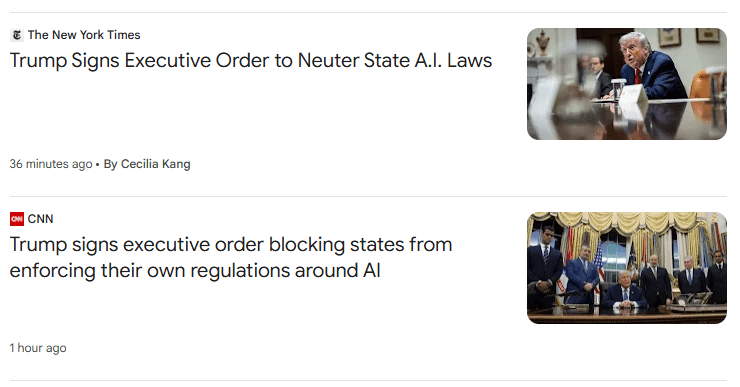
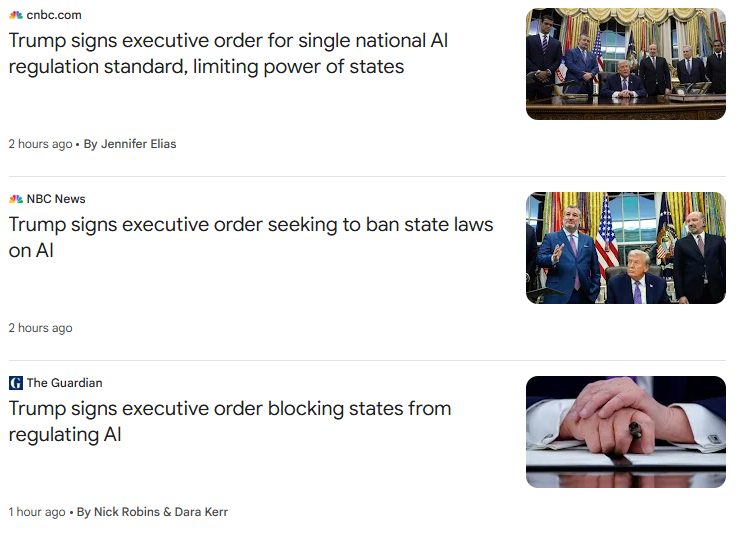
That’s the New York Times, CNN, CNBC, NBC, and the Guardian all confidently telling their readers that Trump can magically override state sovereignty with a memo. These aren’t fringe blogs—these are supposedly serious news organizations with actual editors who apparently skipped the day they taught how the federal government works. They have failed the most simple journalistic test of “don’t print lies in the newspaper.”
Executive orders aren’t laws. They’re memos. Fancy, official memos that tell federal employees how to do their jobs, but memos nonetheless. You want to change what states can and can’t do? You need this little thing called “Congress” to pass this other little thing called “legislation.” Trump can’t just declare state laws invalid any more than he can declare himself emperor of Mars.
Even the text of the actual executive order admits all this:
My Administration must act with the Congress to ensure that there is a minimally burdensome national standard — not 50 discordant State ones. The resulting framework must forbid State laws that conflict with the policy set forth in this order. That framework should also ensure that children are protected, censorship is prevented, copyrights are respected, and communities are safeguarded. A carefully crafted national framework can ensure that the United States wins the AI race, as we must.
Right there in black and white: “must act with the Congress.” Apparently, someone in the White House briefly remembered how government works, even if the president and the entire mainstream media have forgotten.
And look, I actually do mostly agree that we’d be much better off with a single federal solution here, rather than a bunch of piecemeal (and perhaps conflicting) rules from every state. But, that’s why you actually have to work with Congress, and if there’s anything this Congress has shown over the past 11 months, it’s that it is inherently unable to do anything particularly competently.
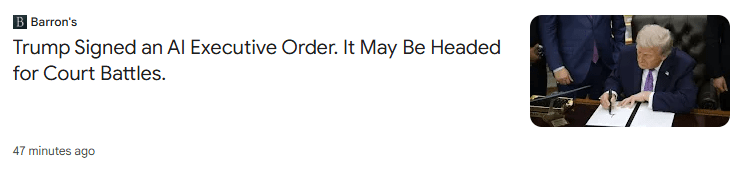
Only a few news orgs managed to call out the problems with this executive order. Barron’s rightly noted that there would be “court battles” over the law:
NPR, however, came out and pointed out that this overall executive order probably isn’t legal:
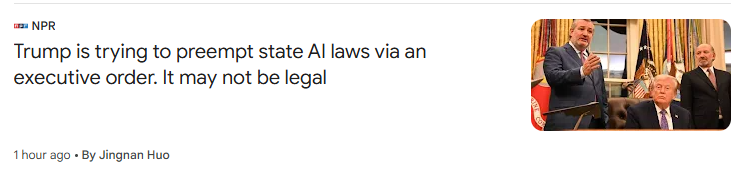
NPR’s right. The order contradicts itself so blatantly it’s almost impressive. First paragraph: “we need Congress.” Rest of the document: “never mind, we’ll just do whatever we want.”
Within 30 days of the date of this order, the Attorney General shall establish an AI Litigation Task Force (Task Force) whose sole responsibility shall be to challenge State AI laws inconsistent with the policy set forth in section 2 of this order, including on grounds that such laws unconstitutionally regulate interstate commerce, are preempted by existing Federal regulations, or are otherwise unlawful in the Attorney General’s judgment, including, if appropriate, those laws identified pursuant to section 4 of this order.
You can’t just say that because a law goes against the intent of this executive order that the DOJ can challenge it. That’s not how that works. At all.
But here’s where this gets kinda funny (in a stupid way): that “interstate commerce” language could backfire spectacularly. Almost all state laws trying to regulate the internet—from child safety laws to age verification to the various attempts at content moderation laws—might run afoul of the dormant commerce clause by attempting to regulate interstate commerce if what the admin here claims is true (it’s not really true, but if the Supreme Court buys it…). Courts had been hesitant to use this nuclear option because it would essentially wipe out the entire patchwork of state internet regulation that’s been building for years, and a few decades of work in other areas that hasn’t really been challenged. Also, because they’ve mostly been able to invalidate those laws using the simple and straightforward First Amendment.
If Trump’s DOJ starts aggressively pursuing dormant commerce clause challenges to keep his Silicon Valley donors happy, they might accidentally create precedent that invalidates every state’s attempts to regulate social media, require age verification, or mandate content filtering. Every red state law targeting “Big Tech censorship,” every blue state law pretending to protect kids online—all of it could get swept away by Trump’s own legal strategy.
Wouldn’t that be something? In some ways, it would be hilarious, since I think almost all of these state laws are awful and a mess and waste everyone’s time… but it would certainly put a dent in a ton of efforts by Republicans and Democrats alike. All to keep the AI bros happy.
There’s also some extortion in here:
Within 90 days of the date of this order, the Secretary of Commerce, through the Assistant Secretary of Commerce for Communications and Information, shall issue a Policy Notice specifying the conditions under which States may be eligible for remaining funding under the Broadband Equity Access and Deployment (BEAD) Program that was saved through my Administration’s “Benefit of the Bargain” reforms, consistent with 47 U.S.C. 1702(e)-(f). That Policy Notice must provide that States with onerous AI laws identified pursuant to section 4 of this order are ineligible for non-deployment funds, to the maximum extent allowed by Federal law. The Policy Notice must also describe how a fragmented State regulatory landscape for AI threatens to undermine BEAD-funded deployments, the growth of AI applications reliant on high-speed networks, and BEAD’s mission of delivering universal, high-speed connectivity.
We’ve talked about BEAD a lot here. That’s the Biden-era program that poured billions of dollars into broadband investment, which took way too long because Trump’s first FCC had fucked up the allocation process of earlier broadband grants. The Biden admin didn’t want a repeat of that, and thus tasked NTIA with figuring out a better allocation system, which took so long that Trump is back in office.
And rather than figure out the best way to allocate those funds, he’s holding them for ransom, and states that comply with his policy wishes might get it, and those that don’t won’t. It’s hellishly corrupt, but that’s what you get these days.
The other potentially interesting tidbit that is going to create a huge mess is Section 7:
Within 90 days of the date of this order, the Chairman of the Federal Trade Commission shall, in consultation with the Special Advisor for AI and Crypto, issue a policy statement on the application of the Federal Trade Commission Act’s prohibition on unfair and deceptive acts or practices under 15 U.S.C. 45 to AI models. That policy statement must explain the circumstances under which State laws that require alterations to the truthful outputs of AI models are preempted by the Federal Trade Commission Act’s prohibition on engaging in deceptive acts or practices affecting commerce.
This seems like an improper use of the FTC’s power to deal with unfair and deceptive practices, but the Trump administration abusing and twisting laws to get what it wants is kind of standard operating procedure these days.
The real story here isn’t that Trump signed some groundbreaking AI policy—it’s that the entire mainstream media apparatus completely failed to understand the most basic principles of American government. Executive orders aren’t magic spells that override federalism. They’re memos.
That said, the potential for this legal strategy to completely backfire is darkly amusing. If Trump’s DOJ successfully argues that state AI laws violate the dormant commerce clause, they’ll have handed every future administration—and every tech company—a nuclear weapon against state internet regulation. Every privacy law, every age verification requirement, every attempt by states to regulate online platforms could get vaporized by precedent that Trump’s own lawyers established.
It wouldn’t surprise me if one of the tech bro folks in and around the administration got that dropped into this executive order without much of the administration realizing it.
Filed Under: ai, bead, donald trump, dormant commerce clause, executive order, ftc, funding, interstate commerce, journalism, moratorium, state laws