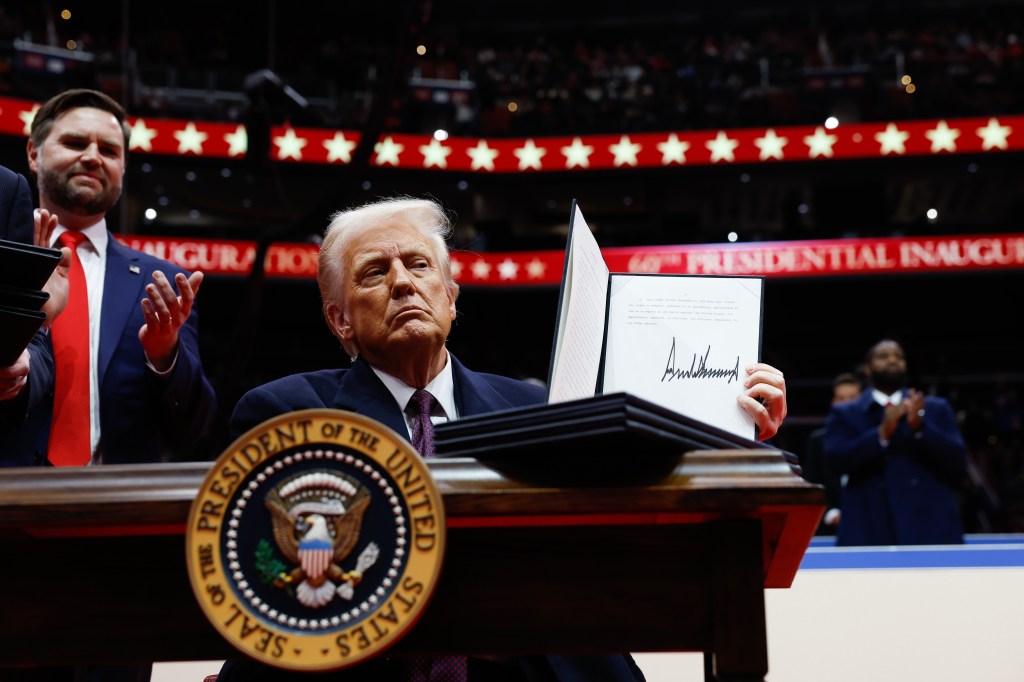
At noon ET today, it will have been one year since President Donald Trump was inaugurated for his second term, during which he promised to Make America Great Again, again. That was his high-level pledge to voters, but at rallies and in interviews, the eventual winner of the 2024 election made hundreds of specific promises about what he would do when he returned to office.
Academic research suggests national leaders generally follow through on their campaign platforms—a 2017 cross-national study found governing parties fulfill a “clear majority” of pledges—but has that been true of Trump during the first year of his second term? To find out, TMD analyzed 142 rallies that Trump spoke at in the run-up to the 2024 general election—along with five press conferences, 13 interviews and podcasts, two debates, and 33 other appearances—and broke down hundreds of distinct campaign promises.
Trump and his administration have done a number of things in office that he did not discuss or emphasize on the campaign trail—striking Iran’s nuclear program, capturing Venezuelan dictator Nicolás Maduro, gutting the U.S. Agency for International Development, dramatically expanding his use of the pardon power—but today’s piece focuses on the promises Trump did make during the 2024 campaign, and whether or not he followed through.
Immigration
Regaining control of America’s southern border and cracking down on illegal immigration more broadly were the most consistent and prominent themes of Trump’s campaign. As he told a crowd in Freeland, Michigan, on May 1, 2024, “On day one of my new administration, I will seal the border, stop the invasion, and send Joe Biden’s illegal aliens back home where they belong.”
More specifically, one of his most frequently made promises was to carry out “the largest deportation operation in American history.” As he clarified in Glendale, Arizona, on August 23, 2024, “larger even than President Dwight D. Eisenhower in the 1950s.” In his first campaign rally for his re-election, in Waco, Texas, on March 25, 2023, Trump promised to “use all necessary state, local, federal, and military resources to carry out the largest domestic deportation operation in American history.”
So, did Trump carry out the largest deportation operation in American history? According to a December 19 Homeland Security Department press release, the agency’s enforcement operations have deported more than 622,000 people since Trump took office in January, in addition to an “estimated 1.9 million self-deportations.” A recent New York Times analysis puts the total number of deportations closer to 540,000, including 230,000 people arrested inside the country by ICE officials and 150,000 people arrested by Customs and Border Protection agents at the border. That’s fewer than the 650,000 total deportations in 2024 and the 590,000 in 2023 under Biden, when border crossings were at record highs.
That said, the Trump administration has dramatically shifted interior enforcement. The Times found that deportations from ICE arrests inside the country during Trump’s first year have already exceeded the total such deportations during Biden’s entire term. The Trump administration also expanded enforcement against illegal immigrants without additional criminal records, with Cato Institute analysis showing that as of late November, 73 percent of ICE detainees had no criminal conviction, and arrests of people without criminal convictions or charges increased more than 1,200 percent year-over-year.
Other specific Trump immigration promises included:
- “immediately ban all sanctuary cities in the United States.” (Madison Square Garden, on October 27, 2024).
- “will deploy the U.S. Navy to impose a fentanyl blockade … boarding and inspecting ships to look for fentanyl.” (Dubuque, Iowa, September 20, 2023)
- “invoke the Alien Enemies Act of 1798 to target and dismantle every migrant criminal network.” (Coachella, California, on October 12, 2024)
- “end catch and release … restore Remain in Mexico. … bring back Title 42.” (Prairie du Chien, Wisconsin, on September 28, 2024)
- “sign on day one, an executive order ending automatic citizenship for the children of illegal aliens.” (Pickens, South Carolina, on July 1, 2023)
- “shut down all entries through Kamala’s migrant phone app.” (Saginaw, Michigan, on October 3, 2024)
- “demand that Congress impose criminal penalties on any future administration that erases America’s borders.” (Columbia, South Carolina, on January 28, 2023)
- “immediately ask Congress for funding to hire 10,000 new border agents.” (Tempe, Arizona, on October 24, 2024)
- “ban all welfare and federal benefits from illegal aliens.” (Tempe, Arizona, on October 24, 2024)
How’s he faring on those promises a year later?
- Trump announced last week that, effective February 1, the government would suspend all federal funds to 11 states hosting sanctuary cities, in addition to Washington, D.C. He has not attempted to “ban” or “prohibit” them as he pledged on the campaign trail.
- The U.S. Navy has not imposed a blockade to bar fentanyl shipments from reaching the U.S., though the military’s dozens of strikes in the Caribbean and Pacific in recent months targeted boats that the administration claimed were smuggling drugs.
- Trump invoked the Alien Enemies Act in March to deport suspected affiliates of the Venezuelan-based gang Tren de Aragua, though a federal appeals panel issued an injunction in September blocking the move.
- Axios reported last February that ICE had released 461 illegal immigrants under “catch and release.” The Trump administration moved to restore the “Remain in Mexico” program but not Title 42 restrictions, which would allow for the immediate expulsion of migrants on public health grounds without permitting them to make asylum claims.
- On day one, Trump signed an executive order redefining constitutional birthright citizenship to exclude individuals born in the U.S. to parents residing in the country unlawfully or on a temporary legal status. Courts have blocked the move, but the Supreme Court picked up the case in early December and is expected to weigh in on the merits this year.
- On Inauguration Day, the Trump administration terminated CBP One’s asylum appointment function, which had allowed nearly a million migrants to legally schedule their arrival at ports of entry. In March, DHS relaunched the app as CBP Home, retaining some original features—such as Form I-94 access and cargo inspection scheduling—while adding a new function allowing illegal immigrants to register for voluntary self-deportation.
- Trump has not urged Congress to pass any legislation penalizing foreign countries for illegal immigration into the U.S. The president did cite such immigration as a reason for placing tariffs on Mexico.
- The One Big Beautiful Bill Act (OBBBA) allocated funding for 3,000 additional customs officers and 3,000 new Border Patrol agents.
- Trump issued an executive order in February stipulating that “no taxpayer-funded benefits go to unqualified aliens,” and, in April, moved to eliminate all legal pathways for illegal immigrants to obtain benefits from Social Security Act programs.
As with his plans for illegal immigration, Trump has at least attempted to fulfill most of his campaign pledges around legal immigration.
On September 20, 2023, Trump told a rally in Dubuque, Iowa, that he would “bring back the travel ban and expand it even further.” In December, his administration placed complete travel bans on 19 countries and partial travel bans on 19 others, and on January 14, the State Department announced it was suspending all approvals of permanent visa applications from 75 countries. The crackdown also extended to legal refugees. Homeland Security Secretary Kristi Noem has moved to end temporary legal status for nationals from 11 countries, although courts have temporarily blocked the administration from immediately revoking legal credentials in some cases.
In Derry, New Hampshire, Trump promised to “implement strong ideological screening of all immigrants,” and in Las Vegas on October 28, 2023, he told the Republican Jewish Coalition that he would “cancel the student visas of Hamas sympathizers on college campuses.” U.S. Citizenship and Immigration Services, in a policy alert issued in August, updated its protocol to allow officers, in cases “where an exercise of discretion is required,” to screen applicants for “any involvement in anti-American or terrorist organizations.” Secretary of State Marco Rubio said in March that the Trump administration revoked 300 student and other temporary visas, telling reporters at the time, “If they’re taking activities that are counter to our foreign, to our national interest, to our foreign policy, we’ll revoke the visa.”
One notable promise remains unfulfilled. Trump told the All-In Podcast—co-hosted by David Sacks, his current White House AI and Crypto Czar—in June 2024 that when “you graduate from a college, I think you should get automatically, as part of your diploma, a green card.” The Trump administration has not created a program to extend green cards or other temporary legal protections for recent college graduates.
Foreign Policy
One of Trump’s other most-repeated campaign promises was to swiftly end the Ukraine war. In 2023, he told crowds in Windham, New Hampshire, that “before I even arrive at the Oval Office, shortly after I win the presidency, I will have the horrible war between Russia and Ukraine settled.” He would repeat this line, verbatim, in Rock Hill (South Carolina), Greensboro (North Carolina), Rome (Georgia), Vandalia (Ohio), Freeland (Michigan), Wildwood (New Jersey), and Green Bay (Wisconsin), among many other places and states.
At some events, Trump changed this deadline to after he entered office. On August 5, 2024, he told livestreamer Adin Ross, “If I win, the first thing I’m going to do is get Putin and Zelensky to make a deal.” He also told a CNN town hall on May 10, 2023, that, upon reentering the White House, he would “have that war settled in one day, 24 hours.”
One year later, however, the war is still ongoing. Though negotiations continue, the Kremlin has refused to engage in any ceasefire proposals, maintaining that Russia will only accept a permanent peace deal if that deal provides Russia with the entirety of Ukraine’s eastern Donbas region, among other stipulations. That’s a nonstarter for Ukrainian President Volodymyr Zelensky, who maintains that his country will not cede territory to Russia. Still, Trump has tried to negotiate a deal and has positioned the U.S. as a leading intermediary in the talks. Trump has invited Zelensky and Putin to the U.S. for separate in-person visits, and a U.S. delegation—led by White House special envoy Steve Witkoff and the president’s son-in-law, Jared Kushner—has met regularly with Ukrainian and European diplomats, as well as Kremlin authorities. Most recently, Witkoff and Kushner spoke with Ukrainian officials in Florida over the weekend, and both sides plan to discuss negotiations again later this week in Davos, Switzerland, ahead of the World Economic Forum. To learn more about the state of the war and negotiations to end it, read the January 9 issue of TMD.
Besides Ukraine, Trump’s foreign policy pledges included:
- “build an iron dome over our country, a state-of-the-art Missile Defense Shield, made in the USA.” (January 22, 2024, in Laconia, New Hampshire)
- “hold the Chinese Communist Party accountable for unleashing the China virus upon the world.” (Manchester, New Hampshire, April 27, 2023)
- “ask for the resignations of every single senior military official who touched the Afghanistan disaster.” (Asheboro, North Carolina, on August 21, 2024)
- “immediately reinstate all sanctions on the murderous Iranian regime” and “shut down Iranian energy.” (Derry, New Hampshire, October 23, 2023)
- “demand that Europe pay much more for the cost of defense.” (Freeland, Michigan, May 1, 2024)
- “begin the largest peacetime recruitment drive in the history of the Armed Forces.” (Asheboro, North Carolina, August 21, 2024)
- Trump has laid out plans for what he has since referred to as the “Golden Dome” and selected the design for the system’s missile defense shield, hoping that it will be operational by January 2029, a target that analysts say is unrealistic. Last week, Trump posted on Truth Social that acquiring Greenland was “vital for the Golden Dome.”
- The Trump administration has not officially cited China’s role in the lead-up to the COVID-19 pandemic as a justification for numerous trade restrictions on China, including tariffs.
- Though Trump has called for firing military officers involved in the 2021 Afghanistan withdrawal and the Pentagon is conducting a formal review, no officers have yet been fired specifically for their role in the pullout.
- The Trump administration has repeatedly issued sanctions on the Iranian regime and its affiliates shipping Iranian oil and other illicit products. Last week, Trump announced in a Truth Social post that he would add a 25 percent tariff rate increase to any country “doing business” with Iran.
- North Atlantic Treaty Organization (NATO) member nations in June agreed to increase defense spending from 2 to 5 percent of that country’s gross domestic product (GDP) by 2035.
- Last month, Defense Department spokesman Sean Parnell said that, in fiscal year 2025, the military recorded the largest share of its annual recruitment target in more than 15 years.
“Woke” Issues & Education
Another one of Trump’s most-repeated promises on the campaign trail was to keep biological males out of women’s sports. Transgender policies and other issues related to “wokeness” were a core theme of the campaign, with Trump promising to:
- “sign a new executive order to cut federal funding for any school pushing critical race theory, transgender insanity.” (Concord, New Hampshire, on January 19, 2024)
- “not give one penny to any school that has a vaccine mandate or a mask mandate.” (Doral, Florida, on July 9, 2024)
- “create massive incentives for states and school districts to adopt crucial reforms to protect parents’ rights.” (Columbia, South Carolina, on January 28, 2023)
- “support universal school choice.” (Philadelphia, Pennsylvania, on June 22, 2024)
- “sign a law to prevent child genital mutilation in all 50 states.” (Rapid City, South Dakota, on September 8, 2023)
- “ban the Department of Veterans Affairs from wasting a single cent to fund transgender surgeries or sex change procedures.” (Windham, New Hampshire, on August 8, 2023)
- “restore the Trump ban on transgender in the military.” (Dubuque, Iowa, September 20, 2023)
Trump issued several gender-focused executive orders on his first day back in office, including one that rescinded dozens of orders issued by the Biden administration. One of those day-one orders redefined federal definitions to recognize only two sexes, mandated that government-issued documents and passports “accurately reflect the holder’s sex,” blocked federal funding of “gender ideology,” and required federal inmates to be held in detention centers matching their sex. Trump also targeted federal diversity, equity, and inclusion (DEI) initiatives that same day, signing an executive order to end what the Trump administration called “illegal and immoral discrimination programs.” That included revising federal policies and training procedures to end “discriminatory” DEI practices, and terminating all DEI and “environmental justice” positions and programs in the federal government. Shortly after, Trump signed two more orders that:
Months later, in late September, the Trump administration froze more than $65 million in federal funding to school districts in Chicago, New York City, and Fairfax, Virginia, for maintaining their DEI and transgender policies—including for school athletics and bathrooms—against the request of federal officials. Last month, the administration proposed new rules to pull Medicaid and Medicare funding for hospitals that provide gender-transition surgeries, hormone treatment, or other puberty-suppressing interventions.
- In January, Trump signed an executive order, titled “Ending Radical Indoctrination in K-12 Schooling,” that blocks the beneficiaries of federal funding from promoting “gender ideology or discriminatory equity ideology.” That same order also directed Attorney General Pam Bondi to coordinate with state attorneys general and local district attorneys to pursue legal action against K-12 teachers and school officials who facilitate a minor student’s social transition.
- Trump signed an executive order in February to pull federal funding from universities and local school districts that require students to receive the COVID-19 immunization. The order does not address mask requirements.
- Trump’s January executive order targeting “radical indoctrination” in public K-12 schools also directed administration officials to create a plan that ensures school policies protect parental rights.
- In a different executive order issued in late January, Trump laid out plans to expand school-choice offerings.
- In a January executive order, Trump barred hospitals and medical institutions that provide surgical or hormone-based gender-transition interventions and research for minors from receiving federal funds.
- In March, the Department of Veterans Affairs announced that, in response to a Trump-issued executive order, it would no longer provide gender-transition hormone therapy for those not previously receiving the treatments.
- Trump revoked a Biden-issued order that permitted transgender individuals to enter the U.S. military, and, in May, the Supreme Court allowed the Defense Department to restrict “individuals with gender dysphoria” from joining military service while legal challenges continue.
Economic Policy
On the campaign trail, Trump pitched a renewed American economy built on tariffs, killing the so-called “Green New Deal,” and dramatically increasing American energy production and manufacturing. He told his supporters in Saginaw, Michigan, on October 3, 2024, that “starting on day one of my new administration, we will end inflation, and we will make America affordable again.”
Year-over-year inflation decreased slightly in the first three months of Trump’s term, according to the consumer price index, and in no month was the annual inflation rate higher than 3 percent, the rate when Trump took office. Inflation remains nowhere near its multi-decade peak immediately following the COVID-19 pandemic, but concerns about prices have not been completely alleviated, with annual inflation above 2.5 percent each month since June.
Trump has reversed course on several climate initiatives, though. On his first day in office, he re-withdrew from the Paris Climate Agreement and ended federal calculations estimating social costs of greenhouse gas emissions. Earlier this month, the Trump administration withdrew from 66 United Nations entities, including the United Nations Framework Convention on Climate Change and the Intergovernmental Panel on Climate Change.
Trump also signed orders to deregulate oil production and fast-track permits for fossil fuel and nuclear power development, and the Interior Department in October opened 1.56 million acres in the tundra of Alaska’s Arctic National Wildlife Refuge for oil and gas drilling. U.S. crude oil production reached an all-time high in October, the last month for which data is currently available, averaging nearly 13.87 million barrels per day—an increase of about 5.5 percent from January.
During the campaign, Trump promised a hardline trade agenda—notably stating in October 2024 that “the most beautiful word in the dictionary is tariff, and it’s my favorite word”—and planned for the trade restrictions to come in the form of a “Trump Reciprocal Trade Act.” Rather than legislation, however, he instead signed an executive order on April 2, a day Trump deemed “Liberation Day,” only to issue a 90-day pause on the duty hikes one week later.
Trump also promised a number of changes to tax policy. He said that, “when I get to office, we are going to not charge taxes on tips” (Las Vegas, Nevada, on June 9, 2024); that there would be “no tax on overtime, and very important for your seniors, no tax on Social Security benefits for our seniors” (Greenville, North Carolina, on October 21, 2024); that he would “support a tax credit for family caregivers who take care of a parent or a loved one” (Madison Square Garden, on October 27, 2024); and that he would “make interest on car loans tax-deductible” (Prescott Valley, Arizona, on October 13, 2024). The One Big Beautiful Bill Act that he signed into law last summer allows workers to deduct tips from their federal income in tax filings, allows non-exempt workers to deduct overtime pay, makes certain seniors eligible for additional tax deductions, expands the Child and Dependent Care Tax Credit, and allows owners of certain cars purchased after 2024 to deduct up to $10,000 of their car-interest loan. More generally, Trump promised to “make the Trump tax cuts permanent” (Waterford Township, Michigan, on February 17, 2024)—and the OBBBA permanently extended tax cuts passed in the 2017 Tax Cuts and Jobs Act.
On a range of other promises:
“will terminate Biden’s atrocious electric car mandates and rapidly restore American energy independence.” (Council Bluffs, Iowa, on July 7, 2023)
The Biden administration never implemented an explicit electric vehicle mandate, though the EPA finalized emissions standards that critics characterized as a de facto mandate. The OBBBA removed tax credits for new electric car purchases and imposed stricter foreign-entity-of-concern requirements on battery manufacturing credits, while also planning to ease regulations on gas-powered vehicle emissions.
“end Joe Biden’s natural gas export ban on behalf of the people of Pennsylvania, who I love.” (Schnecksville, Pennsylvania, April 13, 2024)
In January, Trump lifted a Biden administration pause on liquefied natural gas (LNG) export permit applications, and, one month later, the Energy Department approved its first new LNG export project.
“cut your energy prices in half … in 12 months.” (Traverse City, Michigan, on October 25, 2024)
According to Bureau of Labor Statistics data, the U.S. city average price of gasoline fell 3.4 percent in the 12 months ending December 2025, while the price of electricity rose 6.7 percent and natural gas climbed 10.8 percent over the same period.
“end the Biden assault on ethanol.” (Council Bluffs, Iowa, on July 7, 2023)
While the Biden administration expanded market protections for ethanol, such as issuing temporary summer waivers and allowing sales of higher-ethanol-content gasoline, the Trump administration issued the same emergency waiver in April.
“revoke China’s most favored nation status” and “implement a four-year plan to phase out all Chinese imports of essential goods and gain total independence from China.” (Waco, Texas, on March 25, 2023)
The U.S. has not revoked China’s “most favored nation” trade status, but Trump issued a presidential memorandum in January directing Trade Representative Jamieson Greer to examine whether China is abiding by trade accords. The U.S. currently charges an effective tariff rate of more than 30 percent for most Chinese imports, down from a brief peak of 145 percent in April. Trump has not announced any four-year plan for trade policy with China.
“ban Communist China from buying up American farmland and other critical infrastructure.” (Council Bluffs, Iowa, on July 7, 2023)
In July, the U.S. Department of Agriculture released a national security plan sharing that the agency planned to expand disclosure requirements for foreign owners of U.S. farmland and increase penalties for “late and knowingly false filings.”
“will put 100 or 200 percent tariffs on every car” built in a Chinese-owned Mexican plant. (The Joe Rogan Experience on October 25, 2024)
Trump has not levied new tariffs specifically targeting Mexican-based, Chinese-owned auto facilities.
“create a new Cabinet position for a senior member of my administration, who will be tasked exclusively with doing everything in the federal government’s power to reduce the cost of living.” (Albuquerque, New Mexico, on October 31, 2024)
While Treasury Secretary Scott Bessent said in March that Trump plans to appoint an “affordability czar” and advisory council, no such positions have been established to date.
Crime & Law
On the campaign trail, Trump called for many different classes of criminals to automatically get the death penalty. He told a crowd in Manchester, New Hampshire, on April 27, 2023, that he “will ask Congress to pass legislation ensuring that drug dealers, drug kingpins, and human traffickers receive the death penalty,” then told another crowd in Green Bay, Wisconsin, on April 2, 2024, that he would ask for a bill “ensuring that anyone who murders a police officer will receive immediately the death penalty.“ At many campaign events, he announced, “I’m hereby calling for the death penalty for any migrant that kills an American citizen or law enforcement officer.”
In office, Trump lifted the Biden administration’s 2021 pause on federal executions and directed Attorney General Pam Bondi to seek the death penalty in cases involving the murder of a law enforcement officer or capital crimes committed by an illegal immigrant—but the president’s order applies only to federal charges.
Trump did fulfill one of his most repeated campaign promises: “to take over the horribly run capital in Washington, D.C.” In August, Trump placed the D.C. Metropolitan Police under federal control and deployed thousands of National Guard troops alongside a surge of federal law enforcement officers. City figures show that violent crime decreased 29 percent in 2025 from the year before, with homicides falling 32 percent, robberies dropping 37 percent, and sex abuse down 29 percent—though crime had already been declining before the federal intervention, and researchers dispute how much credit the National Guard deployment deserves. The administration also cleared dozens of homeless encampments and adopted a no-tolerance policy for street homelessness in the nation’s capital—though critics note that cleared homeless people generally relocate to less visible locations rather than entering housing. Still, the White House’s D.C. agenda has largely focused on security rather than his broader promise to “clean it up, renovate it, and rebuild our capital city.” His D.C. rebuilding effort has mostly been isolated to the East Wing of the White House.
Trump also repeatedly promised “to indemnify all police officers and law enforcement officials throughout the United States to protect them from being destroyed by the radical left for taking strong actions on crime.” In office, Trump signed an executive order in April to provide legal assistance and indemnification to law enforcement officers “who unjustly incur expenses and liabilities for actions taken during the performance of their official duties to enforce the law.”
He also told a crowd in Atlanta, Georgia, on August 3, 2024, that not only would his administration “never defund the police,” but it was going to “overfund the police if we have to.” To date, the Trump administration hasn’t boosted federal funding to local police departments, and the Justice Department terminated 373 grants worth about $500 million, primarily to nonprofits, providing funding for projects such as community violence intervention and victim services.
Trump also promised to “direct the DOJ to investigate every radical district attorney and attorney general in America.” In October, a federal grand jury indicted New York Attorney General Letitia James—who filed a civil lawsuit against Trump in 2022—on charges of bank fraud and making false statements to a financial institution. But a federal district judge dismissed the indictment in November, ruling that acting U.S. Attorney for the Eastern District of Virginia Lindsey Halligan, whose office filed charges against James, was improperly appointed.
In August, Trump partially followed through on his promise in State College, Pennsylvania, on October 26, 2024, to “put in legislation immediately upon getting to Washington that makes it an absolute penalty to burn our American flag [of] one year in prison.” He didn’t sign any law on the matter, but he issued an executive order directing Bondi to prosecute individuals who desecrate the American flag and, in doing so, break “applicable, content-neutral laws, while causing harm unrelated to expression, consistent with the First Amendment.” To learn more about the order and its potential legal implications, read Kelsey Dallas’ SCOTUSblog explainer.
Another promise that was partially completed was to pardon January 6 offenders on a “case-by-case [basis],” with a particular focus on those who weren’t violent, as Trump told Time magazine on November 25, 2024. Though he did follow through on this, his eventual pardon was much more sweeping, applying to more than 1,500 January 6 offenders, including individuals charged with and convicted of violent acts.
On unfulfilled pledges, Trump has not made any moves to “establish a federal task force to use every authority that we have at our disposal to end squatting in America” (Green Bay, Wisconsin, on April 2, 2024), nor “appoint a real special prosecutor to investigate every detail of the Biden crime family of corruption” (Pickens, South Carolina, on July 1, 2023).
Other Promises
Trump delivered nearly 1,000 hours of campaign speeches, media appearances, and interviews in the run-up to the 2024 election, and the above focuses primarily on the issues that he brought up most frequently. At points during the campaign, he also promised:
- “if I’m elected this November, for the first time ever, your government will pay for or require insurance companies to pay for all costs associated with IVF fertility treatment.” (Johnstown, Pennsylvania, on August 30, 2024)
- “will support baby bonuses for the new baby boom that will be coming.” (Waco, Texas, on March 25, 2023)
- “land an American astronaut on Mars.” (Latrobe, PA, on October 19, 2024)
- “ask Congress to put a bill on my desk delivering national concealed carry reciprocity.” (Manchester, New Hampshire, on April 27, 2023)
- “will support a constitutional amendment to put term limits on members of Congress.” (Waco Texas, on March 25, 2023)
- “will hold a competition to build new freedom cities throughout our country, giving countless Americans a new shot at home ownership.” (Waco, Texas, on March 25, 2023)
- “will build a full-service VA hospital in New Hampshire right now for your veterans.” (Concord, New Hampshire, on January 19, 2024)
- “will once again make stopping veteran suicide a top priority of my administration.” (Windham, New Hampshire, on August 8, 2023)
- “abolish every Biden COVID mandate and rehire every patriot who was fired from our military with an apology and with back pay.” (Windham, New Hampshire, on August 8, 2023)
- That he would release the Epstein list and UFO files (Lex Fridman podcast, on September 3, 2024)
- Release the JFK files (The All-In Podcast, on June 20, 2024)
- In October, the Trump administration announced that the pharmaceutical company EMD Serono would invest in IVF drug manufacturing operations in the U.S. In February, Trump directed his administration to prepare policy recommendations to expand in-vitro fertilization (IVF) accessibility and lower IVF treatment costs.
- Trump told reporters in April that a one-time, $5,000 payment for new mothers “sounds like a good idea to me,” though no such initiative has advanced to date. The closest has been the announcement of his “Trump Accounts,” which would give parents who opt in a $1,000 government-funded investment account for their newborn—a long-term savings vehicle rather than immediate cash support.
- NASA is continuing with its pre-existing plans to send a crewed mission to Mars by the early 2030s as part of its Artemis exploration program.
- Trump has not lobbied congressional members to approve federal concealed carry reciprocity, and while Republican Rep. Richard Hudson of North Carolina introduced the proposal in Congress, the bill has yet to reach a vote on the House floor.
- Trump has not pushed lawmakers to pass a constitutional amendment to implement term limits for congressional seats.
- While investors have reportedly met with U.S. officials to discuss establishing deregulated “freedom cities,” including potentially on federally leased public lands or Greenland, the Trump administration has not moved forward with any such plans.
- In May, Trump issued an executive order to conduct a feasibility study and action plan for expanding a Veterans Affairs medical center in Manchester, New Hampshire ,to a “full-service” hospital.
- Speaking before a Senate committee in May, Veterans Affairs Secretary Doug Collins said that the agency’s $588 million annually spent toward veteran suicide prevention research had not considerably reduced suicide rates and called for more efficient procedures. In an interview in late March, when asked about the $588 million in suicide prevention research funding, Collins emphasized, “We’ll spend whatever it takes to save a life, but we’re also got to do it in a way that actually shows a return on investment.”
- In January, Trump ordered the military to reinstate service members who had been discharged or voluntarily left for failing to comply with COVID-19 vaccine requirements. Trump issued a pardon for former Army Lt. Mark Bashaw, who was court-martialed for refusing to abide by the military’s COVID-19 protocols. In August, the Trump administration wiped personal COVID-19 immunization and exemption-request records for all federal employees.
- After initially opposing the public release of the “Epstein Files,” Trump signed a bipartisan legislative measure directing the Justice Department to release unclassified, Epstein-case-related files. The agency began sharing heavily redacted records last month.
- Trump in January ordered that case files related to the assassinations of former President John F. Kennedy, his brother and former Sen. Robert F. Kennedy, and Martin Luther King Jr. be made public. In March, the National Archives released the last round of previously withheld information related to JFK’s assassination.