President Trump’s reposturing of the U.S. military forces toward the Western Hemisphere – effectively Monroe Doctrine 2.0 – reinforced this week by the deployment of additional special-operations aircraft, troops, and equipment into the Caribbean, as U.S. forces apply gunboat diplomacy against Venezuela to disrupt crude oil flows routed through Cuba and onward to China, a campaign that, if successful, could spark regime instability in Caracas, and amplify economic and political stress in Cuba as well.
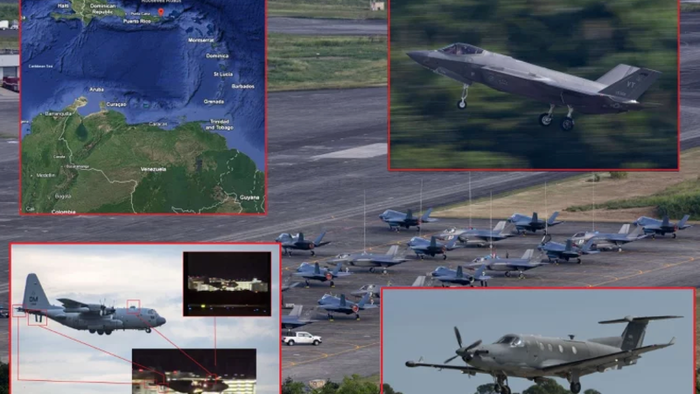
The Wall Street Journal reported Tuesday that a “large number of special-operations aircraft, troops, and equipment” arrived in the Caribbean region early this week – a movement of military assets and personnel confirmed by U.S. officials and flight-tracking data.
According to the WSJ:
At least 10 CV-22 Osprey tilt-rotor aircraft, which are used by special-operations forces, flew into the region Monday night from Cannon Air Force Base in New Mexico, according to an official. C-17 cargo aircraft from Fort Stewart and Fort Campbell Army bases arrived Monday in Puerto Rico, according to flight-tracking data. A different U.S. official confirmed that military personnel and equipment were transported on planes.
It isn’t clear what types of troops and equipment the aircraft were transporting. Cannon is home to the 27th Special Operations Wing, while the 160th Special Operations Aviation Regiment, an elite U.S. special operations unit, and the 101st Airborne Division are based at Fort Campbell. The first battalion of the 75th Ranger Regiment is based at Hunter Army Airfield, at Fort Stewart.
The 27th Special Operations Wing and 160th Special Operations Aviation Regiment are trained to support high-risk infiltration and extraction missions and provide close air and combat support. Army Rangers are trained to seize airfields and provide security for specialized forces, such as SEAL Team Six or Delta Force, during a precise kill or capture mission.
In a separate report, defense and security media outlet Army Recognition, citing open-source intelligence accounts on X, indicated that the U.S. military is ramping up deployments of F-35A stealth fighter jets, intelligence aircraft, and electronic warfare platforms across the Caribbean.

David Deptula, a retired Air Force lieutenant general and dean of the Mitchell Institute for Aerospace Studies, an aerospace think tank, told WSJ that the “prepositioning forces” in the region are “to take action.” He said the movement of such assets indicates that the administration has already decided on a course of action.
“The question that remains is to accomplish what?” Deptula said.
Trump’s gunboat diplomacy – seizing two sanctioned tankers and targeting a third earlier this week – should be viewed as a pressure campaign to disrupt Venezuela-Cuba-China oil flows. It’s always about following the money, and in this case, that oil money props up the Maduro regime.
Jorge Piñón, a Cuban exile who tracks the island’s energy ties to Venezuela at the University of Texas at Austin, told WSJ earlier this week that once crude oil flows are cut, this would act as a domino effect and create regime instability in Caracas, warning that “it would be the collapse of the Cuban economy, no question about it.”
According to analytics firm Kpler, Caracas has shipped nearly 900,000 barrels per day this year and relies on 400 dark-fleet tankers to transport the crude, much of which is bound for China.

“Venezuela has been remarkably effective at masking both origin and ownership of crude and therefore at evading financial and trade-related controls,” Kpler analyst Dimitris Ampatzidis told Bloomberg. “That’s why Washington has increasingly moved from purely financial measures to physical disruption.”
The military buildup across the region and the use of gunboat diplomacy are clear signals of the U.S. intent to force regime change in Venezuela by disrupting Maduro’s funding lifelines; China responded earlier this week, and Beijing is not pleased about crude oil disruptions.
Loading recommendations…