The Argument‘s poll found that only 37 percent of respondents believed the Department of Homeland Security (DHS) to be a very or somewhat trustworthy source of information—the same level of trust respondents said they placed in Trump—whereas 70 percent of respondents found the video recordings very or somewhat trustworthy.
Lakshya Jain, The Argument’s chief pollster, told TMD that the shootings being “caught on video is the biggest thing. You can see the video, so you can make your mind up.” He added, “If they weren’t caught on video, it would be a different story.” Of his poll’s respondents, 82 percent said they watched footage of the shooting incidents, with 64 percent having viewed both.
Brian Rosenwald, a political historian at the University of Pennsylvania, told TMD that voters “don’t want to see people being accosted by masked government officials who are threatening them, or violence against people, or people being ripped out of cars, cars just abandoned on the streets. They don’t want that, they didn’t vote for that, they don’t support that.” He added, “There’s only so much [the administration] can do to message around that when people are seeing images that they don’t like.”
After Pretti’s shooting on January 24, the fallout was swift: the White House dropped the terrorist narrative about the VA nurse, reassigned leadership of the Minneapolis operation, and locked its former leader, Gregory Bovino, out of his social media accounts. The federal government partially shut down over the weekend as Congress attempts to negotiate DHS funding and reforms that could include barring roving patrols and face coverings, while mandating uniform and body cameras. On Friday, the Senate passed a modified five-bill package to keep all non-DHS agencies funded through the end of September, attached to a two-week extension for DHS funding, which is now being discussed in the House.
“The fact that we have a partial government shutdown, and you are seeing this polling, makes [a prospective deal on DHS] a lot more likely,” Lindsey Warburton, the Niskanen Center’s government affairs manager for immigration, told TMD. Yesterday, Homeland Security Secretary Kristi Noem announced that “effective immediately, we are deploying body cameras to every officer in the field in Minneapolis.”
Daniel Di Martino, a fellow at the Manhattan Institute, told TMD that Republicans are often open to body camera requirements—noting that with police, “it actually showed that the police were doing the right thing.” He added that there is some “willingness” among Republicans to demask agents, but that GOP lawmakers would likely resist restricting immigration enforcement’s patrolling authority. “How else are they going to do the deportations of people they’re targeting?” Di Martino said.
White House border czar Tom Homan, now leading immigration enforcement operations in Minneapolis, has signaled he is prepared to scale back the federal presence there if state officials cooperate — specifically by granting immigration agents more access to local jails to pick up illegal immigrants at the end of their sentences. Simon Hankinson, a senior research fellow at the Heritage Foundation, explained that such cooperation would allow arrests “safely behind the prison walls of the courthouse, and then [ICE agents] don’t have to go chase them down in a dangerous neighborhood, where they’re surrounded by maybe neighbors … or activists.”
Alex Nowrasteh, senior vice president of policy at the Cato Institute, told TMD that, if federal immigration enforcement officials want to regain trust, “The one thing they should do is focus on picking up criminals, convicted illegal immigrant criminals who are being released from prisons and jails.” He argued, “They do that, they can start over. There is some hope for them to build back. But they’re not going to do that.”
Evan Roth Smith, a pollster and founding partner of Slingshot Strategies consulting group, argued that Republicans have a “blind spot” on immigration enforcement as distinct from border security—and that declining approval in polls is being driven primarily by the enforcement component, a situation Smith expects will carry into the midterm cycle. “I think it’s going to be awfully hard for Republicans—a rank-and-file Republican running for a competitive state legislative seat or congressional seat—to try and distance themselves from the party’s national position on immigration,” he told TMD. “Some of these Republicans are gonna want to get off this train, and probably sooner rather than later.”
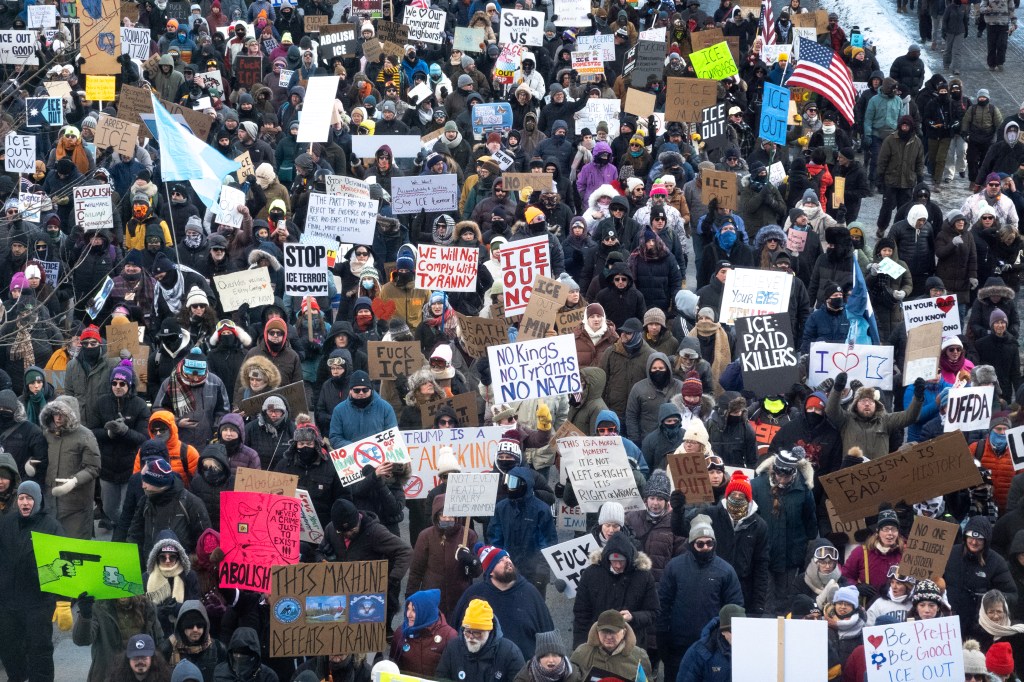
The shift in public opinion has also emboldened Democrats, who had pulled back from criticizing immigration enforcement, to resume their attacks—and to revive previously fringe points. The Argument’s poll found that 48 percent of respondents strongly or somewhat support abolishing ICE entirely, compared with 45 percent strongly or somewhat opposed to eliminating the agency.
In a survey of more than 300,000 registered voters last updated on January 28, polling and data analytics firm Civiqs found 44 percent approval for abolishing ICE, with 48 percent opposed. That’s more than double the support the issue received in Civiqs’ September 2024 poll, which found only 20 percent support for abolishing ICE. Before Trump’s second term, Civiqs found support for abolishing ICE peaked in July and August 2020 at 36 percent.
Sarah Pierce, the director of social policy at Third Way, where she leads the advocacy think tank’s work on immigration, told TMD, “I absolutely think it would be a mistake for [Democrats] to pick up that message.” She noted, “This is the same electorate that voted Donald Trump in on the message of mass deportations. People clearly want our immigration laws enforced, and luckily, I think most Democrats recognize that, and are staying as far away as they can from the abolish ICE rhetoric, even though it’s very understandably tempting, because this is a really tragic moment, and it calls for very strong rhetoric.”
Andy Schoenholtz—a Georgetown Law professor and former deputy director of the U.S. Commission on Immigration Reform—told TMD that when Trump was elected, “the concerns were definitely about what was happening at the southern border.” But he added, “This isn’t that. This is attacking U.S. citizens, attacking legal immigrants, being cruel to all sorts of people.”
The question now is whether the shift in voters’ sentiments is temporary or structural. As Jain noted, “Something fundamental has changed about the approach to immigration in the eyes of the public. Even after people solidify into their partisan camps, you’re not going back to the days where ‘abolish ICE’ is at negative 40.”