Life, Liberty, Property #127: Is There No Escaping the Entitlement Trap?
Forward this issue to your friends and urge them to subscribe.
Read all Life, Liberty, Property articles here, and full issues here and here.
IN THIS ISSUE:
- Is There No Escaping the Entitlement Trap?
- Video of the Week: EPA Exits Climate Alarm Business – The Climate Realism Show #185
- The One Defensible Goal of Economic Policy
IT’S BACK! SAVE THE DATE. SPRING 2026.

Is There No Escaping the Entitlement Trap?
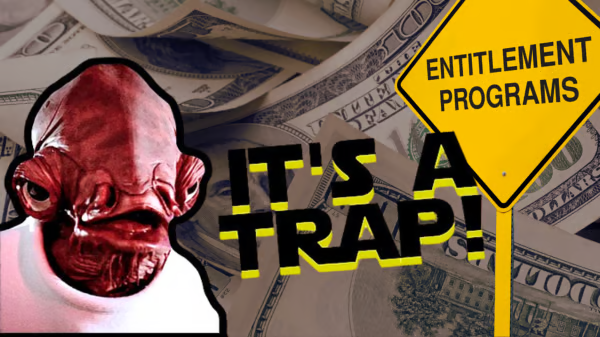
Short of a total fiscal collapse of the government, that is?
The failure of both the Democrat and Republican plans for extending or partially replacing the enhanced Obamacare subsidies last Thursday shows just how rare and difficult it is for politicians and taxpayers to escape the entitlement trap.
Government spending on individual welfare invariably creates a self-perpetuating system that must continually grow. Once such a program is set in place, politicians cannot ask that it be made logical or sustainable. They can only increase it.
The political disputes about such programs are always about how much to increase spending, not whether to do so, and how to arrange the taxes and spending.
That is what is happening with the enhanced Obamacare subsidies. The inability to agree on a subsidy extension “leave[s] no clear path in Congress for aiding millions of Americans facing soaring Affordable Care Act insurance costs next year,” The Wall Street Journal reported on Thursday:
The Democratic proposal would have extended the enhanced Covid-era ACA subsidies for three years. The bill was backed by 51 senators—including Republican Sens. Lisa Murkowski and Dan Sullivan of Alaska, Susan Collins of Maine and Josh Hawley of Missouri—with 48 opposed, short of the 60 votes needed to advance under the Senate’s filibuster rule.
Republicans, who control the chamber 53-47, put forward an alternative healthcare bill that wouldn’t extend the subsidies, but instead offers federal funds to some households to put toward out-of-pocket healthcare costs. The Republican proposal also failed with 51 in favor and 48 opposed. GOP Sen. Rand Paul of Kentucky sided with Democrats in voting against the measure. Sen. Steve Daines (R., Mont.) was absent for both votes.
This story in the supposedly pro-market Wall Street Journal utterly ignores the question of whether “aiding millions of Americans” by afflicting millions of other Americans with the responsibility to pay for their health care is a justifiable use of government coercion. That is how it always works. Once established, an entitlement can only increase.
Both the rejected plans were offering much more taxpayer money than Obamacare recipients’ insurance companies are scheduled to get next year. As a result of the Senate votes, “hope is fading for any deal to extend the subsidies before the end of the year, if at all,” the Journal reported. I would not have characterized an extension of the subsidies as something to be hoped for, though the story is correct to indicate that an extension is increasingly unlikely. The Journal summarizes the differences as follows:
About 24 million people are enrolled in ACA plans, and most of them receive subsidies. The enhanced ACA subsidies were enacted in 2021 during the Covid pandemic and have attracted millions of consumers to ACA plans, many of them in states President Trump won in 2024, but are set to expire at the end of this year. Unless Congress acts, some middle- and upper-income people will lose the benefit entirely. Other households will still receive an ACA subsidy, but the size will revert to prepandemic levels, increasing their healthcare costs.
Trump has said he doesn’t want to continue the subsidies and has said he likes the idea of instead giving Americans money in tax-advantaged health savings accounts—a central piece of the legislation proposed by Sens. Bill Cassidy (R., La.) and Mike Crapo (R., Idaho) that failed Thursday. The Cassidy-Crapo bill would put up to $1,500 a year into accounts for ACA enrollees earning less than 700% of the federal poverty level and enrolled in lower-priced “copper” or “bronze” insurance plans in 2026 and 2027. The funds could be used to cover out-of-pocket expenses, but not to pay for premiums or for abortion or gender-transition services.
Their proposal also would allocate federal funds to finance discounts that the ACA promises to many low- and middle-income consumers on their out-of-pocket charges. Currently, the expense of funding the cost-sharing reductions is wrapped into premiums, pushing them upward.
The Democrats want Republicans to extend an expansion they never voted for of a program they never voted for. The Republicans want to ease very slightly the damage that program is doing. Those two goals are mutually exclusive.
That is how these entitlement traps are supposed to work.
Proponents of big government have had a winning strategy for decades. They propose a law that will transfer money, resources, and freedom from one group of taxpayers to another, which is called an entitlement, and when the costs become prohibitive and the economic distortions are obvious and causing widespread pain, the big-government politicians dare the opposing party to reduce the benefit to the left’s firmly established client group.
Those who claim to be for smaller government then back away in horror or offer weak reforms that nibble at the edges of the gigantic burden the big-government purveyors have laid on the nation’s productive people.
That is why we have been stuck for decades with phenomena such as the socialist ratchet, the Uniparty, RINOs, tax collectors for the welfare state, and all the economic and social destruction for which the onward march of ever-bigger and evermore-interfering government is responsible.
It is a taxpayer-money entitlement trap that puts the entire nation in an economic vise as imprisoning as the poverty trap that keeps welfare recipients on those programs in perpetuity. The system makes it more profitable in the near term to stay on the dole instead of moving into the workforce and adding to the nation’s economic output. It also makes it all but impossible for politicians to roll back these programs, much less to eliminate them.
The Affordable Care Act (ACA), or Obamacare, has been one of the most powerful of these taxpayer-money entitlement traps. The original bill established a system in which people who could not find affordable health insurance could get cheaper coverage through a government system in which everyone would be forced to participate, thus spreading the (enormous) cost around.
That was designed to create a gigantic political constituency of beneficiaries of the system, who would vote for politicians who press for ever-higher government spending (i.e. Democrats). The fact that not a single Republican voted for the ACA shows that they realized it was going to create a trap for them, in addition to being an extremely expensive, intrusive, and ineffective mess.
The Democrats passed it anyway. And it worked exactly as intended, building on more than a century of government obeisance to doctors and the health care industry, as media producer Connor O’Keeffe writes at Mises Wire:
So, zooming out, industry leaders and interest groups joined forces with government officials to use government interventions to create a healthcare system designed to move as much money as possible to healthcare providers, pharmaceutical companies, and the insurance industry. That is, and has always been, the main motivation behind the federal government’s healthcare policy.
But, as with any scheme like this, the party cannot last forever. It only works as long as money keeps coming in. For an important service like healthcare, which most people don’t consider optional, the threshold is pretty high. But there is still a point where premiums grow too high, fewer employers or individual buyers are willing to buy insurance, and the flow of money into the healthcare system starts to falter.
According to the government’s own census data, that tipping point was reached in the early 2000s. For the first time since the scam had really kicked off, the number of people with health insurance began to fall each year. The industry—which had apparently assumed the flow of money would never stop increasing—began to panic. Something had to be done.
And that something was Obamacare.
Pushing more money to the health care industry, specifically for the insurance companies, was the sole goal of Obamacare, O’Keeffe argues:
Despite all the talk of affordability and access used to sell the bill to the public, the Affordable Care Act is best understood as a ploy by the healthcare industry and the government to keep the party going.
Obamacare required all 50 million uninsured Americans to obtain insurance and greatly expanded what these “insurance” companies covered. Demand for healthcare shot back up, and the vicious cycle started back up again.
As any competent economist was saying before the bill was even passed, ramping demand back up would not make healthcare more “affordable,” it would only raise prices. And that’s exactly what happened.
Of course, as prices rose higher and health “insurance” moved further and further away from actual insurance, it’s made the American people even more dependent on the government for healthcare, which is how we’ve arrived at our current situation where extra, “temporary” subsidies rolled out during an official national emergency need to be made permanent to keep everything going.
That is how the advocates of big government set these traps: get people addicted to the government handout, and use activists, nonprofit organizations, and the media to push for more people to be included and more spent on each enrollee.
Where the design of the ACA went badly wrong was in including everybody from the start. Drunk on the political power generated over multiple decades by the government’s provision of “free” health care to the indigent and the elderly, the Democrats thought that subsidized health care for people in the individual insurance market would be just as popular.
The very opposite happened, as Obamacare pushed up health care prices for everyone. Nobody is satisfied, and everyone is complaining about rapidly rising health care costs as another affordability crisis.
Republicans are now floating multiple proposals in a desperate effort to avoid political pain in next year’s elections. “In the House, Speaker Mike Johnson (R., La.) said Republicans plan to put on the floor next week a package of healthcare proposals that doesn’t include extending subsidies.,” the Wall Street Journal article reports. However, the story continues, “Many lawmakers see an ACA-subsidy extension as the only way to prevent widespread pain ahead of the 2026 midterms and get a GOP-led Congress in position to make more sweeping changes.”
That’s the trap. No amount of taxpayer money is ever enough, and any limit on how much to spend is arbitrary and cruel. The effect on the taxpayers, the federal debt, the economy, and the national morale is inconsequential when compared with the plight of an individual Obamacare enrollee whose premiums will increase next year.
It will be a highly unusual outcome if the debate over the Obamacare subsidies does not result in higher government spending down the road. The government must grow or die, because political power requires ever-higher payments to voters. Cutting the payments means cutting votes.
Ever-higher taxes and crony-empowering regulations are the price we pay for living in a representative democracy. The politics of a democratic republic with wide suffrage always move toward greater concentration of power in the government and the destructive corruption of all competing institutions, such as private business enterprises, the family, the church, the press, and academia. Any shortage of willing clients of the government is made up through the importation of new ones.
We have seen this process accelerate during the present century, as the price of each vote moves higher and higher. Progressives do whatever they want to do when they have the power. Conservatives, when in power, quibble with one another over processes and punctilious interpretations of legalities, resolute only in failing to reverse what the leftists have done while they were in power.
Conservatives never learn. On Thursday, the U.S. House of Representatives passed a bill to invalidate President Trump’s March 2025 executive order blocking collective bargaining for more than a million federal employees. Twenty Republicans voted with all the Democrats to pass the bill.
Think of how awful it is that the federal government has more than a million employees. Now consider how absurd it is that the Republicans could not get together to eliminate the political power of those workers’ unions.
Federal government employees make far more money than the nation’s private-sector workers. Decertifying their unions would not exactly force those government henchmen and -women into homeless shelters.
The bill may not pass through the Senate, and Trump would surely veto it should it reach its desk. Even though this vote was therefore largely symbolic, it is symbolic of Republican cowardice that generally manifests as outright perfidy.
The Republican yes votes were largely from representatives of swing districts with heavy labor-union presence. That is further evidence of the problem: the left stays unified against its chosen enemies, while the right retreats in terror. The right’s fear is the potential loss of power that they never use for sweeping reforms. It is shameful cowardice.
Conservatives cannot even yell “Stop!” to government employee unions, a political atrocity that even the hard-left President Franklin D. Roosevelt opposed. This is William F. Buckley conservatism at its most emblematic.
Witness also the Indiana Republicans’ pathetic failure to redraw their congressional map last week in full knowledge that their decision may very well hand over control of the U.S. House of Representatives next year, with impeachments of President Trump to follow immediately. Like all good conservatives, they held themselves hostage to unwritten rules while the opposition laughs at their ineptitude.
I would laugh too, but I do not find the imminent collapse of my country to be particularly amusing.
Conservatives consistently refuse to use their legitimate power to reverse the metastasis of government. Instead, they content themselves with figuring out how to preserve the deteriorating statist system over which they have taken temporary, limited authority. This is what comes of standing athwart history and yelling, “Stop!” as Buckley recommended. The train runs right over you, the engineer laughs, and the passengers do not even look out the windows as they rush toward the cliff from which the bridge has fallen.
Donald Trump broke that habit on the American right, restoring a vigor not seen since the early years of the twentieth century. He was a longtime Democrat, so he understands how to do politics: just win, baby, and then do what you want and, especially, what you promised to do.
The Trump approach involves saving the current political system by implementing reforms limiting the growth of entitlement spending (other than Social Security) while expanding the liberty for the private sector to increase economic growth and make government spending a smaller part of gross domestic product.
This plan may or might not work. It is, however, the only way to keep the current system going. Without it, the U.S. government will collapse, unable to pay its bills or borrow money for that purpose at a decent interest rate, less than 10 years from now (and possibly much less than that). The resulting inflation of the U.S. dollar will take down the entire system.
That is exactly where the United States was headed after just two years of a Democrat-controlled Congress and President Joe Biden’s autopen in 2021 and 2022. Inflation was dangerously high, and interest rates were heading up rapidly. The voters stopped that by electing Republican majorities to Congress in November 2022 and then an (un-stealable) return of Trump to the White House.
Trump failed to turn back the spending tide and reform the federal government (“drain the swamp”) in his first term, for a variety of reasons, a prominent one of which was the congressional Republicans’ failure to legislate when they had the chance. In his second term, Trump has pushed forward with countless initiatives established through executive orders. While Trump has been indefatigable in pressing his agenda, however, the GOP-majority Congress has been dilatory and fainthearted about establishing these policies in law.
The sad (though ultimately positive) fact is that the United States will eventually escape the entitlement trap. It will arrive either through the Trump approach of slower government growth and faster private-sector expansion, or through a collapse of the government caused entirely by massive overspending attributable to the entitlement trap.
With their conservative approach to governance, Republicans remain an impediment to the necessary reforms.
Sources: The Wall Street Journal; Mises Wire; Government Executive; Daily Caller

Video of the Week
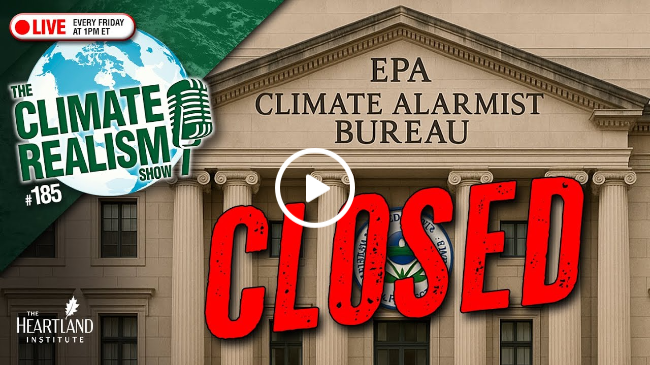
The signs are all around us. The climate cult is losing its grip on our politics and culture. The UN’s climate conference, COP30 in Brazil, was a flop that even the alarmist cheerleaders in the legacy media could not ignore. A major paper justifying radical climate action was just retracted. The Sierra Club is shedding a shocking number of members. And when was the last time you saw climate alarmist propaganda shoved annoyingly into your favorite TV show or movie – which was very common not so long ago?
The One Defensible Goal of Economic Policy

The key goal in economic policy today must be to remove government-imposed distortions, as I have noted before in this newsletter. That has been the case since the onset of the Progressive Era more than a hundred years ago.
The Progressives brought about the managerial revolution, in which the U.S. government initiated the deployment of experts to determine how the American people would conduct themselves in all aspects of life. This applied not just to the government itself but to all the nation’s institutions, through government spending, mandates, regulations, manipulation, and other forms of infiltration.
This is what Alexis de Tocqueville called soft despotism, which he forecast as the outcome of increasingly democratic rule. It has come to pass.
The Expertocracy that the Progressives established presumed to have scientific answers for every question. That premise is absurd, because of what the great economist F. A. Hayek identified as the Knowledge Problem:
Today it is almost heresy to suggest that scientific knowledge is not the sum of all knowledge. But a little reflection will show that there is beyond question a body of very important but unorganized knowledge which cannot possibly be called scientific in the sense of knowledge of general rules: the knowledge of the particular circumstances of time and place. It is with respect to this that practically every individual has some advantage over all others because he possesses unique information of which beneficial use might be made, but of which use can be made only if the decisions depending on it are left to him or are made with his active coöperation. We need to remember only how much we have to learn in any occupation after we have completed our theoretical training, how big a part of our working life we spend learning particular jobs, and how valuable an asset in all walks of life is knowledge of people, of local conditions, and of special circumstances. To know of and put to use a machine not fully employed, or somebody’s skill which could be better utilized, or to be aware of a surplus stock which can be drawn upon during an interruption of supplies, is socially quite as useful as the knowledge of better alternative techniques. And the shipper who earns his living from using otherwise empty or half-filled journeys of tramp-steamers, or the estate agent whose whole knowledge is almost exclusively one of temporary opportunities, or the arbitrageur who gains from local differences of commodity prices, are all performing eminently useful functions based on special knowledge of circumstances of the fleeting moment not known to others.
It is a curious fact that this sort of knowledge should today be generally regarded with a kind of contempt and that anyone who by such knowledge gains an advantage over somebody better equipped with theoretical or technical knowledge is thought to have acted almost disreputably.
No board of experts can gather and process all that information. It is simply impossible, Hayek observes:
[T]he sort of knowledge with which I have been concerned is knowledge of the kind which by its nature cannot enter into statistics and therefore cannot be conveyed to any central authority in statistical form. The statistics which such a central authority would have to use would have to be arrived at precisely by abstracting from minor differences between the things, by lumping together, as resources of one kind, items which differ as regards location, quality, and other particulars, in a way which may be very significant for the specific decision. It follows from this that central planning based on statistical information by its nature cannot take direct account of these circumstances of time and place and that the central planner will have to find some way or other in which the decisions depending on them can be left to the “man on the spot.”
Fortunately, there is an alternative, a system which, in fact, has worked throughout human history when allowed:
Fundamentally, in a system in which the knowledge of the relevant facts is dispersed among many people, prices can act to coördinate the separate actions of different people in the same way as subjective values help the individual to coördinate the parts of his plan.
Experts ask what the trade deficit or surplus should be, and they argue interminably over the information they have at hand. Similarly: what should the tax rate on this or that activity be? What percentage of the population should have health insurance? What should that insurance cost? How much should gasoline cost? How much should we take from currently working people to give to those who do not work?
The endless list of questions results in perpetual disputes, engaged in with highly unscientific ferocity and rage.
The answer to all those questions is right before us and always has been: the price system. Prices show us what distribution of resources people desire and are willing to pay for. The government has a legitimate duty to adjudicate compensation for externalities—harm our activities do to one another. It has neither the duty nor the right to manage externalities by taxing and regulating people to death.
Given that prices are the key to economic wisdom and that the United States has ignored that truth since the beginning of the twentieth century, the government’s major role in the economy has to be to remove or at least reduce to a minimum the distortions it has already imposed. These include taxes, regulation, wealth redistribution, and, crucially, currency manipulation.
All governments create such distortions by their very nature as coercive institutions. The U.S. government has been guilty of massive economic distortions for more than a century. Of that there can be no doubt or dispute.
Taxes distort, and different taxes distort different things and to different extents. A small tax on something common and vital will be much more damaging to the nation as a whole than a big tax on something uncommon or unimportant. Those of us who advocate greater liberty and freer markets should always bear that in mind when choosing what policies on which to devote the most attention.
Regulations distort, and different regulations distort different things and to different extents. A marginal regulation on something vital will be much more damaging to the nation as a whole than a big regulation on something unimportant. Regulations advantage some economic actors over others. As such, they are inherently sources of corruption.
Wealth redistribution distorts by reversing incentives for productive work and investment. The economy naturally rewards work and punishes voluntary idleness. That increases material wealth, which is of course the purpose of economic activity. Wealth redistribution reverses that process, suppressing enterprise and demoralizing all.
Currency manipulation distorts massively by attacking the price system directly, causing inefficiency and misallocation of resources all across the nation.
Removing these distortions and restoring the liberties of the people should be the one true goal of government today.The key goal in economic policy today must be to remove government-imposed distortions, as I have noted before in this newsletter. That has been the case since the onset of the Progressive Era more than a hundred years ago.
The Progressives brought about the managerial revolution, in which the U.S. government initiated the deployment of experts to determine how the American people would conduct themselves in all aspects of life. This applied not just to the government itself but to all the nation’s institutions, through government spending, mandates, regulations, manipulation, and other forms of infiltration.
This is what Alexis de Tocqueville called soft despotism, which he forecast as the outcome of increasingly democratic rule. It has come to pass.
The Expertocracy that the Progressives established presumed to have scientific answers for every question. That premise is absurd, because of what the great economist F. A. Hayek identified as the Knowledge Problem:
Today it is almost heresy to suggest that scientific knowledge is not the sum of all knowledge. But a little reflection will show that there is beyond question a body of very important but unorganized knowledge which cannot possibly be called scientific in the sense of knowledge of general rules: the knowledge of the particular circumstances of time and place. It is with respect to this that practically every individual has some advantage over all others because he possesses unique information of which beneficial use might be made, but of which use can be made only if the decisions depending on it are left to him or are made with his active coöperation. We need to remember only how much we have to learn in any occupation after we have completed our theoretical training, how big a part of our working life we spend learning particular jobs, and how valuable an asset in all walks of life is knowledge of people, of local conditions, and of special circumstances. To know of and put to use a machine not fully employed, or somebody’s skill which could be better utilized, or to be aware of a surplus stock which can be drawn upon during an interruption of supplies, is socially quite as useful as the knowledge of better alternative techniques. And the shipper who earns his living from using otherwise empty or half-filled journeys of tramp-steamers, or the estate agent whose whole knowledge is almost exclusively one of temporary opportunities, or the arbitrageur who gains from local differences of commodity prices, are all performing eminently useful functions based on special knowledge of circumstances of the fleeting moment not known to others.
It is a curious fact that this sort of knowledge should today be generally regarded with a kind of contempt and that anyone who by such knowledge gains an advantage over somebody better equipped with theoretical or technical knowledge is thought to have acted almost disreputably.
No board of experts can gather and process all that information. It is simply impossible, Hayek observes:
[T]he sort of knowledge with which I have been concerned is knowledge of the kind which by its nature cannot enter into statistics and therefore cannot be conveyed to any central authority in statistical form. The statistics which such a central authority would have to use would have to be arrived at precisely by abstracting from minor differences between the things, by lumping together, as resources of one kind, items which differ as regards location, quality, and other particulars, in a way which may be very significant for the specific decision. It follows from this that central planning based on statistical information by its nature cannot take direct account of these circumstances of time and place and that the central planner will have to find some way or other in which the decisions depending on them can be left to the “man on the spot.”
Fortunately, there is an alternative, a system which, in fact, has worked throughout human history when allowed:
Fundamentally, in a system in which the knowledge of the relevant facts is dispersed among many people, prices can act to coördinate the separate actions of different people in the same way as subjective values help the individual to coördinate the parts of his plan.
Experts ask what the trade deficit or surplus should be, and they argue interminably over the information they have at hand. Similarly: what should the tax rate on this or that activity be? What percentage of the population should have health insurance? What should that insurance cost? How much should gasoline cost? How much should we take from currently working people to give to those who do not work?
The endless list of questions results in perpetual disputes, engaged in with highly unscientific ferocity and rage.
The answer to all those questions is right before us and always has been: the price system. Prices show us what distribution of resources people desire and are willing to pay for. The government has a legitimate duty to adjudicate compensation for externalities—harm our activities do to one another. It has neither the duty nor the right to manage externalities by taxing and regulating people to death.
Given that prices are the key to economic wisdom and that the United States has ignored that truth since the beginning of the twentieth century, the government’s major role in the economy has to be to remove or at least reduce to a minimum the distortions it has already imposed. These include taxes, regulation, wealth redistribution, and, crucially, currency manipulation.
All governments create such distortions by their very nature as coercive institutions. The U.S. government has been guilty of massive economic distortions for more than a century. Of that there can be no doubt or dispute.
Taxes distort, and different taxes distort different things and to different extents. A small tax on something common and vital will be much more damaging to the nation as a whole than a big tax on something uncommon or unimportant. Those of us who advocate greater liberty and freer markets should always bear that in mind when choosing what policies on which to devote the most attention.
Regulations distort, and different regulations distort different things and to different extents. A marginal regulation on something vital will be much more damaging to the nation as a whole than a big regulation on something unimportant. Regulations advantage some economic actors over others. As such, they are inherently sources of corruption.
Wealth redistribution distorts by reversing incentives for productive work and investment. The economy naturally rewards work and punishes voluntary idleness. That increases material wealth, which is of course the purpose of economic activity. Wealth redistribution reverses that process, suppressing enterprise and demoralizing all.
Currency manipulation distorts massively by attacking the price system directly, causing inefficiency and misallocation of resources all across the nation.
Removing these distortions and restoring the liberties of the people should be the one true goal of government today.
Source: Foundation for Economic Education
NEW Heartland Policy Study
‘The CSDDD is the greatest threat to America’s sovereignty since the fall of the Soviet Union.’

Contact Us
The Heartland Institute
1933 North Meacham Road, Suite 559
Schaumburg, IL 60173
p: 312/377-4000
f: 312/277-4122
e: [email protected]
Website: Heartland.org