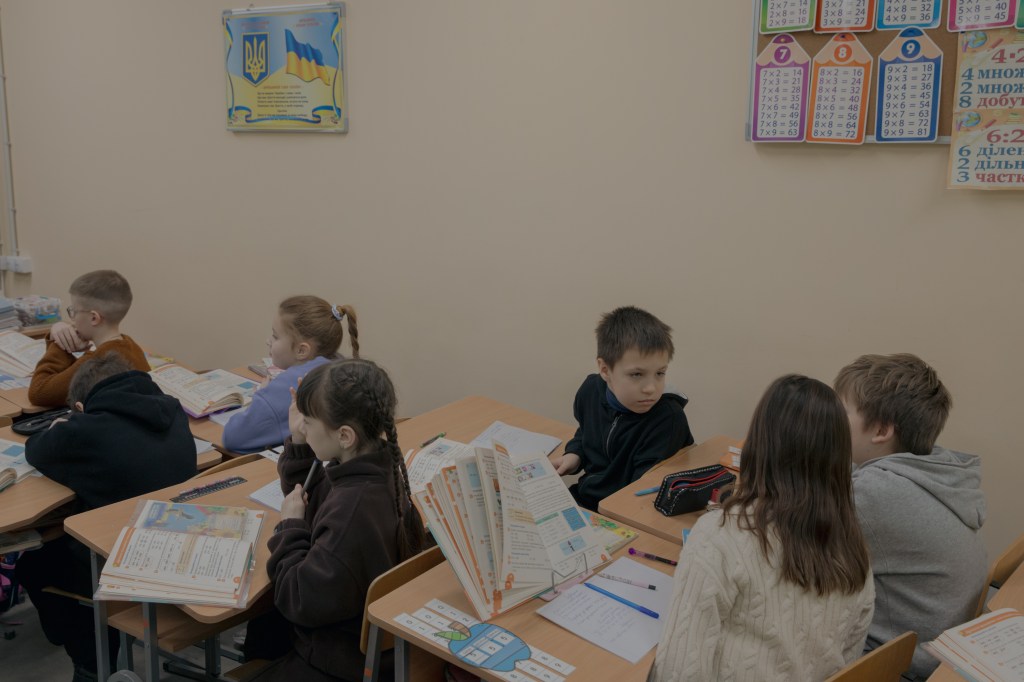
KHARKIV, Ukraine—In an underground bunker turned school, children’s drawings paying tribute to the Ukrainian armed forces cover the walls. Blue and yellow dominate. From classroom to classroom, sheltered from the bombs, children of all ages listen attentively to their teachers.
Above ground, an air raid siren wails. The war goes on.
Located in Saltivka, a northeastern district of Kharkiv less than 20 miles from Russian positions and subject to near-daily shelling, this facility—one of seven underground schools in the city—serves 1,200 students ages 6 to 17. Six additional structures operate in various metro stations.
As Ukraine enters its fifth year of war, with no peace in sight, local authorities aim to increase the number of underground schools to 43 by spring 2026, ensuring education for 80,000 children.
In this setting of concrete, windowless walls and fluorescent lights, 52-year-old teacher Olena Vuideva has observed a paradoxical shift. She says students are doing better than they were at the beginning of the invasion.
“Many were displaced at the start of the war. Some left for Poland or Germany before returning. Others had just arrived from combat zones,” she says.
But for the past two years, she adds, the children have regained a measure of stability.
As she guides me through the school’s narrow corridors, Vuideva describes the activities organized by her team: Ukrainian dance classes, choir, foreign language instruction. Nearby, students follow a German lesson with focus and care.
“Children adapt faster than adults. But it all depends on their environment. If an adult is stressed, [the children] absorb it.”
Olha Romanenko, the school psychologist, agrees. “We absolutely must give children the feeling that everything will be okay.”
Despite the many challenges, that effort seems to be paying off. Romanenko shared that the school recently conducted a psychological screening with the support of Ukrainian Smile, an organization dedicated to supporting children’s health and education.
“We assessed about 100 students, from elementary school through fifth and sixth grade, to identify possible nervous disorders or symptoms related to post-traumatic stress,” Romanenko says. “Out of those 100 children, only three showed truly concerning signs.”
Preparing for war.
In a crowded classroom, teenagers listen to an armed forces instructor who has come to teach them how to handle weapons. With a shaved head and gaunt face, he carefully demonstrates how to dismantle a Kalashnikov rifle.
At the back of the room, Bohdan, 17, seems distracted. He whispers with Yaroslav, also 17, and Ania, 16.
“I don’t want to leave Ukraine,” he says. “It’s my city, it’s my country. I love living here despite the war.”
Soon to turn 18, he could, if he wished, join the army next year. In Ukraine, however, mandatory mobilization applies to men ages 25 to 60.
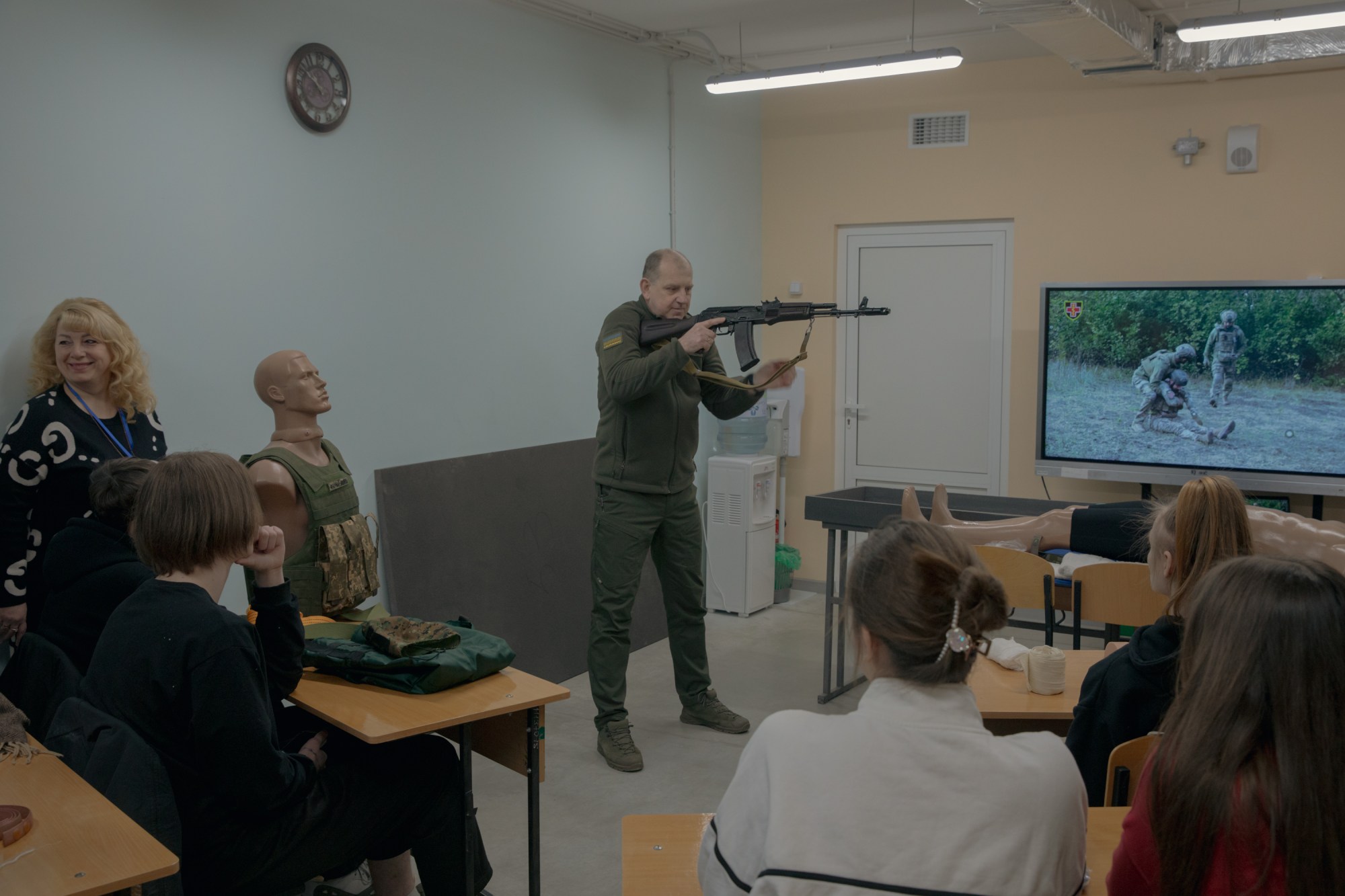
Despite his attachment to his country, Bohdan, wearing large black-framed glasses and braces, does not see himself pursuing a military career. Weapons training holds little interest for him.
“The only class I find really useful is first aid. In Kharkiv, it’s essential. There are bombings almost every day. You need to know how to save lives.”
Beside him, Yaroslav is more reserved. While he does not plan to enlist when he turns 18, he is considering joining Ukraine’s security services. Bohdan teases him.
“He’d make a good secret agent. I couldn’t do it, I talk too much. He’s quiet.”
For his part, Bohdan dreams of studying Ukrainian literature in Kyiv.
The mood shifts when the conversation turns to relatives fighting at the front. Bohdan says he has no close family members mobilized. Yaroslav remains vague. Ania’s father, however, is fighting.
“He left in 2023 as a volunteer. Since then, we barely see him. On average, once every six months.”
He could request a transfer to the Kharkiv region but has refused so far.
“He says he’s gotten used to it. I feel like the army has become his new family. Before, he took part in assaults. Now he’s a bit further back. That’s something, at least,” she says softly.
The war’s lasting scars.
According to Olena Vuideva, a significant number of students live with the absence of a mobilized parent.
“Forty-two parents from our school are serving in the army,” she notes.
When one of them is killed at the front, the school immediately adapts its support.
“We begin by surrounding the child with care, without overwhelming them,” Ms. Romanenko explains. The psychologist evaluates the child’s emotional state and sets up a personalized follow-up. If necessary, the school refers the family to outside specialists, “because some traumas go beyond what a school can handle.”
In class, teachers double their attention and tact, “without ever putting the child on display,” so that grief remains an intimate ordeal, shielded from the gaze of others.
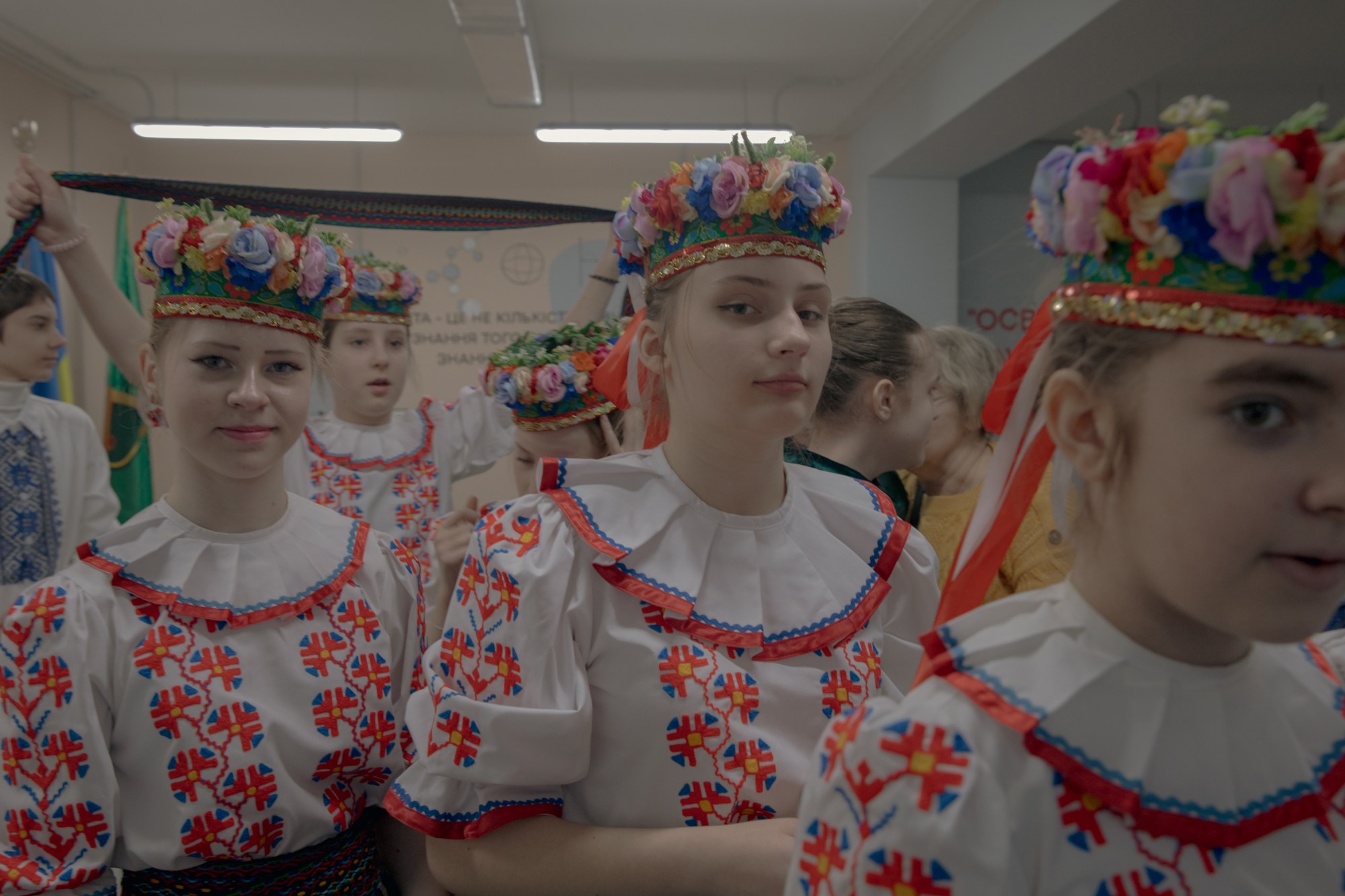
Despite the war, Olena remains hopeful.
“They are very brave. They are full of dreams.”
In a classroom of 6- and 7-year-olds, Valeria, a teacher, asks her students about their dreams. Hands shoot up immediately.
“I want to be a dentist,” says Alina, 6.
“A veterinarian,” Oleksandra replies confidently.
But very quickly, the war enters their answers.
“My dream is to become a pilot to protect our sky from the Russians,” says a little boy with a shaved head.
Then, almost in unison, several children voice the same wish: that the war ends as soon as possible and that they can return to a school in the daylight.
At the back of the classroom, a small girl who has been silent until now timidly raises her hand. Her eyes are sad. Almost in a whisper, she says:
“I just want my dad to come back from the front. He promised that after the war, we would go to France together. That’s my dream.”