The removal from power of Venezuela’s dictator, Nicolás Maduro, is great news for Venezuela and Latin America. For more than 12 years, Maduro terrorized his people, depleted the country’s vast wealth for the benefit of a small, corrupt clique of cronies, funded anti-Americanism across the Western Hemisphere, and turned his country into a forward-operating base for China, Iran, Russia, and others to plunder natural resources, run criminal networks, evade sanctions, and advance an anti-Western agenda. But the criminal gang Maduro commanded remains in power in Caracas, even as it fears more U.S. military action. Washington’s threats may persuade them to comply with U.S. demands, including Secretary of State Marco Rubio’s intimation that Hezbollah and Iran must leave. But ultimately, the U.S. will extract only so many concessions from an illegitimate, brutal dictatorship whose staying power depends not only on its largely intact, repressive internal apparatus but also on its ongoing geopolitical alliances.
By contrast, a full democratic transition and the restoration of the rule of law is, long-term, the strongest guarantee that Venezuela will stop being the playground for America’s enemies. Take Caracas’ cozy relationship with Tehran. María Corina Machado, the internationally recognized leader of Venezuela’s opposition and Nobel Prize laureate, would move quickly to dismantle the decades-long strategic relationship that binds the Islamic Republic to the Bolivarian regime still running Venezuela. But Delcy Rodríguez, who has temporarily replaced Maduro, is unlikely to forgo her partnership with Iran. Barely hours after Maduro was airlifted to the United States, Rodríguez took the airwaves to denounce Maduro’s capture as a plot with “Zionist undertones”—evidence of the conspiratorial antisemitism inhabiting, rent-free, the minds of those that President Donald Trump left to run the country. Venezuelan propaganda channels, meanwhile, are mourning the Cuban goons who died trying to protect Maduro from U.S. capture as revolutionary martyrs and repeating the mantra that Iranian protesters are foreign agents armed by imperialist forces.
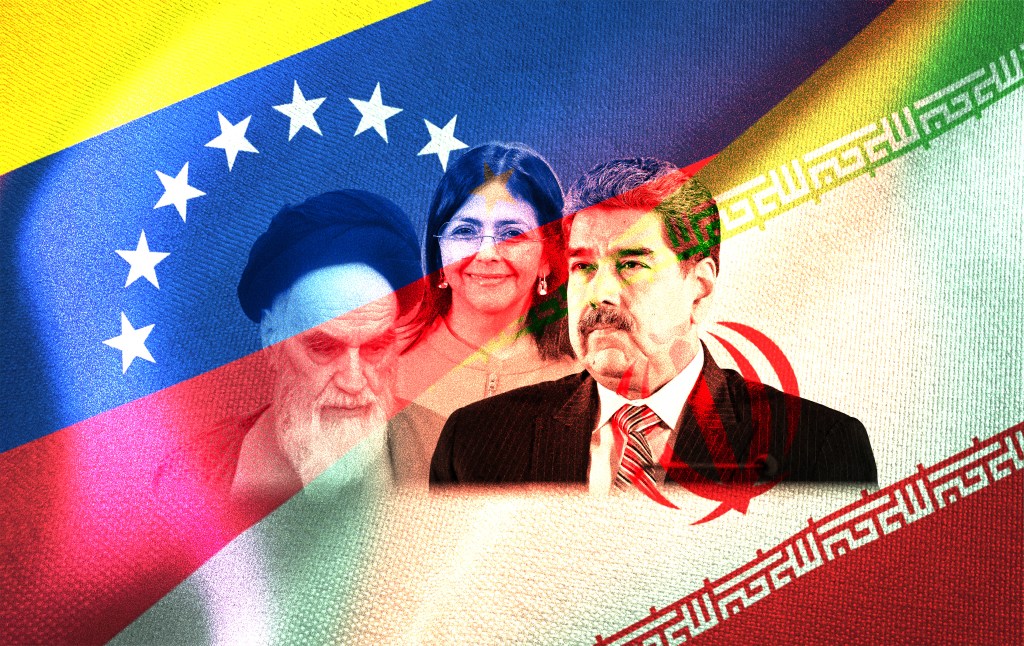
What unites the Bolivarian socialist kleptocrats in Caracas and the Shiite revolutionaries in Tehran is more than just anti-Americanism. Theirs is a full ideological convergence buttressed by profitable business complicity. They have helped each other evade sanctions. When, during the Bush and Obama administrations, Tehran reeled under financial pressure from international sanctions, Venezuela’s leaders opened their country to Iranian banking and welcomed joint industrial and real estate projects. Later, when it was Venezuela’s turn to feel sanctions pressure from the United States, Iran came to its rescue, providing technology and technicians for Venezuela’s beleaguered energy sector, emergency shipments of refined gasoline, and weapons systems that Maduro could use in its imperial pursuits against its neighbor, Guyana. Venezuela shipped gold to Iran for payments, quenching Tehran’s thirst for hard currency. Iran set up a drone factory in Venezuela and equipped Bolivarian forces with its fast boats. Both helped each other launder money and enrich those involved in the laundering schemes.
The two regimes also run parallel and intertwined propaganda campaigns. When, in 2012, Tehran launched HispanTV, its Spanish-language propaganda platform, it did so from Caracas. The Chavista channel, TeleSUR, shares journalists, producers, and commentators with HispanTV. Their editorial line is indistinguishable—they lie on behalf of one another’s international agendas.
The Maduro regime has also let Iran establish a permanent headquarters in Caracas for Al Mustafa International University, a regime tool that uses its cover as a university to spread its radical ideology abroad through conferences, recruiting Venezuelans to the Iranian cause. And in fact the school is under U.S. and Canadian sanctions for its role as a terrorism enabler. From Caracas, the ayatollahs run influence operations across the Spanish-speaking region, including through universities such as Caracas’ Bolivarian University, where Iran established a department named after Qassem Suleimani, and a center for Islamic, Arabic and Persian studies affiliated with Argentina’s University of Rosario, which heavily relies on Al Mustafa “academics.” Iran has opened its universities to Venezuelan students, while the Maduristas have let Iranian academia enter its universities through exchange programs and cooperation projects.
Finally, Venezuela has given Iranian and Hezbollah agents sanctuary—turning Caracas into a haven where Khomeinist agitators, financiers, and hitmen enjoy impunity for their regional mischief. Iran’s plot to assassinate Israel’s ambassador to Mexico was hatched in Caracas. Venezuela’s opposition speaks of thousands of Venezuelan passports granted, over the years, to Middle East nationals with little or no connection to Venezuela. These include Abdel Majid Hussein, who is a business partner of Hassan Mohamad Daqqou, a U.S.-sanctioned Syrian-Lebanese dual national nicknamed the “king of Captagon,” —a deadly and cheap-to-manufacture amphetamine that the Bashar al Assad regime mass produced to finance itself during Syria’s civil war—and Adel Mohamad Ali Safieddine, a business associate of U.S.-sanctioned Hezbollah terror financier, Ahmad Jalal Reda Abdallah. Their access to Venezuela’s economy and territory made Hezbollah’s financial operations in the region easier to accomplish.
The Trump administration prefers working with the remnants of the Bolivarian regime, who patiently built their strategic alliance with Iran over 26 years and greatly enriched themselves thanks to it. There is no guarantee the democratic opposition that decisively won the July 2024 elections can quickly take over the country and successfully transition Venezuela away from dictatorship, while the armed forces and the paramilitary groups aligned with the regime still hold a monopoly over force inside the country. But betting on Delcy Rodríguez to pull the carpet from under the feet of her Iranian friends, rather than on María Corina Machado and her beleaguered but firmly pro-Western opposition, could prove just as perilous.