President Trump has acknowledged that he has a plan for Iran, but naturally isn’t going to make it public. “Well, we can’t tell them the plan,” Trump said Saturday. “If I told them the plan, it would be almost as bad as telling you the plan – it could be worse, actually.” Several Gulf allies have meanwhile complained of being “in the dark” on what the US might do next.
Fresh quotes from US officials in The Wall Street Journal suggest major military action is not imminent, but ‘limited’ strikes might be. The Pentagon is worried its troops and bases in the region are too exposed, given Tehran has vowed all-out war if it gets hit.

“Trump has yet to say whether and how he might use force,” the WSJ writes. “But American airstrikes on Iran aren’t imminent, U.S. officials say, because the Pentagon is moving in additional air defenses to better protect Israel, Arab allies and American forces in the event of a retaliation by Iran and a potential prolonged conflict.”
“The U.S. military could conduct limited airstrikes on Iran if the president were to order an attack today, U.S. officials say,” the report continues. “But the kind of decisive attack that Trump has asked the military to prepare would likely prompt a proportional response from Iran, requiring the U.S. to have robust air defenses in place to protect Israel as well as American troops, the officials say.”
Again, Iranian officials have repeatedly said its own response will not be limited – that it will unleash its significant ballistic missile arsenal on American assets in the region and Isarel, much of which can be launched from well-protected underground bunkers and tunnels.
This is why the Pentagon is rushing to get more THAAD, Patriots, and other anti-air measures to the region. These systems have already likely been beefed up in Qatar, home to a major US base outside Doha.
The WSJ details further:
The military already has air defenses in the region, including destroyers capable of shooting down aerial threats. But the Pentagon is deploying an additional Thaad battery and Patriot air defenses to bases where U.S. troops are stationed across the Middle East, including Jordan, Kuwait, Bahrain, Saudi Arabia and Qatar, according to defense officials, flight tracking data and satellite imagery.
High on the minds of US and Israeli officials is Iran’s response during the 12-day June war. The below commentary is worth revisiting…
Statements by Ali Shamkhani, adviser to Iran’s Supreme Leader, threatening to strike the heart of Tel Aviv and those supporting it, provide an insight into Tehran’s evolving strategic calculus.
Unlike the previous 12-day conflict, during which Iran conducted limited… https://t.co/x5OSi3QFLx pic.twitter.com/8D01iGFEsF
— Talha Ahmad (@talhaahmad967) January 30, 2026
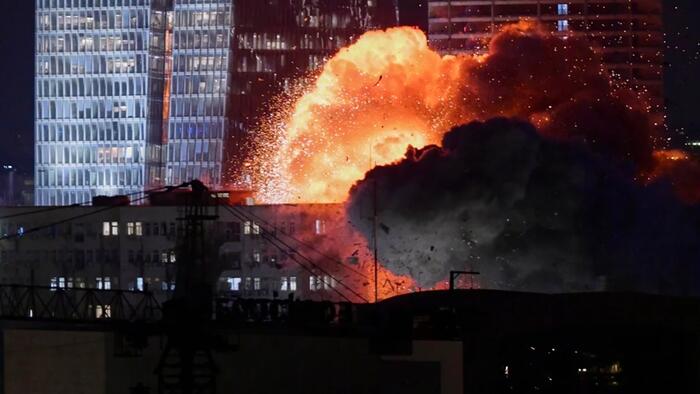
The country’s ballistic missiles, drones, and even hypersonic projectiles that rained down on Tel Aviv and elsewhere was significant – and likely caused much more damage than what Israel publicly acknowledged.
Loading recommendations…