With ‘hard’ US macro data having drifted weaker all year, consensus was expecting only a modest decline in S&P Global’s US Composite index in preliminary March data (that presumably will be affected in some part by the war and its consequences).
The consensus was right, but the picture was mixed with Manufacturing PMI surprising to the upside (52.4 vs 51.5 exp vs 51.6 prior) – highest since Oct 2025.
Services PMI, on the other hand, disappointed, falling to the lowest since April 2025…

Source: Bloomberg
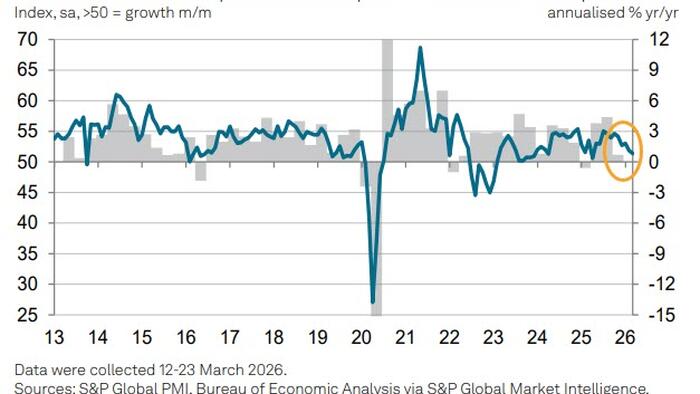
Overall, that combination dragged the Composite PMI to 51.4 – the lowest in 11 months – indicative of GDP rising at an annualized rate of just 1.0%, with a modest 1.3% expansion signalled for the first quarter as a whole.

The survey’s price gauges meanwhile point to consumer price inflation accelerating back to around 4%.

“The flash PMI survey data for March signal an unwelcome combination of slower growth and rising inflation following the outbreak of war in the Middle East,” warns Chris Williamson, Chief Business Economist at S&P Global Market Intelligence.
“Companies are reporting a hit to demand from the additional uncertainty and cost of living impact generated by the conflict. Travel, transport and tourism related issues are compounded by financial market jitters and affordability constraints, notably including concern over the impact of higher interest rates, surging energy prices and supply chain delays.
“Companies are meanwhile building safety stocks amid concerns that the war may lead to more protracted supply issues and price rises while trimming headcounts to reduce overheads.”
Today’s PMI print appears to confirm the overall theme of the last couple of months… ‘higher’ inflation and stagnant (or falling) growth…

Source: Bloomberg
…in other words, central bankers’ biggest nemesis: Stagflation.
As Williamson concludes, “The Fed will therefore need juggle these intensifying upside risks to inflation against the growing risk of the economy losing growth momentum, with much depending on the duration of the war and its impact on energy prices and global supply chains.”