Maduro’s regime jailed political dissenters, rigged elections, and greenlit corruption schemes to enrich Maduro and his allies, while his country endured rounds of devastating hyperinflation, lost half of its GDP in a decade, and saw a third of its citizenry flee abroad. Maduro responded to these issues by declaring that Christmas begins in October and announcing plans to form a “vice ministry of supreme social happiness.” It did not win over the public.
With his removal, many Venezuelans—abroad and at home—hoped this would be the end of the Chavistas’ rule, and restoration of democracy, with Venezuelan opposition leader—and 2025 Nobel Peace Prize winner—María Corina Machado being widely viewed as the legitimate leader-in-waiting. “She’s easily the most respected and admired figure in Venezuela today,” explained Daniel Batlle, an adjunct fellow at the Hudson Institute and former senior official in the State Department and the U.S. Agency for International Development. She was the leading candidate ahead of Venezuela’s 2024 elections, and when the Maduro regime blocked her electoral candidacy in June 2023, she pushed for Edmundo González, who won the vote by roughly 70 percent. That victory “was based largely on María Corina Machado’s bringing the opposition together” around him, Batlle explained.
The opposition, in a well-organized effort, collected official tally sheets from roughly 80 percent of the country’s polling stations and posted them online, showing González had won by a more-than-two-to-one margin. Experts from the United Nations and U.S.-based Carter Center were invited by Maduro’s government to observe the election and validated those tally sheets as legitimate. The regime denied the results though, and Maduro retained power. Then-U.S. Secretary of State Antony Blinken stated in a press release shortly after the election that “we have consulted widely with partners and allies around the world, and while countries have taken different approaches in responding, none have concluded that Nicolás Maduro received the most votes this election.”
In her first interview since the capture of Maduro, Machado praised Trump’s Saturday operation. “What he has done, as I said, is historic, and it’s a huge step toward a democratic transition,” she said, telling Fox News host Sean Hannity that she would return to her country, hoping to compete in a prospective election.
But such an election does not seem to be coming soon. Yesterday, Secretary of State Marco Rubio announced a three-step plan for Venezuela’s post-Maduro future: stability, economic recovery, and then transition to a new government. “In the end, it will be up to the Venezuelan people to transform their country,” he said while offering no specifics on how the plan would unfold
He also said that Trump’s recent announcement of selling 30 million to 50 million barrels of Venezuelan oil would be used to help fund the transition to that new government. “That money will then be handled in such a way that we will control how it is disbursed in a way that benefits the Venezuelan people, not corruption, not the regime, so we have a lot of leverage to move on the stabilization front,” he said.
Politico reported that officials generally believe the transition will occur after a new election, but that this is some time off, as Trump believes it is “far too premature for us to even be discussing elections in Venezuela.”
“A democratic transition would require significant nation-building, significant U.S. occupation, which Trump doesn’t seem to want to do, in part because there’s so little public support [in the U.S.] for this,” David Smilde, a human relations professor at Tulane University and author of several books on Venezuela’s political state, told TMD.
Rubio’s announced framework seems to be the public side of a larger plan, which Rubio and Defense Secretary Pete Hegseth briefed the Senate and the House on earlier this week. While the briefings were classified and the details of the plan have not been released, Democrats did not come out speaking positively, saying the plan was mostly focused on taking oil. “They are talking about stealing the Venezuelan oil at gunpoint for a period of time undefined as leverage to micromanage the country,” Sen. Chris Murphy, a Democrat from Connecticut, said. It’s “an insane plan.”
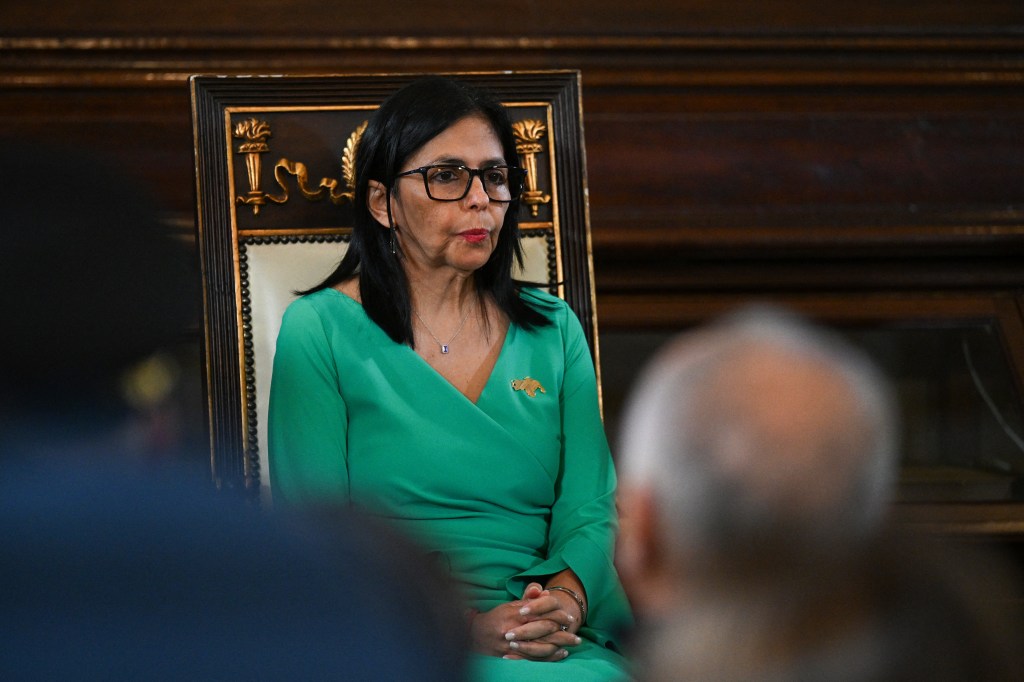
For the first stage of that plan at least, the White House plans to leave Rodríguez in charge. The New York Times reported that U.S. officials had determined she was an acceptable temporary replacement weeks before the U.S. military put the military operation in action, notably due to her management of Venezuela’s oil industry during her time as vice president and economics minister, when she oversaw a slight increase in oil production even amid rising U.S. sanctions from the U.S. She also served as the Maduro regime’s primary liaison to oil executives.
Politico reported Monday that the Trump administration demanded that Rodríguez immediately crack down on drug trafficking and criminal networks, deport residents who pose a potential threat to the U.S.—such as Iranian and Cuban operatives—and block the sale of Venezuelan oil to American adversaries. U.S. officials also reportedly demanded the release of all Americans currently jailed in Venezuela—but seemingly not of any Venezuelan political prisoners. According to one official, White House officials are more “confident they can whip her in whatever direction they want before they dispose of her and move on.” If she complies with U.S. demands, officials have reportedly offered sanctions relief—and threatened to seize her financial assets, which are mainly in Qatar, if she doesn’t. Yesterday, Rodríguez removed Javier Marcano Tábata, the commanding general of Maduro’s personal bodyguard wing, from his position, and White House press secretary Karoline Leavitt told reporters the administration would be “selectively rolling back sanctions” on Venezuelan oil.
But whether Rodríguez will be able to do much to move the country toward institutional stability or crack down on gang activity and corruption still remains a question.
Rodríguez is “very much compromised by the same criminal and corrupting elements that had entrenched [and] had gotten their claws into Maduro,” Andrés Martínez-Fernández, a senior policy analyst for Latin America at the Heritage Foundation, told TMD. “I think that while there may be an opportunity for engagements with Delcy [Rodríguez] and other kinds of elements of the regime currently … the focus of that should be on ensuring a transition [where] they’re essentially ceding power and ensuring that we have a full restoration of stability and democracy in Venezuela.”
“It’s a test for her, and it’s a test for the Trump administration to … try her out and see how she performs,” Michael Shifter, a senior fellow and former president of the Inter-American Dialogue policy forum, told TMD. The White House wants to instill short-term stability in Venezuela, he explained, “and they’re sort of betting that Delcy Rodríguez will hold things together, but I don’t think there’s any guarantee of that.”
Even so, backing Rodríguez runs contrary to much of the reasoning the administration has used to support Maduro’s removal. “This administration has emphasized the illegitimacy of the Maduro regime, and having Delcy Rodríguez in power, even in a transitional role, really runs counter to that,” Batlle explained. “Delcy Rodríguez is not the face of change. She is Maduro in a dress.”
Javier Corrales—a political science professor at Amherst College who specializes in Latin America—agreed. “She is sometimes considered more Madurista than Maduro,” he told TMD, noting that she gained notoriety for defending Maduro’s worst policies. Machado described Rodríguez in her Fox News interview as “one of the main architects of torture, persecution, corruption, narco-trafficking.”
Though the Venezuelan diaspora has widely celebrated Maduro’s removal, Corrales said that, in Caracas, the continuation of his regime has made for a quieter tone, with many feeling too unsafe to openly celebrate in the streets. On Saturday, the Venezuelan government ordered police to “immediately begin the national search and capture of everyone involved in the promotion or support for the armed attack by the United States.” Immediately following Maduro’s seizure, government-linked armed militia groups, known as colectivos, were ordered to patrol the streets, search cars and phones, and administer checkpoints. On Monday, the government also detained 14 journalists, including five who had been reporting from within the Venezuelan National Assembly, 13 of whom have since been released.
“The colectivos especially are worrisome, because it seems like they are both reporting to other [regime] figures, but they’re also a little bit autonomous,” Corrales explained. News reports seemed to corroborate that sentiment. “There’s fear,” Mirelvis Escalona, a 40-year-old resident in western Caracas, told The Guardian on Tuesday. “There are armed civilians here. You never know what might happen, they might attack people.”
“I don’t see anybody in the diaspora saying, ‘Oh, things are fixed. Let me head back,’” Corrales said. “And even people who support what just happened don’t think that the job has been done.”