
The U.S.-Israel conflict with Iran and the subsequent closure of the Strait of Hormuz to oil exports have sent oil prices soaring around the world. Although the U.S. is less susceptible to oil price shocks from the Middle East than in the past, thanks to record production, consumers are still feeling the pinch. Gas prices have risen by 74 cents a gallon since the start of the war, and Brent and West Texas Intermediate crude have both topped $100 a barrel, with no sign of slowing.
It’s unlikely that Democrats will let this “crisis” go to waste, especially with midterms approaching. While the effects of the supply shock should sober Democrats to the consequences of stymying domestic energy producers through regulatory and permitting barriers, early indications are that they aren’t learning the right lesson — blaming President Trump’s “drill, baby, drill” agenda and its vehicle, American energy producers.
Amid reactions to the war, rumors are circulating that some on the Hill are considering a new oil export ban. Although a ban, as a policy response to high prices, has been ruled out by Energy Secretary Chris Wright, its harmful effects warrant renewed attention. Implemented by the 1975 Energy Policy and Conservation Act, the crude oil export ban was intended to work alongside price controls on crude oil in response to the 1973 Organization of Arab Petroleum Exporting Countries embargo, preventing American companies from selling their products overseas at higher prices. However, as with many government programs implemented during times of “crisis,” policy sclerosis kept it in place long after circumstances changed.
Even though the oil export ban was always a bad idea, the issue was not particularly relevant when oil production was declining and imports were rising. That changed after the Shale Revolution, during which American entrepreneurs doubled crude oil production from 2009 to 2015. With fears of another oil supply shock mitigated by American ingenuity, Congress repealed the ban in 2015, but not without complaints from prominent Democrats at the time.
As a coalition of senators wrote to President Obama at the time the bill was being considered, “Repealing the crude export ban is opposed by a broad coalition, including the AFL-CIO, the United Steelworkers, environmental organizations and domestic refiners. We are concerned that repealing the 40 year old statutory prohibition on exporting U.S. crude oil could harm consumers, businesses and our national security.” To these Democrats, more oil exports meant fewer resources for Americans, raising prices and creating a national security risk.
These fears, however, were not based on sound economic thinking. U.S. oil reserves are not a fixed pie to be divided among different constituencies, but a deep pool that will be increasingly drawn from as demand and, subsequently, prices rise. If the consumer base for American oil expands from domestic consumers and businesses to the entire world, that incentivizes American companies to invest greater resources in extraction, creating economies of scale that allow producers to get more out of each oil well.
Advocating for the repeal of the ban, former IER Economist Robert P. Murphy claimed that allowing oil companies to ship their product abroad “would spur the expansion of the domestic oil industry, spurring hiring of American workers, investment in new facilities in various American cities, and so forth.” Notably, he also explained that lifting the ban would lower gas prices, stating that “the crude oil ban introduces artificial bottlenecks in the refining sector that paradoxically drive up the world (and hence U.S.) price of gasoline.”
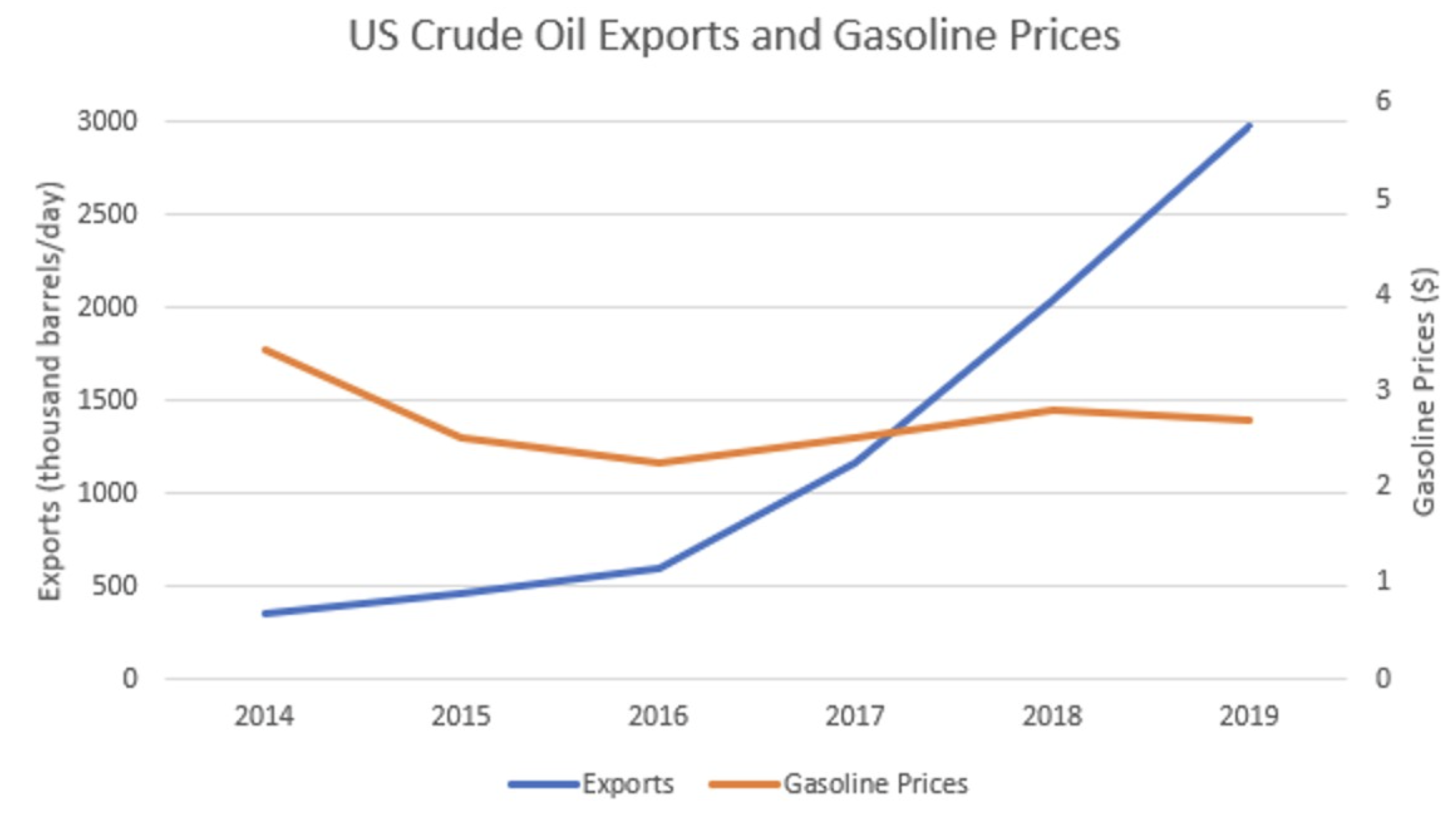
As the above chart shows, Murphy’s predictions have been vindicated. Increasing crude oil exports have not led to higher gas prices, and there’s no reason to expect that they should. In contrast, gas prices would increase if the U.S were to cease exports, due to less global supply.
Fundamentally, proponents of oil export bans do not understand how the oil supply chain works, and fail to distinguish between the grades of oil we produce domestically and the capabilities of U.S. refineries. Although the U.S. is a net exporter of total energy products, we are a net importer of crude oil, with about 40% of the oil our refineries use to produce products, including gasoline, diesel, and jet fuel, being imported. This imported oil is heavier and sour, coming primarily from Mexico and Canada, compared with the light and sweet oil produced in the Permian Basin and the Bakken Formation, and it would be prohibitively expensive for refineries to re-tool to process more domestic oil. Thus, the oil used for domestically produced gasoline differs from the oil we export, which goes to refineries overseas in countries such as the Netherlands, India, and Japan, thereby increasing the supply of oil worldwide and depressing prices.
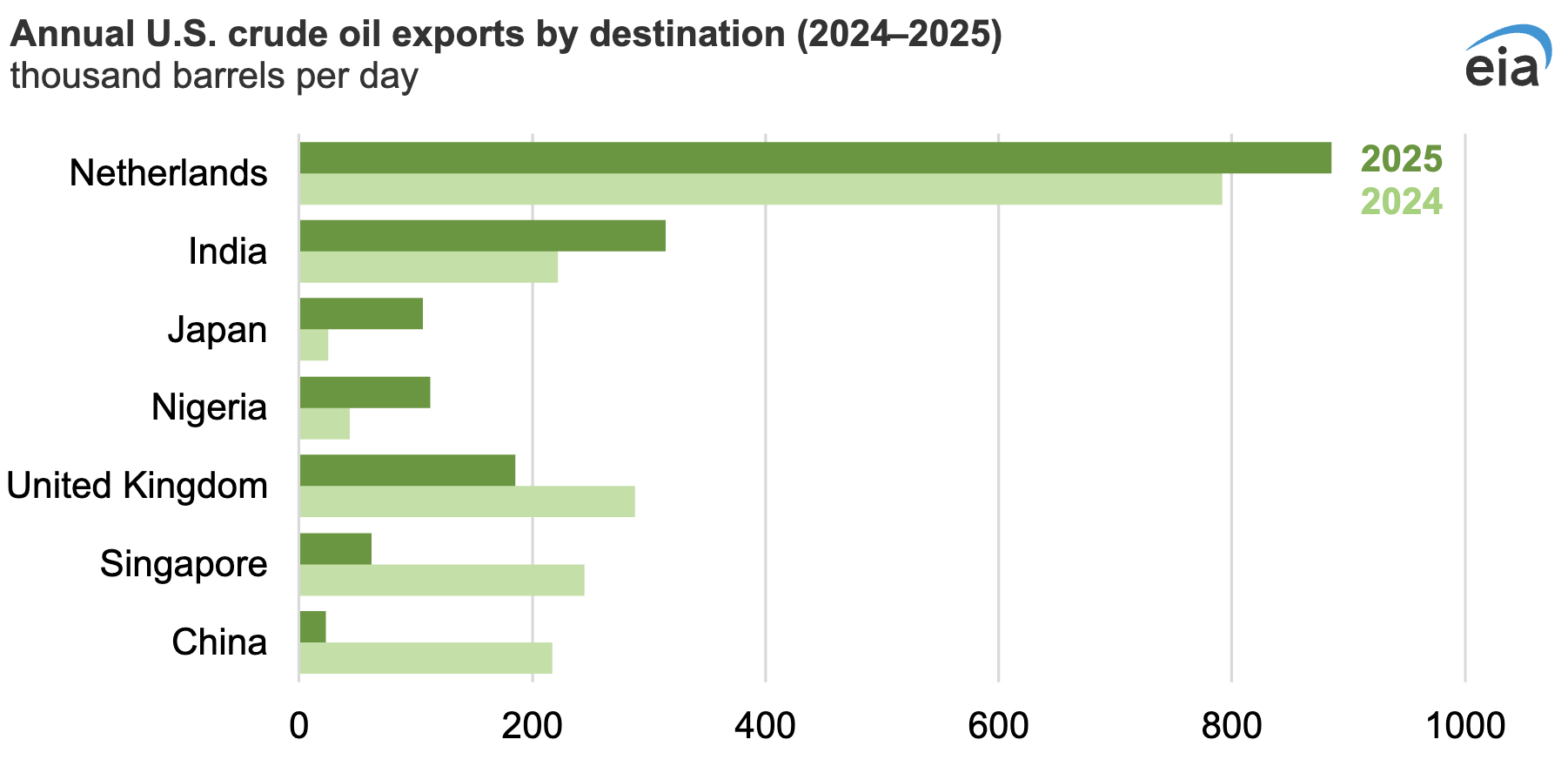
The lack of refining capacity for our domestic production stems from U.S. policy that has blocked the development of new refineries for decades through adverse environmental standards and regulatory uncertainty. With the exception of the recent announcement of a new refinery in Brownsville, Texas, most refineries in the U.S. were built well before the U.S. became a major producer, and they are set up to refine heavier, sour grades that we historically relied on from imports.
Clearly, the crude oil export ban exemplifies a government intervention that “lasted well beyond the immediate crisis that was used to justify action,” as IER Founder and CEO Robert L. Bradley Jr. puts it. Because these interventions create entrenched interests that seek to uphold them against diffuse opponents, reform is tedious and costly.
At the state and federal levels, anti-energy politicians and activists have sought to make it increasingly hard for energy companies to operate. Possessing a resume that includes pursuing climate superfund laws, climate lawfare, and a Waste Emissions Charge, it’s no wonder oil companies are worried about what their opponents could seek to do next. Years of time and effort won a great victory in 2015, and the world has since reaped the benefits of oil exports, but it would be foolish to pretend that the interests supporting an export ban have disappeared or that the policy’s proponents’ goal has changed. The goal of export bans is to disrupt the oil market, not to protect the consumer. Republicans can’t let the oil supply shock from the conflict in Iran lead to poor energy policy choices. An oil export ban, even if temporary, would be going backwards, reneging on a policy that has worked well for all Americans.