Editor’s Note: This is the fifth entry in a new Dispatch series titled “Where I’m From.” Every Saturday, a writer will share a meditation on his or her hometown—a bustling metropolis, distant desert outpost, quiet suburb, or somewhere in between—and what makes it unique. The goal? Highlight voices—and good writing—from every corner of these United States.
The beating heart of Raleigh—the cornerstone on which the city’s foundation was laid and the central point by which its grid is oriented—is the North Carolina Museum of Natural Sciences. Well … not really. The museum sits some 500 feet from the State Capitol, the actual city center. This inconvenient fact, however, did not trouble my childhood devotion to the science museum. I eagerly seized any opportunity to “go downtown” and stare through glass at poison dart frogs, pet a baby alligator, or gape at dinosaur bones.
The museum’s finest exhibit is a multistory walk through North Carolina’s ecosystems. From a second-floor mezzanine, onlookers take in the hulking jaw bones and eerily long fingers of the museum’s whales. Notable among the collection are a North Atlantic right whale named Mayflower and a sperm whale infamously dubbed “Trouble.” The gargantuan centerpiece is an unnamed blue whale, its jaw stained dark by oil. Behind the whale-riveted guests, the rest of the great diorama exhibit stretches up another two stories, re-creating the Piedmont and Mountain regions, complete with mounted bears, a waterfall, and live gar.
This, as every public-school pupil knows, is our state: To the west, the weathered peaks of Appalachia rise and tumble until they reach the invisible borders of Tennessee and Georgia. Those borders, made by man, are flimsy, malleable things, and therefore ignored by the mountains, which were made by God. The region’s early settlers considered borders not merely manmade but worse, British-made, and treated them with appropriate contempt, pushing farther and farther west in search of new lands.
To the east lies the coastal plain, cut through by rivers and estuaries. In South Carolina, Charlestonians will tell you that the rivers Cooper and Ashley come together at their great city to form the Atlantic Ocean. Tidewater North Carolinians, a humbler people, are content to consider the source of the Atlantic a mystery and focus on a more immediate concern: the superiority of their vinegar-based barbecue sauce to the mountain folk’s tomato-based kind.
In between the mountains and the coastal plain lies the Piedmont, and in the Piedmont lies Raleigh. Raleigh is situated just inland from the “fall line”—the point at which rivers become unnavigable and waterfalls begin to form. Her gently rolling hills are a foretaste of the steeper terrain to the west, while the runoff from every road, storm drain, and sprinkler collects in the creeks and winds eastward, draining into the Neuse River.
What we give to the Atlantic in steady drips inevitably returns in autumn’s cyclonic torrents. The warm Gulf Stream flings mighty storms against the coast, flooding and flattening the land and towns in its path. I remember being little, walking with my grandfather to a low cul-de-sac in the aftermath of a storm. A flooded creek lay to the right; to the left there were houses built high, with brick retaining walls in front to spare them from floods. The cul-de-sac was filled with murky water and someone was going about in a boat. Even so, not believing the water could be that deep, I pressed my yellow-booted foot to a patch of floating grass near the new shore. It disappeared into the murk, and I hopped back in fear.
In such a land, my boyhood love of the natural world could not be confined by museum walls. The vacant woods near my house, a city park pond, the bare fields under power lines, and Umstead State Park were my stomping grounds. Here, I could catch turtles in nets, raise frogs from tadpoles, run from snakes, build bridges and forts, and do every manner of boyish thing.
I could write of the smell of curing tobacco, the roar of water beside ruined mills, the frigid nights spent camping, the sweet, precious warmth of early spring, or the sound of brass on Easter Sunday.
Still, the city’s urban grandeur was not lost on my boyhood imagination. I gazed on the capitol building’s Greek-revival columns and copper dome with reverent fascination. Standing sentinel around its grounds, statues looked outward from the seat of government, memorials to our state’s achievements and failures. I considered the capitol, legislative building, and governor’s mansion with an awe of government and civic life that only a child could feel, unburdened by the cynicism of politics.
As is often the case with suburban-raised kids, I knew the places I went and the routes my parents drove to take me there, but much of the city itself was still a mystery. This changed dramatically when I got a car. What a glorious place to have a car! What revelry! What indulgence! What freedom! Parks, parking lots, trailheads, used book stores, new book stores, guitar shops, museums, soccer fields, train tracks, and fast food joints were our haunts. My friends and I were “third-place” aficionados, escaping home and school by fleeing to the cheap and free.
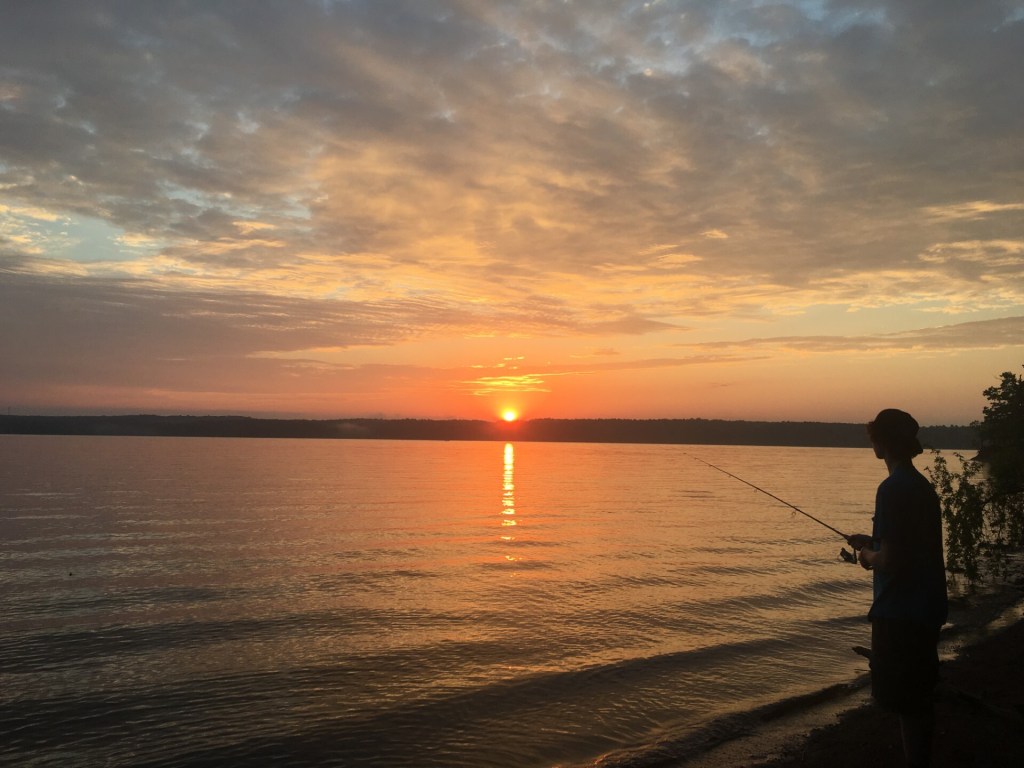
Often we would drive up Route 50 to the shores of Falls Lake. There we would build fires, swim, and talk. We talked and talked. Once, a friend and I sat in McDonald’s for many hours of an evening, and when his father asked what we’d been doing all that time, he didn’t seem to believe that we’d just been talking. But we had. It was our chief pleasure.
I find myself at a loss trying to summarize my city. How can you summarize what you love? I could write of church luncheons scheduled around North Carolina State basketball games; I could write of the smell of curing tobacco, the roar of water beside ruined mills, the frigid nights spent camping, the sweet, precious warmth of early spring, or the sound of brass on Easter Sunday; I could write of miles and miles run on the greenways, reflective hours in art galleries, or the sheer sense of relief when touching down at RDU airport. All of this and more would be insufficient.
Earlier this year, my elementary school music teacher died. Ms. Nolstad was one of those old-school educators with whom praise was hard won. She had little time for nonsense, took her subject seriously, and, over six years, taught me a great deal about music and about discipline.
Reading her obituary, I was struck by her degree of embeddedness in the region’s institutions. Ms. Nolstad was born in Raleigh, where her father was a North Carolina State University mathematics professor, and spent the entirety of her life in the city. She graduated from Broughton High School and obtained degrees from UNC-Chapel Hill and Duke University. She taught for 35 years in the public school system at all levels, including elementary school choir and (if memory serves me right) high-school marching band.
Ms. Nolstad fit the mold of a type of citizen with whom I was well acquainted growing up. Many of the older generation in my church, schools, and community were born in or near Raleigh, educated in North Carolina’s colleges and universities, and spent their careers in the city, often in some form of public service. Many could recall a time when North Raleigh was little more than fields, farms, and forest. They had deep knowledge of the region and remembered controversies and events long consigned to newspaper archives.
I didn’t appreciate Raleigh’s pace of growth until I left. On visits back from college, I would find half-constructed medical buildings on land that used to lie vacant, or an interchange I had navigated hundreds of times torn up and reconfigured as part of increasingly desperate attempts to alleviate Raleigh’s traffic problems. In fact, every time I return, I’m forced to reckon more and more with the fact that Raleigh is not the city I knew growing up. During my lifetime, the city’s population has more than doubled. Central Raleigh’s new buildings get taller while her suburbs push farther and farther outward. Towns like Cary, Apex, and Holly Springs, once distinct communities separated by miles of farmland from the capital, are melting into the greater Raleigh area.
In a way, this state of rapid growth is perfectly consistent with the Raleigh I’ve always known. In the 1950s, North Carolina leaders were rightly concerned about the state’s prospects: Per capita income was low, and profits in both industry and agriculture were declining. One proposed solution was Research Triangle Park, a technology center located between North Carolina’s three research universities: Duke, UNC-Chapel Hill, and NC State. The project was implemented and became a smashing success. The Triangle now ranks as a top U.S. research center, employing tens of thousands of people. Over the decades, it has prompted exactly the sort of economic growth its founders were hoping for. My parents did not move to Raleigh to work in the research park specifically, but their jobs (civil engineer and economic developer) were both products and drivers of the area’s spirit of industry and growth.
I am proud to come from such an industrious and educated city. Forever a partisan for the success of my state, I laud new manufacturing, mining, or technological ventures. I want Raleighites to start new businesses, schools, and civic organizations. Yet development, by its very nature, changes the city I grew up in.
One such change is that people like Ms. Nolstad have become rarer. I myself have not conformed to the pattern I observed in the baby boomers I knew growing up. Though I was born and raised in Raleigh, I went out of state for college and now work in Washington, D.C. Some of my high-school friends stayed in the city, but many have careers that have taken them to other cities and states. This exodus is nothing unique in the U.S., and in some ways is a magnified version of the moves made by many of Ms. Nolstad’s peers: While some were born in Raleigh, many others were born in small North Carolina towns and moved to the capital in pursuit of jobs and prosperity.
On the one hand, it would be selfish to truly want my hometown not to change. Changes should be weighed on their merits with the recognition that new things can be good. When people instinctively resist change, they do it because of a deeply rooted desire for permanence. This is a good and right desire, but it cannot be fully satisfied in this life. To try and satisfy the nostalgic longing by clinging to the things of this world is both wrong and impossible. We change and the places we grew up change. The result is, as North Carolinian Thomas Wolfe observed nearly a century ago, “You can’t go home again.”
They gave me whale bones and woods.
On the other hand, not all change is equal. Take one example: To Raleigh’s west, the town of Pittsboro is getting a literal Disney makeover. At the end of 2023, Storyliving by Disney—a community development venture by Walt Disney Studios—revealed plans for “Asteria, a 1,500-acre Disney-branded residential community.” Asteria is to be part of a larger development, the Chatham Park Planned Development District, which has been in the works for several decades. Pittsboro, a small, charming town of roughly 4,700, may triple in size, its bucolic surroundings systematically transformed into centrally planned sprawl manned by Disney employees. The community aims to provide residents with an “immersive lifestyle experience” curated in the style of “Disney’s signature storytelling flair” by “Disney Imagineers.” This is no normal development, but “a carefully crafted blend of Disney magic and modern living” that “promises a future filled with enchantment and growth.”
Excuse me while I vomit.
But how can I object? Farms and homes lie beneath the waters of my beloved Falls Lake, which the Army Corps of Engineers completed in 1981. The same can be said of Lake Jordan, which lies to Raleigh’s west and submerged the towns of Seaforth, Farrington, and Lane. And what of the farm that likely occupied the hill on which my childhood house now stands? What of the gentrified neighborhoods whose streets my friends and I roamed?
The best I can say is this: “Development” is often good. But development that has no interest in the people already living in a place, only in those who might move there, is decidedly not good. Despite Disney’s claims to the contrary, I don’t think they’re interested in improving the residents of Pittsboro’s quality of life. I think they’re interested in raising the cost of living such that many locals will move away, and more “desirable” residents will take their place.
It was forward-looking Raleighites who planned parks, funded museums, and, in some cases, literally laid out streets who made Raleigh the kind of place that could be a good home for a young, curious boy, and they did it without the help of Disney. They did not give me a “carefully crafted blend”of immersive enchantment. They gave me whale bones and woods. My imagination had to do the rest. And for that, I am grateful.