You’re reading Dispatch Faith, our weekly newsletter exploring the biggest stories in religion and faith. To unlock all of our stories, podcasts, and community benefits—as well as our newest feature, Dispatch Voiced, which allows you to listen to our written stories in your own podcast feed—join The Dispatch as a paying member.
We’re hitting the road and heading to Dallas, Texas, for Dispatch Energy: The Current State, a symposium focused on the future of energy innovation. You can catch Kevin D. Williamson, Jonah Goldberg, Steve Hayes, and more of your favorite Dispatch authors as we bring our Dispatch Energy newsletter to life. Tickets are available here.
I spent much of Saturday the way I’m betting most of you did: watching every development in the U.S. and Israeli strikes in Iran. Of course, new questions now surround the theocracy over which Ali Khamenei ruled. We’ll have more coverage in the days ahead on our website and in our newsletters.
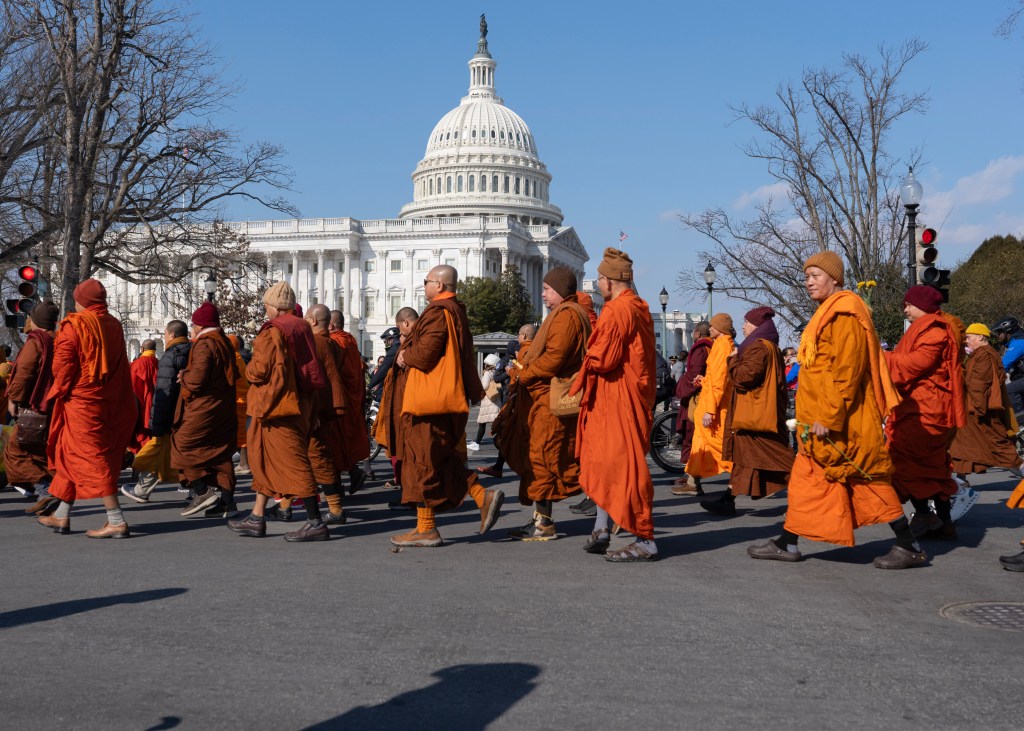
Today’s Dispatch Faith essay was in motion long before the strikes in Iran. Its origin—which starkly juxtaposes Saturday’s news—lies with a group of Buddhist monks who decided to march from Texas to Washington, D.C., to rally for peace. The monks made lots of news as they walked through different communities on their way to Washington and as Bryan Gentry writes in today’s essay, often protests. But when Gentry—a member of the Church of Jesus Christ of Latter-day Saints—joined the monks for a portion of their walk, he found himself drawing on many lessons he’s learned in his own faith journey.
What a Latter-day Saint Learned Walking With Buddhist Monks
On a recent Sunday afternoon I told my wife and kids that I was going to go walk with the monks.
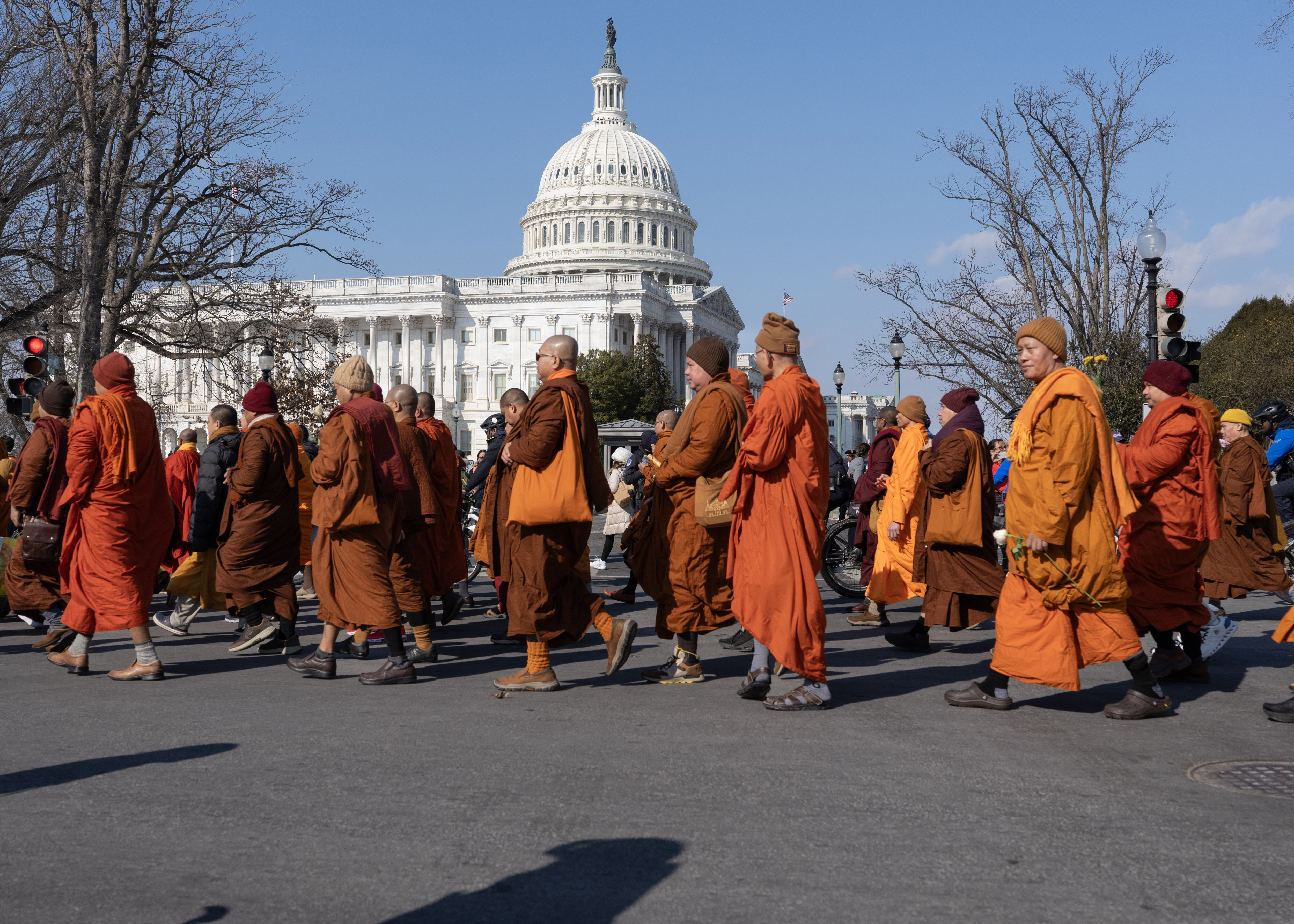
I was referring to a group of Buddhist monks walking through the Bible Belt on a months-long, 2,300-mile “Walk for Peace.” On their march from Texas to Washington, D.C.—which began in October and concluded at the Lincoln Memorial on February 11—they stopped almost daily to give “peace talks” to crowds large and small at churches, parks, and other sites.
The humble monks became something like internet celebrities. Their Facebook page has more than quintupled its followers since late December, now reaching 2.9 million people. Their social media posts chronicling morning prayers, interactions with spectators, peace talks, and evening meditations easily received 10,000 likes within minutes, especially when they pictured the monks’ “peace dog,” Aloka.
The monks marched into Columbia, South Carolina, where I live, on a Saturday afternoon just days after an ICE agent shot and killed Renee Good in Minneapolis. America was fighting over immigration policy and video footage of a shooting. Peace seemed all too distant.
Perhaps that is why thousands of people thronged the monks and followed them across a bridge into the heart of the state capital for a welcoming ceremony at the South Carolina State House. I wasn’t there, but I had already decided to meet the monks on a quiet, rural highway the next day.
Once my family was settled after church, I zig-zagged through winding country lanes, found a parking spot by other cars in a grassy field, and walked up to Highway 21 just in time to hear a woman say that the monks’ escort vehicle had come into view. People who had been lounging along the road snapped to attention.
Looking back, I wonder if this is what it was like for someone in Jerusalem 2,000 years ago to hear that a rabbi named Jesus was drawing near.
Stories We Think You’ll Like
Dialogue vs. debate.
The monks’ pilgrimage drew significant interfaith attention. The place where I lined up with hundreds of others to see them was halfway between two Baptist churches just 3,000 feet apart. Earlier in the day, the monks had stopped for lunch at a Catholic church, and they had spent the previous night at a Lutheran seminary. Browse their Facebook mentions, and you’ll see people of different religions and denominations sharing their support.
But not everyone was happy to have the monks walk through. In Georgia, protesters showed up to oppose the monks and the attention they received. One protester held a sign proclaiming that God hates false religions (among other sins). He told the monks, “You’re walking your way to hell.” (And no, he was not referring to their destination of Washington, D.C.) Another warned those listening to the monks that they were “believing a lie,” telling them that Buddhists reject Christian scripture, “yet you support them!”
The contrasting ways that Christians received the monks—some listening with gratitude and others protesting with passion—reveal a tension that Christianity has grappled with at least from the moment Peter was sent to preach to Gentiles. Some prefer to have a dialogue with those whose beliefs differ, but others want a debate.
Both of these approaches claim to be based on love, and both have scriptures to back them up. Some savor the thought of a savior “sent not … into the world to condemn the world” (John 3:17) while others warn, “he that believeth not shall be damned” (Mark 16:16). Some find common cause since “he that is not against us is on our part” (Mark 9:40), but others emphasize Paul’s command, “Have no fellowship with the unfruitful works of darkness, but rather reprove them.” (Ephesians 5:11).
I’ve lived in the tension between these ideas my entire life. As a member of the Church of Jesus Christ of Latter-day Saints, or a Mormon, growing up in the Bible Belt, I had schoolmates who believed that my church was an un-Christian cult. Occasionally someone cut off a friendship when they learned about my faith. However, I met others who appreciated my belief in Jesus.
But I also spent two years (ages 19-21) as a missionary teaching people about my church, and I engaged in more than my share of debates during that time. I’ve had friends who felt alienated or judged by members of my church—and sometimes I was the one whose actions made them feel judged.
Resolving these tensions—trying to show Christlike love without diminishing zeal for Christ himself—has become a quest for me. There must be a way to embrace people of other faiths even while disagreeing on doctrine and holding your own faith closer to your heart. Surely we can foster peace rather than pit ourselves against each other over doctrinal differences.
A historical perspective.
I gained some perspective on this quandary while studying the history of the 1893 Parliament of World Religions, held in conjunction with the World’s Fair in Chicago. It was the first mass gathering that included Buddhists and Western Christians, as well as Catholics, Hindus, Jews, and one Muslim (an American convert).
When the organizers began inviting people of many faith traditions to participate, they met vitriol from some Christians. A missionary in Hong Kong warned them they were “playing fast and loose with the truth and coquetting with false religions,” and “unconsciously planning treason against Christ.”
Other believers embraced the event as a way to spread Christianity. John Henry Barrows, chairman of the planning committee and a Presbyterian minister, told a group of missionaries that the conference could help them better understand the people they were trying to convert.“We believe that Christianity is to supplant all other religions,” he said.
Charles Carroll Bonney, a Chicago lawyer who instigated the interfaith gathering, championed a more unifying message at the conference: “When the religious faiths of the world recognize each other as brothers, children of one Father, whom all profess to love and serve, then, and not till then, will the nations of the earth yield to the spirit of concord and learn war no more.”
Several leaders from my church who attended the conference were awed by what they learned about Asian religions. “The Buddhists and the followers of Confucius … prove that long before the Savior was born, many of the truths which He proclaimed were taught by their leading men,” one LDS leader wrote. Another said that the Eastern religions “have a great many truths among them, and they are not so imperfect and heathenish as we have been in the habit in this country of believing them to be.” (He wasn’t alone. The Chicago Tribune wrote nearly the exact same sentence.)
According to one scholar, the experience led these Latter-day Saint leaders to emphasize more of the church’s teaching that God had revealed truths to multiple nations throughout human history. This tapped into a nearly universalist strand of LDS thought. Church founder Joseph Smith once said that while humans condemn each other, “the Great Parent of the universe looks upon the whole of the human family with a fatherly care and paternal regard.” He said God will judge us for our deeds (he quoted 2 Corinthians 5:10), not “whether these deeds were done in England, America, Spain, Turkey, or India.” He even taught that those who do not accept Jesus and receive baptism during mortal life may do so later.
That has become my way of reconciling these two approaches toward Christianity’s intersection with other faiths: recognize God’s love for people of all faiths, respect the truths taught in their religions, and share my beliefs with an attitude of love. Whether someone is a Christian who protests loudly for his faith or a Buddhist pleading for acceptance, I have decided I can learn from them. That is one reason I went to march with the monks.
Walking with the monks.
When the orange-clad monks reached the place where I waited for them on Highway 21, I bowed awkwardly. The lead monk nodded in return. A few seconds later, I jumped into an entourage that followed behind them and clasped my hands reverently.
As I walked in the footsteps of the monks, I began to feel lighter, less worried, and more at peace. The unhurried pace and the lack of a podcast blasting in my ear made it more relaxing than my morning jog. Being with other people who want peace and compassion made me feel less alone than scrolling a social media feed, where algorithms would serve up fresh debates, atrocities, and anxieties.
It wasn’t as though the problems that vex me and my neighbors didn’t matter anymore. It didn’t stop mattering that countless people in America are fearful of ICE while others are fearful of illegal immigrants. Anxieties about potential wars and artificial intelligence didn’t disappear. But part of the Walk for Peace message is that we find peace as we learn to focus on the here and now—the only place and time that we can do any good—and that peace will emanate from us as we show compassion.
Spreading peace and compassion; That’s what it means to walk in the footsteps of these monks. It’s also what it means to walk in the footsteps of Jesus.
Hundreds of people were waiting alongside the highway to catch a glimpse of the monks. Some of them handed the monks flowers, many of which were regifted to other spectators several yards down the road. We passed a woman with tears running down her cheeks as she held a sign that said “THANK YOU.” When a couple bowed to the earth by a road sign, the monks stopped to chant a prayer.
In all, I walked with the monks for only about a mile, at which point they took a detour to rest. Before I started hiking back to my car, I talked briefly with three other locals who had marched with the monks for three hours. They planned to continue until the monks stopped for the night.
“We have to finish the mission,” one of them said.
On my way back to my car, I thought about the many people who had lined the highway, smartphones, cameras, and flowers in hand. Several of them had been surprised to see me and others who were not monks in the procession. Some of them whispered aloud, “Wait, are we allowed to walk, too?”
Elsewhere
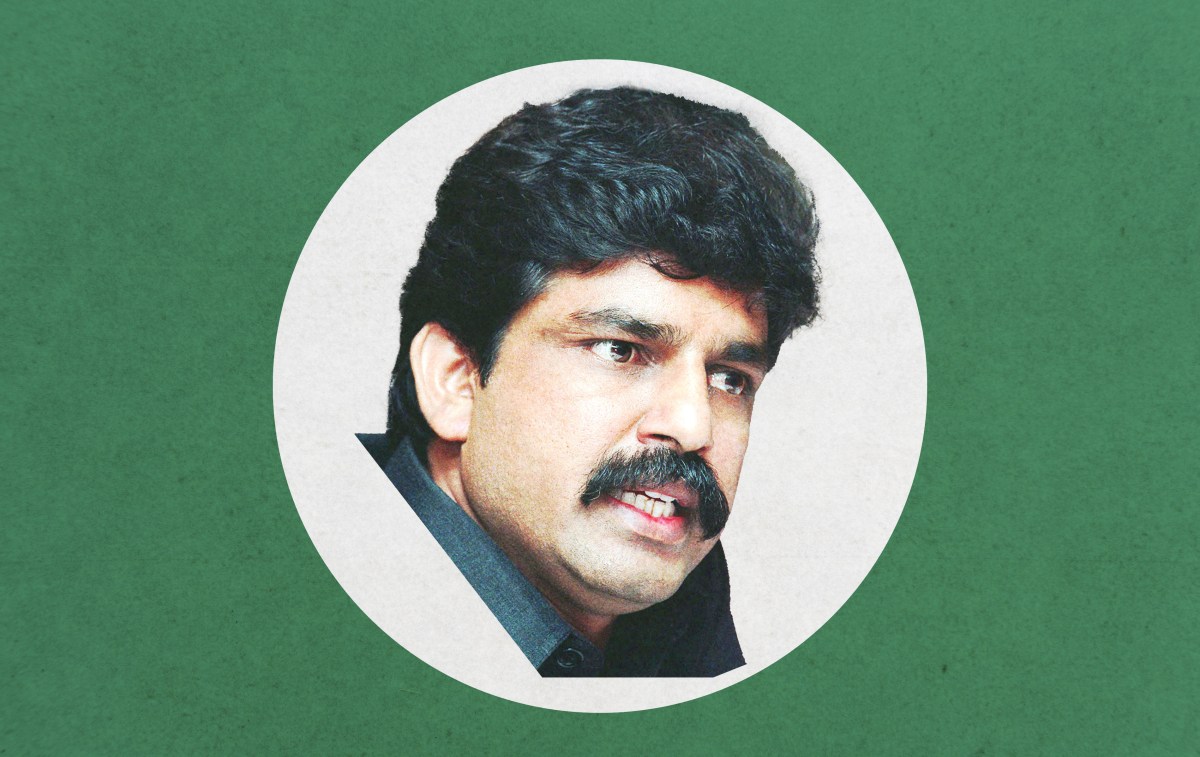
In 2008 Shahbaz Bhatti rose to a unique position: A devout Christian, he was appointed a Cabinet post in the Pakistani government. After his long and determined advocacy for Pakistan’s religious minorities, he would take on the job of serving them as the minister for minority affairs. But 15 years ago, gunmen from the Pakistani Taliban ambushed and murdered Bhatti while he was on his way to work. Former State Department official Knox Thames wrote about Bhati—his friend—in a piece on our website today.
Events that would lead to his death started to accelerate in 2010 when a Punjab court sentenced Asia Bibi, a Catholic mother of five, to death over bogus blasphemy charges. He advocated for her release alongside Salman Taseer, the Muslim governor of Punjab. As the death threats piled up, both pushed ahead. Shockingly, Taseer was murdered by his bodyguard in January 2011 for opposing the blasphemy law. The stakes were becoming life and death.
During this period, when serving as a U.S. diplomat, I saw firsthand how Shahbaz courageously and tirelessly advocated for Bibi and fellow Christians or members of other communities. As threats against him proliferated, I met him in his poorly guarded Islamabad office. While I and many others worried about his safety, he was ever the optimist. In his brief time in the Cabinet, he successfully established a special federal jobs quota to help religious minorities overcome workplace discrimination, a national minorities day to remember the role of minorities in the country’s founding, and a network of interfaith peace committees. He even ignited a conversation about reforming the abusive blasphemy law, the ultimate third rail of Pakistani politics.
During his last visit to Washington in February 2011 for the National Prayer Breakfast, he met with then-Secretary of State Hillary Clinton and senior members of Congress. He knew the risks he would face for his work. “These threats and these warnings cannot change my opinion and principles,” he said in a hauntingly prescient interview days after leaving Washington. “I prefer to die for my principles and for the justice of my community rather than to compromise on these threats.”
More Sunday Reads
- For The Atlantic, Karim Sadjadpour puts into context the death of Iran Supreme Leader Ali Khamenei, who rose to power after life as a poor cleric with revolutionary—and murderous—zeal. “Khamenei’s lack of clerical legitimacy, and his general insecurity, led him to cultivate the Islamic Revolutionary Guard Corps as his praetorian force; he handpicked commanders and rotated them to prevent rivals from accumulating power. The IRGC eclipsed the clergy as Iran’s most powerful institution—politically expedient for Khamenei and financially expedient for the Guards, which became the dominant economic force in the theocracy it defended. Khamenei wielded Iran’s elected institutions as facades, allowing just enough political theater to project legitimacy. No matter what agenda the president espoused—the economic pragmatism of Rafsanjani, the liberal aspirations of Mohammad Khatami, the populist provocations of Mahmoud Ahmadinejad, the nuclear diplomacy of Hassan Rouhani—Khamenei emasculated him,” Sadjadpour writes. “An Iranian academic, some of whose students rose to senior government positions in Tehran, once told me that at the revolution’s beginning, the regime consisted of ‘80 percent indoctrinated believers—largely ignorant of global realities—and 20 percent charlatans and chameleons.’ By Khamenei’s final years, he said, the ratio had inverted: 20 percent believers, 80 percent opportunists who flocked around officials for wealth and privilege.”
- The last Jew to come from a small Jewish community in Saudi Arabia died this week. David Shakur, who claimed in the Wall Street Journal in 2022 that he was the last survivor of the community near Najran, Saudi Arabia, was 82. For the Times of Israel, Zev Stub reports on Shakur’s ultimately unsuccessful attempts to get Saudi Arabia to allow him back the land of his birth for a visit after the kingdom banned Jews following the creation of the state of Israel: “Before the expulsion, Jews had a presence in Saudi Arabia for centuries, historians say. ‘Jews lived in Najran long before the Saudi rule. In fact, there is evidence that Jews lived there as early as 2,000 years ago,’ Shuker told Channel 13 in a 2022 interview. Some traditions trace their origin to the Ten Lost Tribes of Israel. ‘We were openly Jewish. The relations between the Jewish and Muslim communities were very close. They even helped us keep Shabbat,’ he said. But ‘the rulers treated us like second-class citizens. … Jews were not equal to Muslims.’ ‘Contrary to the rule in neighboring Yemen, the Jews of Najran were allowed to carry the traditional dagger, the jambiya, on their belts,’ Shuker wrote in the WSJ. ‘To this day, I remember the king’s soldiers spoiling me with sweets and patting my curly hair.’”
Religion in an Image