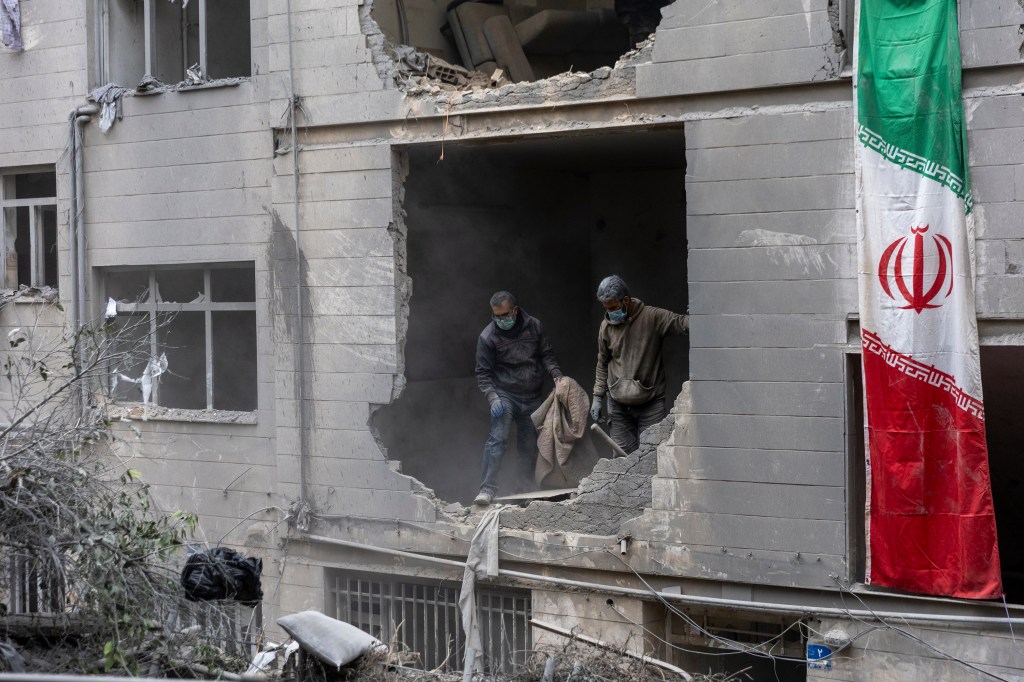
When Chinese Foreign Minister Wang Yi addressed reporters for his annual press briefing earlier this month, he spoke in the typical vernacular of a Chinese Communist Party (CCP) official. Of President Donald Trump’s war in Iran, he said, “A strong fist does not mean strong reason. The world cannot return to the law of the jungle.” Regime change in Iran, he said, would find “no popular support.”
But when Wang was inevitably asked about Beijing’s view of Taiwan—the island off its coast it claims rightfully belongs to China—Wang said “reunification” of Taiwan and China “is a historical process that cannot be stopped.” He added: “Those who defy it shall perish.”
Regime change for me, and not for thee, then.
While the war in Iran is unlikely to have changed Chinese President Xi Jinping’s overall calculus on Taiwan, close China watchers suggest the war in Iran is underscoring both Trump’s unpredictability and the capability of the U.S. military—even amid strategic uncertainty.
U.S. defense analysts in Washington have their eye on 2027 as a key date in China’s strategic planning for any potential cross-strait invasion to violently take back Taiwan—based on intelligence that suggested Xi had ordered his People’s Liberation Army (PLA) to be prepared to move by then.
But several factors make a full-bore invasion next year seem unlikely, and a coerced capitulation—by exploiting internal Taiwanese political divisions and slow, stepwise escalation—more likely.
For one, Xi is in the midst of a purge of his top military brass. He’s expelled, investigated, or simply disappeared dozens of high-ranking military officials since 2023. The Central Military Commission, a six-member group of China’s most senior military planners, is down to just one member. Many officials are facing corruption allegations—which, in a graft-prone PLA, could be legit or trumped up—but the removals may also reflect a failure to modernize the Chinese military by Xi’s deadline.
Plus, an invasion or even a drawn-out blockade could implicate the U.S. and its allies, given the U.S. policy of so-called “strategic ambiguity” about whether it would come to Taiwan’s aid if China threatened its sovereignty. The war in Iran brings the threat of U.S. military intervention into focus. “I don’t think [the war in Iran] fundamentally changes Xi’s calculus on Taiwan right now,” said Kirsten Asdal, a China risk adviser and founder of Asdal Advisory Group. “But it is a reminder for Xi that the number one factor for whether the PLA is ready to take Taiwan is whether they’re ready to repel and keep out the Americans—and any of their partners—as they attempt to do that.”
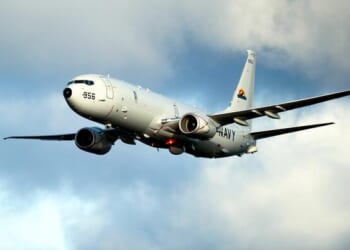
And the ongoing U.S. air and naval campaign in Iran is giving Xi a hard look at what American forces can do tactically and operationally. “Our air and naval forces are getting another good workout,” said retired Rear Adm. Mark Montgomery. “We’ll get better. We’ll understand our weapon systems better.” While Beijing will be learning, too, he adds, any tactical advantage to them may be a wash.
Still, plenty of observers have pointed out that the U.S. is expending valuable munitions, like the gold-standard Patriot air defense batteries, in its Iran operation that will take several years to restore. In just the first week of the war, the Washington Post reported, the U.S. fired $5.6 billion worth of munitions.
The Trump administration is also reportedly moving some Patriot and Terminal High-Altitude Area Defense (THAAD) missile defense batteries from South Korea to the Middle East.
Republican members of Congress are assembling a supplemental military spending package, but it’s not likely to come to the floor until later this month. And passage, if it happens, will be a slog, as even Republican lawmakers balk at the idea of plussing up the Pentagon’s $1 trillion budget, passed last year, without the White House making a strong case that it’s needed.
But it’s not just the weapons systems themselves that are at issue; it’s also the human teams that operate them. Their ratio of time deployed relative to time at home could affect those units’ readiness in the medium-term for a Taiwan scenario, said Montgomery.
This dilemma—the “simultaneity problem” of a war, or potential for war, on multiple fronts—is at the very heart of the 2026 National Defense Strategy (NDS). The document that ostensibly sets America’s defense priorities is explicit in calling for the U.S. “and its allies to be prepared for the possibility that one or more potential opponents might act together in a coordinated or opportunistic fashion across multiple theaters.” Thus, the strategy calls for burden-sharing among Western partners and targeted U.S. support to allies when it comes to their own defense.
While the NDS suggested the U.S. should offer only limited support to Israel against Iran and “empower it to defend itself,” actions speak louder than words.
So what message are U.S. actions sending to China? Montgomery argues it’s projecting deterrence in the Asia-Pacific. “The United States does stand by its allies and partners,” said Montgomery. “If you’re Korea and Japan, this isn’t all bad. There’s a strategic messaging in this that’s strong.”
Yet U.S. action in Iran has further strained at least some of those alliances. Many Western allies, even those who’ve avoided condemning U.S. and Israeli action, have flatly refused to aid an operation to establish control over the Strait of Hormuz, through which typically flows roughly 20-25 percent of the world’s oil and which the Iranians have effectively closed. In response, Trump threatened consequences for NATO allies.
But China had partnerships, too. Venezuela—whose dictator, Nicolás Maduro, U.S. forces detained in January—was the largest recipient of Chinese loan commitments underwritten by oil commodities. China has helped Tehran avoid Western sanctions on its oil exports, purchasing roughly 90 percent of Iran’s supply and smuggling it out on “dark fleet” tankers.
But Beijing has let Iran fend for itself since the outbreak of war, calling into question its own reliability as a partner. And while Iran was clearly not essential to Beijing, “it’s not a foregone conclusion that these investments [in partners] were wasted in every sense,” said Henry Tugendhat, a Soref fellow at the Washington Institute for Near East Policy. “But they’re certainly reckoning with the fact that they cannot necessarily predict the ways in which Trump will engage on any particular issue. It makes for a harder negotiating partner.”
Xi will have the chance to come face-to-face with whirlwind himself when Trump travels to Beijing—but not this month, as was previously planned. On Monday, Trump announced that he’d asked to push the visit back a month.
“Because of the war,” he said.
Perhaps the most fundamental lesson for Beijing of the last two weeks of war—and of 2026 so far—has been that Trump is unpredictable, Asdal said. “What’s been unfolding really validates for Xi his existing view of how the world works,” she said. “Self reliance as critically important to a nation’s security—that lesson is being validated for him loud and clear. … These partnerships and friendships can be useful, but never put all your eggs in those baskets.”