The joint U.S.-Israeli operation that began over the weekend is notching significant victories against Iran’s regime. Supreme Leader Ali Khamenei is gone, along with key government and military officials, in a surprisingly effective decapitation campaign echoing Israel’s opening strikes last June.
Killing Khamenei is important in its own right. His regime killed American service members and civilians; Iran’s reputation as the world’s top state sponsor of terrorism is well-deserved. Khamenei also oversaw the Revolutionary Guard’s (IRGC) resurgence from a humiliated and hollow force after the Iran-Iraq War to a leading regional power bristling with conventional, proxy, and near-nuclear arsenals. Even after their sharp defeat last summer, Khamenei and his coterie made clear that their military and atomic ambitions were undimmed.
The supreme leader’s welcome demise also affects how the ongoing war will be fought. The stakes of the standoff with America and Israel—the Great and Little Satans, as Ayatollah Ruhollah Khomeini labeled them—were clear in Tehran even before Khamenei’s death. Revolutionary regimes see sedition everywhere, with internal and external threats innately linked. President Donald Trump’s promise of help amid protests of unprecedented breadth and intensity earlier this year convinced the regime that the next round of conflict would be existential, and Trump’s recent call for the Iranian people to rise up as the United States and Israel take out Tehran’s military and internal security forces only reinforced such concerns. In exposing the regime’s brittleness, Khamenei’s death will spur his replacements to demonstrate just how dangerous they can be, both at home and in the region.
Knowing it cannot defeat the American or Israeli militaries directly, Iran is opting for horizontal escalation that raises the war’s political and economic costs by broadening and prolonging it. Attacks against military bases, critical infrastructure, and shipping in the region are intended to inflict American casualties, strain stocks of U.S. and Israeli critical munitions, and push world powers to demand the war cease before spiraling out of control. Though fraught with risk for Tehran, this strategy is its best counter to Trump’s preference for short, decisive, and contained campaigns.
This approach will create a competition between Iran’s ability to sustain drone and missile fire on the one hand and the United States and Israel’s capacity to neutralize those systems on the other. Last summer’s 12-Day War and this weekend’s strikes both made clear that Iran cannot orchestrate mass projectile barrages if under active assault. Coordinating hundreds of missile and drone launches, as it did twice against Israel in 2024, required unleashing the big first shot unhindered.
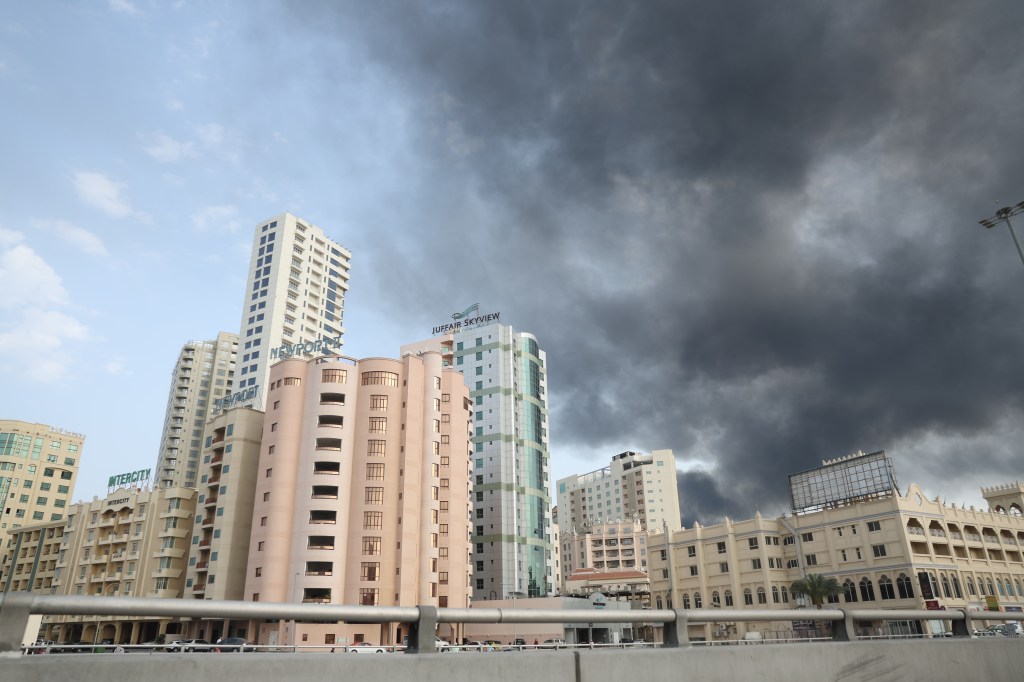
Despite being under fire and outgunned, however, Tehran has a key tactical advantage in the unfolding conflict, since even the threat of smaller attacks can have outsized effects. This is evident from the reaction to small handfuls of drones and missiles—or even just one—slamming into energy facilities, airport terminals, skyscrapers, merchant ships, and other conspicuous civilian targets throughout the region. These attacks jeopardize Gulf countries’ carefully cultivated image as the region’s stable oasis for investment, technology, and tourism, and by undermining trust in U.S. security umbrellas and air defenses, they may fray the political threads binding Iran’s adversaries together. Spiking crude oil prices and raising inflationary pressures will also affect America’s Asian allies, which consume most Middle East energy exports, and pinprick attacks on British and French bases could prompt those countries to call for de-escalation as well—or so Iran hopes. And while Israel is far more inured to combat, having to remobilize tens of thousands of reservists against Iran and its proxies compounds the stresses from two long years of war.
The IRGC prepared for precisely this kind of conflict, reflecting its ability to adapt between and amid exchanges of fire with the United States and Israel. It pre-dispersed authorities and locations of its launchers after Israel devastated its over-centralized command and control last June. It learned to leverage the country’s strategic depth by moving missile infrastructure deeper into its interior, farther from Israeli and U.S. bases but still in range of high-value targets in the Gulf and beyond. Initial losses during the 12-Day War also taught the IRGC to make a virtue of necessity by spreading out its attacks, seeking to besiege its enemies rather than pummel them with all-out blitzes.
Even in flux, Iran’s regime underlines this approach by signaling defiance at home and abroad. The IRGC vowed after Khamenei’s death to “ stand firm against internal and external conspiracies” and to “[punish] the aggressors.” Its former commander, Ali Larijani, and another close associate, Mohammad Bagher Ghalibaf, have begun filling the ensuing vacuum. The IRGC’s worldview was forged in its death grapple with Iraq in the 1980s when Iran’s missile attacks on Iraqi cities, so the story goes, staved off catastrophic defeat. By that same logic, missile strikes on U.S. forces in Qatar last summer, and in Iraq in 2020, persuaded Trump to end hostilities.
Joint U.S.-Israeli operations—also reflecting lessons from past conflict—aim to invalidate this theory of victory, racing to degrade Iran’s launch capabilities and internal security command structure as swiftly as possible. Strikes appeared to prioritize Iran’s air defense radars and mobile above-ground launchers, all of which proved vulnerable last summer. America’s first-ever operational deployment of aerial refueling tankers to Israel helps address what proved to be the major chokepoint in Israel’s capacity to generate long-range strikes last June, and the parallel deployment of F-22 stealth fighters to Israel gives the United States its first land-based platform in the region to strike Iran. The absence of this option last summer was one reason Operation Midnight Hammer required so many bombers and tankers to fly halfway around the world.
More broadly, the ongoing campaign reflects last summer’s biggest takeaway: U.S.-Israeli intelligence sharing, planning, and combined operations are force multipliers. Israeli planes literally cleared the way for Midnight Hammer, even conducting last-minute strikes at America’s request. Months later, this cooperation proved invaluable once again in targeting Khamenei and other Iranian leaders, as well as devising an effective operational division of labor: The United States has focused on Iran’s threats to the Gulf, while Israel has targeted longer-range capabilities and pillars of internal control.
The weight of U.S. and Israeli operations currently falls heaviest on western and southern Iran, where many launchers, naval forces, and IRGC and other regime leaders are located. Many of the country’s urban areas lie along this belt and, with them, key nodes in the regime’s internal repressive apparatus. As attrition takes its toll, the IRGC will have two options to extend the conflict and amplify its costs: Trade space for time, relocating inward to make it harder for U.S. and Israeli warplanes to reach its launchers and leaders, and close the Gulf by force with naval mines and attack craft. The U.S. Navy has limited countermeasures against the latter threat, and clearing them entails operating in cramped waters directly off Iran’s coast.
Escalating to de-escalate is often the gravest roll of the iron dice, but the Iranian regime will have it no other way. Its remaining leaders are uniting against U.S.-managed regime reshuffling, leaving little opening for the internal coups and fissures that forced capitulations by Germany in 1918, for example, or Japan in 1945. And Khamenei’s martyrdom, coupled with a deeply hostile populace, means that the poisoned chalice of surrender is off the table for his successors.
Having rolled the same dice, Trump should be crystal clear that he agrees with Iran’s leaders on one thing: There is no Venezuela-style outcome here. Anything short of regime collapse, even any hint of negotiations or other off-ramps, only portends an even more dangerous, IRGC-led junta, founded on the conviction that its own aggression overcame the worst its enemies could throw at it. This would forsake the president’s explicit pledge to clear the way for the Iranian people, forever erase his redline against crushing protesters, and crater U.S. credibility globally among allies and adversaries alike.
Trump should address the nation, the Iranian people, and the world to clarify and reiterate why he has committed the American military to its most consequential conflict in decades. Having perhaps grown accustomed to relatively short and cost-free ventures, the American people need to understand why eliminating the Iranian regime’s pillars of power is worth the risks it may bring. They also need to appreciate the burdens and costs borne by Israel in this shared fight, as well as the value of the bilateral partnership now and in the future.
And ultimately, Trump should stand by his commitment to the Iranian people. He could draw inspiration from Franklin Roosevelt’s fireside chats of the early 1940s. Though easily forgotten in the gauzy memories of “The Good War,” FDR, too, had to justify the patience and perseverance he was asking of Americans, our allies, and our fighting men and women. Those conversations gave hope to people suffering under the grip of our enemies and outlined his vision for a better future.