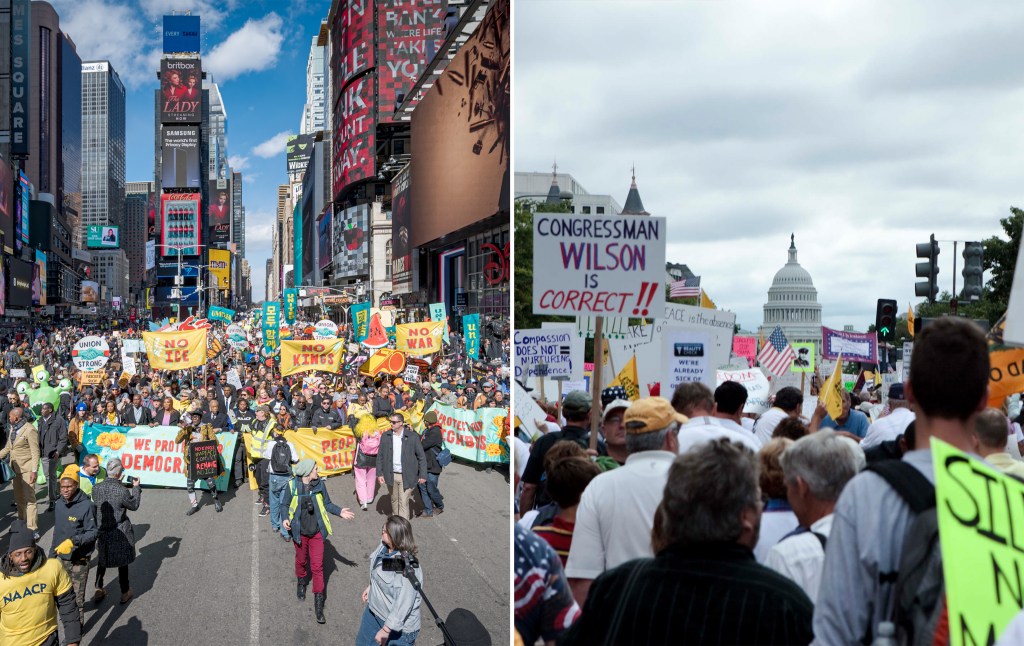
On Monday, I saw a segment on Fox News’ Special Report about the No Kings protests.
My old friend Bret Baier opened the segment by noting that a “network” of some 500 groups was behind the protests and that “some critics are doubting the sincerity of that movement.” Fox Digital reporter Asra Nomani conceded that there were some “well-intentioned people” in the protests, but claimed the “command and control” of the protests were these 500 groups with a supposedly shocking combined “$3 billion budget.” (This averages out to a less-than-shocking $6 million budget per organization, by the way.)
In some follow-up commentary, Brit Hume came on—introduced by a clip of some idjit commie kids chanting about “communist revolution”—to opine on the No Kings protests. With his hallmark sarcasm, Brit said we have to count these protests as a “great success.” After three of these No Kings marches, “We don’t have any kings … and so they’ve won.” He went on to note the “absurdity” of these protests and dismissed with a chuckle the suggestion that Donald Trump might have any kingly ambitions.
So, in short, the gist of the report and commentary was that the No Kings protests were of dubious sincerity, ideologically silly on the merits, infiltrated by dangerous radicals using the protests as cover for more nefarious and in some cases violent ends, and largely funded by a network of shady organizations and sinister billionaires. In short, it was a dismissible exercise in astroturf politics, reflective of a tiny and negligible “minority” of Americans.
I’m open to all of these claims.
For starters, it’s fine to question the sincerity of some of the No Kings crowd in at least one regard. If a Democratic president were abusing the system comparably to how Donald Trump is, the composition of these protests, if they happened at all, would be very different. Partisanship is obviously part of the motivation, and Hume is surely correct that a major driver of these protests is anti-Trump sentiment, not a serious objection to executive power run amok.
To which I say, “Okay.”
But rather than mock the protests, I think it would be much better for the country and conservatism to encourage the protesters to think through their newfound horror at presidents exceeding their authority.
It’s a bit like the progressives who suddenly discover the merits of federalism when Republicans are in office. Rather than bebop and scat on their hypocrisy, it would be better for everyone to foster some buy-in to the idea that might last into a future Democratic administration.
Second, as a rule, I don’t like protests. (At least not in the democratic West. Protests in authoritarian countries are very different.) A big part of my dislike is not ideological or political but psychological and aesthetic. Finding comfort in large mobs of people is, simply put, a bit creepy to me. I’ve written about the seduction and false transcendence of crowds many times.
Regardless, what struck me watching the combined segments was how familiar they felt. I thought, “Wasn’t this pretty much exactly how the mainstream media covered the tea party protests?” Instead of George Soros (who was name-checked in the Fox report) the New York Times, MSNBC, et al. harped incessantly about how the tea parties were funded by the Koch brothers and various astroturf right-wing organizations. They’d “question the sincerity” of the tea parties—or outright deny it.
These outlets also focused on the freaks, weirdoes, cranks, and characters who inevitably sign up for any mass movement and suggested they weren’t marginal but representative. As the Los Angeles Times noted back then, “At MSNBC, commentators Keith Olbermann, Rachel Maddow and Chris Matthews wrote off the demonstrations as the work of nothing more than crackpots or political stooges.” Others insisted that the tea parties literally fit the textbook definition of fascism. Some haven’t let go of this conviction.
The symmetry isn’t perfect. Mainstream media and various progressive groups were obsessed with the idea that the tea parties were racist, sometimes even likening the tea party to the KKK and Herman Cain as an heir to the Klan.
There hasn’t been anything like that, that I’ve seen, from the right with regard to the No Kings demonstrations. Though Scott Jennings did do a bit of amusing opportunistic nutpickery.
But the claims that the No Kings protests were a Trojan horse for communists just doesn’t feel all that different from the claims that tea parties were cover for fascists.
As for the scorn for the idea that “No Kings” is a silly slogan—which I’m marginally sympathetic to—I think it’s worth noting that the whole idea behind a movement built around the ideas that inspired the Boston Tea Party is not so very different. The Boston Tea Party was a protest against, well, a foreign king. There was other stuff involved of course, but conceptually the similarities are far more obvious to me than the differences.
And if we’re scoring for hypocrisy and insincerity, where the fudge are all the tea partiers these days? Trump’s fiscal incontinence, crony capitalism, and fetish for bailouts and taxes are certainly no better than Barack Obama’s. I attended many tea party events where speakers waxed eloquent about the Constitution and attendees carried little pocket Constitutions. If the No Kings crowds are hypocrites because they didn’t mind Joe Biden or Obama’s excesses but hate Trump’s, the same charge of hypocrisy works the other way around.
I mean, Trump has literally levied taxes on tea! He’s done so without the consent of Congress. Strictly speaking, this is taxation without representation. That Trump has levied taxes on a bajillion other things without constitutional authority doesn’t lessen the irony. The fact that he’s also launched a couple wars without congressional authority makes the “No Kings” argument stronger, not weaker.
Here’s another data point. The Ruthless podcast promoted its latest episode on social media by lamenting how “Democrats’ normalization of fringe characters, like Hasan Piker, shows you who is driving their party. We review insane clips from No Kings rallies that show the same problem—there’s no such thing as a moderate Democrat.”
Now, in the linked video clip I agree entirely with Josh Holmes that it’s outrageous for the New York Times to be platforming Hasan Piker, a terrorism-supporting left-wing poltroon.
But, here’s the thing. The right is suffused with right-wing versions of Piker. They might not be getting softball treatment from the right-wing equivalent of the New York Times, but that’s because there is no right-of-center equivalent of the New York Times (which is why everyone should subscribe to The Dispatch—editors).
But you know where there are plenty of ideological freaks? In the Trump administration. One of the most obvious, Joe Kent, just resigned as the director of the U.S. National Counterterrorism Center. But there are plenty of inmates running the asylum, from you know, the president of the United States, to the secretary of health and human services. Stephen Miller has his talons in everything.
Indeed, the administration is infested with social media propeller beanie white nationalists, spewing “Heritage American” bilge. The vice president, who dismissed “I love Hitler” chat groups by Young Republicans as boys-being-boys hijinks, recently gave an interview to Benny Johnson, “MAGA’s Chief Content Creator.” Johnson is not the New York Times, of course, but that’s the point. The scandalousness here runs the other way. Johnson is an election-denying, ridiculous, plagiarist grifter who insisted that Taylor Swift’s Super Bowl appearance was a pro-Biden “psyop,” suggested that Nicolás Maduro was abducted to prove Venezuela’s role in rigging the 2020 election, and took money from Russia—“unknowingly”—to spread bilious divisive nonsense. He claimed he was the victim of the scheme.
Worse gargoyles man every parapet of the broader MAGA infotainment complex, many of whom are granted special access to the White House. I don’t need to call the roll, because it’s such a familiar story now. But if you think Piker being a guest on a New York Times podcast is evidence that the Democrats have caved to the sinister fringe, you might want to take into account the fact that Candace Owens, Tucker Carlson, Megyn Kelly, Alex Jones et al. host podcasts, some of which often get more downloads than the Times and all of which are respected platforms in the GOP echo-system. The Young Republicans, an arm of the Republican Party, has been infiltrated and in many places, taken over, by groyper acolytes of admitted racist and Nazi fanboy Nick Fuentes. At the latest CPAC, a Texan politician said that we need to deport “100 million people.” Trump’s first choice for attorney general, Matt Gaetz, sees “Zionists” along similar lines to Piker. He also recently explained to Benny Johnson that a “whistleblower” told him the U.S. military is forcibly breeding space aliens with migrants to create hybrid beings for … reasons.
My point here is not to say the right is worse than the left, or that Republicans have surrendered more to their fringe than the Democrats to theirs, or that right-wing media is more morally or politically corrupted than left-wing media—or vice versa. Such arguments, however valid, miss a simpler fact: Both sides have little right to get on a high horse about how terrible the other is. They all have splinters in their eyes. They all sit atop horses sunk to their haunches in mud.
Pointing all of this out doesn’t make me a centrist or moderate in the way I discussed at the beginning. But it does put me in an uncomfortable place all the same. I get grief from people all the time for making “both sides” arguments and complaints. So be it.
When I say I’ve never been more politically homeless but I’ve also never been more ideologically grounded, this is what I mean. Do I think the median Republican politician is more likely to be right on a given policy issue? Sure. Though it obviously depends on the specific question. But do I think Republicans are in any position to righteously lament how crazy the Democrats are in order to insinuate that the GOP is the party of sanity and probity? Hell no. And the fact that apologists for the fringe right—or full-fledged members of it—run Congress and the White House, not to mention so much of the right-wing media infrastructure, makes finger-pointing at the “liberal media” or even Zohran Mamdani, AOC, Bernie Sanders et al.—however awful they might be—seem utterly insincere.
But I don’t think it’s insincere, at least not in many cases. Fish don’t know they are wet. And people inside partisan bubbles have trouble seeing what is obvious to those outside of them.
It’s not just that I’m disgusted with the ideological fringes on both sides, I’m frustrated to the point of being frequently appalled by the inability or unwillingness of the non-fringers in both parties to acknowledge the obvious truth as seen from outside the fishbowl. This puts me in an uncomfortable middle, or muddle.
In formal logic, the law of the excluded middle says that a proposition is either true or not true. In law, the jury either finds the defendant guilty or not guilty, but there’s no third option. In science, the object is either alive or dead, the light bulb is either on or off. This is how I often think about policy stuff.
But the law of the excluded middle doesn’t apply to politics, despite all of the “binary choice!” dogmatism we’ve been drenched in. If one party sucks, that doesn’t mean the other doesn’t. A stunning number of people really struggle to understand this, which is why all of those cliches about the most dangerous place to be is the “middle of the road”—because that’s where you get run over by cars on your right and left. But I guess I’m with Dwight Eisenhower, who was called a moron by the left and a secret communist by the fringe right. “People talk about the middle of the road as though it were unacceptable,” he said. “The middle of the road is all of the usable surface. The extremes, right and left, are in the gutters.”