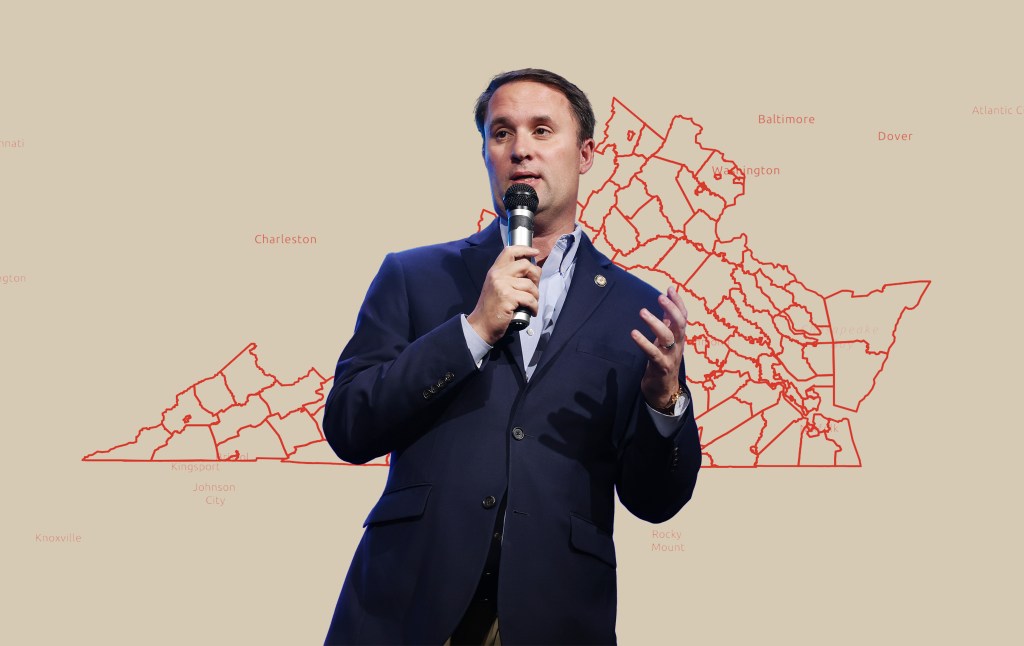
WINCHESTER, Virginia—Jason Miyares, the Republican former state attorney general, stood in front of a small group of GOP voters in the back section of an Italian restaurant Monday afternoon, trying to sound the alarm.
Early voting has already begun in a special election to amend the Constitution of Virginia and allow the Democratically controlled General Assembly to redraw congressional districts before this year’s midterms. If the amendment passes next month, in one fell swoop Democrats will remake the commonwealth’s map in an egregious gerrymander intended to strip Virginia Republicans of four of their five current seats in the U.S. House of Representatives.
As Miyares gestured at a poster showing the current and proposed district maps, a collective look of horror gradually spread across the faces of the dozen or so locals in attendance.
“They’re splitting into four districts the Shenandoah Valley,” Miyares said, efficiently ticking through each outrageous dilution of GOP power. “They have a district that starts in Northern Virginia, goes all the way down to Williamsburg through Yorktown. Hampton Roads, Virginia, goes from three congressmen to two. [If] this map passes, you’re going to have five members of Congress from Virginia all living within a 20-mile radius of each other—all in Northern Virginia.”
Multiple people gasped. Could the good people of the beautiful mountain and valley towns of western Virginia really find themselves represented in Congress by someone from … Arlington?
Republicans in the Old Dominion are scrambling to stop that frightening prospect from happening before the April 21 special referendum election. The GOP first went the litigation route, arguing that the Democratic majority in the General Assembly passed the amendment illegally and set the referendum election date sooner than state law requires. The state supreme court has twice turned away Republican attempts to pause the referendum, while the question of the legality of the amendment itself is pending and unlikely to be resolved before next month’s election.
“The courts, I don’t think, are gonna stop this,” Miyares said in Winchester. “I think now it has to be winning at the ballot box.”
Jason Miyares, a Republican with ambitions, cannot tell the rightfully concerned voters of rural Virginia the full truth: If gerrymandering draws them into unrepresentative districts, Trump will be largely to blame.
Jason Miyares is the public face of Virginians for Fair Maps, the most prominent anti-redistricting group to crop up in recent weeks. And with just about $3 million raised, it’s also the best funded, thanks to the involvement of Miyares and Eric Cantor, the former House majority leader who remains tapped into the GOP’s national donor networks. But that pales in comparison to the $22 million raised by Virginians for Fair Elections, a similarly named pro-redistricting group. That campaign has spent $12 million already on ads, including a ubiquitous digital and TV buy featuring former President Barack Obama.
That money advantage hasn’t translated into runaway support for the Democratic gambit. One poll from late January found a small majority of Virginia voters favor the amendment to allow for this one-time mid-decade redistricting, while another from last month found a small majority would vote against the amendment. Both polls found that a large majority of Virginia voters approve of the way Virginia does its regular redistricting: once a decade, following the U.S. Census, and with the approval of the General Assembly.
That suggests a real opening for Republicans, if they can figure out how to step through it. After the nearly 55 percent turnout in November’s gubernatorial election, Miyares says he expects only about a 20 percent turnout for the special election, where getting the vote out is typically more difficult. The name of the game for Republicans, then, is getting as many of their base voters across the commonwealth to show up on a random Tuesday in April—or better yet, vote early and “bank it,” as Miyares likes to say—and vote “no.”
So Miyares made a two-day swing up and down the Interstate 81 corridor this week, hitting the state’s deep red areas to spread the message. “Unless rural Virginia shows up, your voice is going to be silenced,” he told a crowd of brunchgoers at a restaurant in Warrenton on Monday morning. Miyares has linked this blatant power grab from Democrats as one of a string of early disappointments in the tenure of newly elected Gov. Abigail Spanberger, who campaigned as a moderate but has thrown her support behind the redistricting amendment.
In Winchester, Miyares noted Spanberger’s statement last year during her campaign that she had “no plans” to pursue mid-decade redistricting and referred to her tweet from 2019 that gerrymandering is bad for democracy.
“It’s like a bad used car salesman, right?” Miyares said. “What were they selling us last November, remember? Affordability.”
Miyares ticked off the list of new proposals coming from the Democratic majority in Richmond, from a carbon tax and tax on users of digital services like Netflix to expanding collective bargaining for nearly every public-sector employee in the commonwealth. “They said they were going to focus on lowering the cost of living for us,” Miyares went on. “And what have they done? Well, I guess affordability is a translation for more taxes, more regulations.”
(If all this sounds like the start of a stump speech, well, the consensus among Virginia Republicans I’ve talked to is that Miyares, who lost his bid for reelection last year, is the GOP’s leading candidate for the 2029 governor’s race.)
In all of Miyares’ and Republicans’ campaigning against this referendum, there’s something—or, rather, someone—conspicuously missing from the conversation: Donald Trump. The president features heavily in the Democrats’ ads, and for good reason. It was Trump who began the push last year for Republican-majority state legislatures to draw new congressional districts to give the GOP a boost in the midterms. Texas led the way, passing a new map in August 2025 designed to give the state five more Republican House seats, surviving legal challenges all the way to the U.S. Supreme Court.
Republican majorities in Missouri and North Carolina followed Texas’ lead by redrawing more favorable House maps. But all this spawned a predictable response from Democratic-run states. California led the counterattack, with Democratic Gov. Gavin Newsom backing a ballot referendum to redraw the state’s map to offset the gains Republicans would get in Texas. An overwhelming majority of voters passed that referendum in November.
Virginia is simply the next battleground for a redistricting war started by Trump, though Miyares dismisses that argument.
“Wrong,” Miyares says when I started to ask him about how Texas kicked things off. “The first state to do mid-decade redistricting was New York, and it is a frustration of mine that the legacy media has never mentioned that in their reporting of this.”
That’s technically true, but it’s also a convenient sidestep to the big Trump-shaped question. New York’s redistricting was the end of a years-long battle dating back to the regular post-2020-Census redistricting in New York. The state’s independent redistricting commission deadlocked and missed its deadline. When the commission finally came up with its long-delayed map, the Democratic majority in the state legislature rejected it and wrote its own after the state’s highest court ordered it. New York Democrats were hardly innocent of dirty partisanship, but their redistricting has a different provenance than this current exercise in tit-for-tat gerrymandering.
Miyares, a Republican with ambitions, cannot tell the rightfully concerned voters of rural Virginia the full truth: If gerrymandering draws them into unrepresentative districts, Trump will be largely to blame. This was a fight he started to bolster his party’s power in Congress without seeming to anticipate that Democrats would respond in kind. It’s clear even to Virginia Republicans, who will admit as much in private, that the president’s adventures in redistricting have backfired.
The five new districts meant to pad Republican numbers in Texas may not end up all going for the GOP. California’s own gerrymander, intended to merely neutralize Texas, may end up a net positive for Democrats. Team Trump’s effort to strong-arm the Republican majority in the Indiana state Senate into embracing mid-decade redistricting failed.
It may not matter that Miyares, who voted for the creation of Virginia’s independent redistricting commission while in the House of Delegates, and Virginia Republicans have the stronger and sounder argument in this redistricting fight. Thanks to Trump’s miscalculation of power politics, the commonwealth’s GOP voters may be stuck with the consequences.