When markets closed on February 27, before the Middle East attacks broke out, U.S.-benchmarked crude oil futures were priced at $67. They closed on Friday at $91, and have since exploded during off-hours trading to $106. That’s a nearly 60 percent increase in less than 10 days.
The Iranian regime’s decision to embroil its Gulf nation neighbors in the conflict has only made matters worse. Statistician Nate Silver recently noted that, while Iran’s 2024 oil production ranked only sixth worldwide—at about one-fifth the production of the U.S. that year—when combined, Iran, Bahrain, Kuwait, Iraq, Oman, Qatar, Saudi Arabia, and the United Arab Emirates (UAE) account for about 30 percent of the global oil supply.
On March 2, Iran apparently launched a drone attack against a Saudi Arabian oil refinery, one of the largest in the world. Iranian Deputy Foreign Minister Majid Takht-Ravanchi claimed that Iran had no responsibility for the attack, but Saudi Arabian officials said their defenses successfully shot down two drones—though debris fell on the facility, causing “limited” damage and a fire that was soon contained. In what Saudi Arabian officials described as a precautionary move, some operations at the oil refinery were suspended as they fully assessed the damage.
More recently, on March 5, Iran launched a drone strike against an oilfield in the northern Iraqi region of Kurdistan owned by HKN Energy, a subsidiary of the U.S.-based company Hillwood Energy. An oilfield engineer told Reuters that the Iranian attack sparked a fire at the field, prompting a halt in production. Before the Iranian attacks, the oilfield had produced an average of 30,000 barrels of oil per day.
Kuwait has also announced cuts to oil production because, as the Wall Street Journal reported on Friday, the country is running out of storage space as the war limits its ability to export its reserves. Saudi Arabia and the UAE are in a similar boat, according to the analytics firm Kpler, with both countries also running out of container space to store oil and currently on pace to reach full capacity in three weeks.
While larger storage capacity would allow these Gulf nations to keep churning out oil, they haven’t preemptively expanded it because, outside of a regional military conflict, the benefits would be limited. “I think there’s a limit to how much excess storage capacity you want, because you don’t need that all the time,” Antoine Halff, the founder of Kayrros, an environmental intelligence and asset observation analytics firm, and former chief oil analyst of the International Energy Agency, explained, noting that countries exporting large volumes of oil don’t need vast storage space because “spare capacity is kind of your spare production capacity.” In other words, why store it in a tank when you can sell it to the highest bidder?
And the oil market is not the only one facing disruptions.
Qatar, which exports about 20 percent of the world’s liquefied natural gas (LNG) supply, announced last week that it would be suspending production amid continued Iranian aerial attacks. That same day, Qatar’s Defense Ministry said that Iranian drones, in separate attacks, targeted an energy facility and a power plant’s water tank. Two days later, on March 4, Qatar declared force majeure on LNG exports, meaning it anticipates it will not be able to meet pre-arranged export targets due to circumstances beyond its control, with Reuters reporting that it will take at least one month for production to ramp back up.
Those who have refilled their gas tanks in recent days have likely already noticed the effects of this oil supply shortage. According to the American Automobile Association, the average price of gas has increased nearly 17 percent in the last week alone, from $2.98 per gallon to $3.47 per gallon. And the pain is unlikely to stop at the pump. “The higher oil and natural gas prices show, first and foremost, in the cost of a gallon of regular unleaded, but it quickly impacts prices for almost everything,” Mark Zandi, chief economist of Moody’s Analytics, told TMD. “Oil and natural gas are critical to all manufacturing processes,” he added, noting that price increases for that valuable input source will mean that “all manufacturing goods would be more expensive” if the Iran conflict continues to constrain the global oil market.
According to Zandi, the inflationary pressure from the conflict will only build as it drags on, but even once the fighting subsides, prices won’t immediately drop back to pre-war levels. “Businesses are quick to raise prices [during] events like these, especially in the oil market, but they’re very, very slow to bring them back down,” Zandi said. “They eventually come back in because of competitive pressures, but that takes time.”
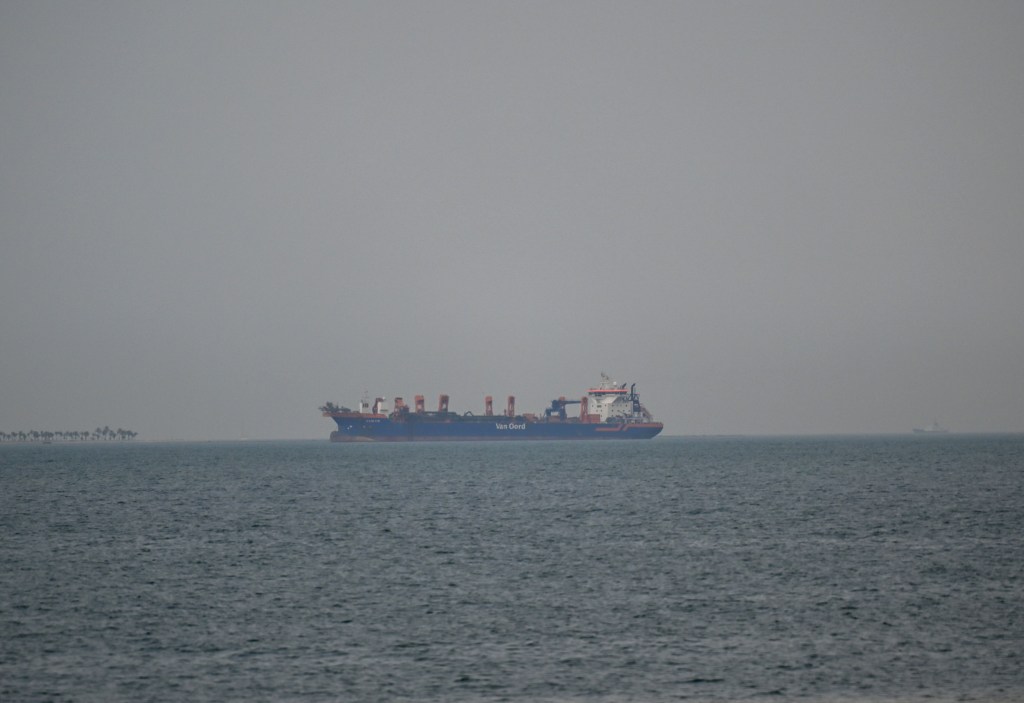
And while production is certainly impacted by the war, so is shipping. Much of the oil exported by the Gulf states passes through the Strait of Hormuz, a narrow sea passage between the Persian Gulf and the Gulf of Oman, with Iran on its northern shore and Oman and the UAE to its south. Iran’s elite military branch, the Islamic Revolutionary Guard Corps, said on Friday that its forces have not closed the Strait of Hormuz, while warning that it wouldn’t hesitate to attack any U.S. or Israeli ships that enter the area. President Donald Trump, in a social media post shared on March 3, said that he was prepared to order U.S. naval ships to physically escort commercial vessels through the Strait of Hormuz “if necessary,” though the Wall Street Journal noted that American naval powers may currently be spread too thin to provide a sufficient amount of military support to safely do so. According to vessel-tracking data analyzed by Bloomberg, it’s been more than 24 hours since a non-Iranian-flagged commercial ship has entered the Strait of Hormuz, the last being a Chinese-owned bulk carrier on Saturday morning.
Bob McNally, the founder and president of Rapidan Energy Group who formerly served as a White House energy adviser to former President George W. Bush, explained that the potential economic impact of the war will largely depend on whether and when commercial vessels feel safe to trek the Strait of Hormuz. If oil tankers begin traveling the Strait again in a matter of days, then the economic consequences “will be remembered as a sharp but transient hit to consumers’ wallets,” McNally told TMD. “If, however, we are unable to reopen the Strait of Hormuz to commercial traffic, then we’ve only begun to see the pain, and prices will keep rising,” noting that the average price of gas per gallon could approach $4.
Trump himself, already dealing with flagging approval numbers, seems to be preparing Americans for that reality. “Short term oil prices, which will drop rapidly when the destruction of the Iran nuclear threat is over, is a very small price to pay for U.S.A., and World, Safety and Peace,” he wrote on Truth Social last night. “ONLY FOOLS WOULD THINK DIFFERENTLY!”