One of the more head-scratching facts about World War II is this: The United States responded to the Japanese bombing of Pearl Harbor by sending more than 5 million troops to Europe. It is counterintuitive, at least, that the U.S. would send half its military to the opposite side of the globe from the enemy who attacked it.
Even after Nazi Germany declared war on the United States—on December 11, 1941, days after Pearl Harbor—the U.S. could have prioritized Japan and left Europe to Britain and the Soviet Union. Many Americans, including Adm. Ernest King, the commander in chief of the United States Fleet, argued for a “Japan First” strategy. The U.S. did the opposite. Why?
The answer reveals something important about the role the United States chose to play on the world stage. American power was supposed to be different from the great powers of the Old World. It would not be cynical, narrow, used exclusively for its own preservation to the detriment of others. American power would be linked to American ideals.
It would be tough-minded, yes, and prudently self-interested. But American statesmen took a longer view and understood that a truly self-interested strategy was not the short-term, cynically transactional, calculating self-interest in dollars and cents, but relational and ideological, measured in the growth of American ideals and the networks among like-minded nations.
These ideals found expression in President Franklin Roosevelt’s idea of the neighborhood of nations, in his Four Freedoms, and in the Atlantic Charter, the clearest and most consequential expressions of the American experiment on the world stage.
The neighborhood of nations.
Earlier in 1941, months before Pearl Harbor, the American and British militaries had already war-gamed a possible global conflict against the Axis powers. They rejected the “Japan First” strategy and agreed, at least for planning purposes, on “Germany First.”
The logic was straightforward and starkly realist. Germany was the center of gravity of the Axis powers: It was the largest, richest, most technologically advanced industrial power. If it conquered Britain, it imperiled the Atlantic Ocean. If it conquered the Soviet Union, it would amass untold resources. Japan, by contrast, could be contained.
Yet when it came time to sell the war to the American public, Roosevelt made a different argument. He did not argue to the American people about Germany’s GDP, how many metric tons of steel its factories produced, or the advanced state of its armaments factories. He linked American security to the moral meaning of the war.
“The Nazi masters of Germany have made it clear that they intend not only to dominate all life and thought in their own country, but also to enslave the whole of Europe, and then to use the resources of Europe to dominate the rest of the world,” he said in his December 1940 fireside chat.
The Nazis “openly seek the destruction of all elective systems of government on every continent—including our own,” Roosevelt told the White House Correspondents Dinner in March 1941. “They seek to establish systems of government based on the regimentation of all human beings by a handful of individual rulers who have seized power by force.”
That is why the United States could not be aloof from events in Europe. In December 1940, explaining his proposed lend-lease program, Roosevelt argued that if a neighbor’s house caught fire, any decent person would immediately lend their garden hose to help put out the fire. The analogy played to Americans’ sense of altruism but also their self-interest: Fires spread, including in the neighborhood of nations.
The neighborhood of nations: That image is key to Roosevelt’s—and America’s—vision of what the war was about. If America was intent on defending its house alone, it would have adopted a “Japan First” strategy, possibly leaving the fighting in the European theater to the British and Soviets armed with American weapons. Adopting a “Germany First” strategy was not just a calculation about the relative strength of the Axis powers. It was also a statement about America’s vision of the world and its role in it.
Fires spread, and America would be the fire warden.
The ‘Four Freedoms.’
The fire warden had a firm idea of how the neighborhood should be organized. In January 1941 Roosevelt reiterated the injustice of the Nazis’ vision of the world and contrasted it with the principles of American freedom.
“No realistic American can expect from a dictator’s peace international generosity, or return of true independence, or world disarmament, or freedom of expression, or freedom of religion,” Roosevelt told Congress. He argued that the “principles of morality” prevented him from “acquiesc[ing] in a peace dictated by aggressors and sponsored by appeasers,” because “enduring peace cannot be bought at the cost of other people’s freedom.” The Nazis, he said, wanted to build a new “one-way international law, which lacks mutuality in its observance, and, therefore, becomes an instrument of oppression.”
Contrasting with the Nazis’ vision of the world, Roosevelt famously outlined his Four Freedoms: freedoms of speech and religion, freedom from want, and freedom from fear. Freedom from want referred to conditions that enabled a nation to provide a “healthy peacetime life for its inhabitants,” and freedom from fear meant disarmament to the point that aggressive warfare became impossible.
The same ideals that led America to assemble the mightiest army in world history, to build and use nuclear weapons, are the same ideals that led America to annex no territory, to voluntarily demobilize its military, and to go home.
Roosevelt saw a cohesive moral order underlining American democracy at home and the Four Freedoms abroad. “Just as our national policy in internal affairs has been based upon a decent respect for the rights and the dignity of all our fellow men within our gates,” he said, “so our national policy in foreign affairs has been based on a decent respect for the rights and dignity of all nations, large and small. And the justice of morality must and will win in the end.” American strategy in World War II was an outworking of American ideals on the world stage.
“By winning now, we strengthen the meaning of those freedoms, we increase the stature of mankind, we establish the dignity of human life,” he later said. He called for the nations of the world to “serve themselves and serve the world” by respecting the Four Freedoms and “abandon man’s inhumanity to man.” The Four Freedoms are the best summation of Roosevelt’s understanding of the just cause for which the war would be fought.
The Atlantic Charter.
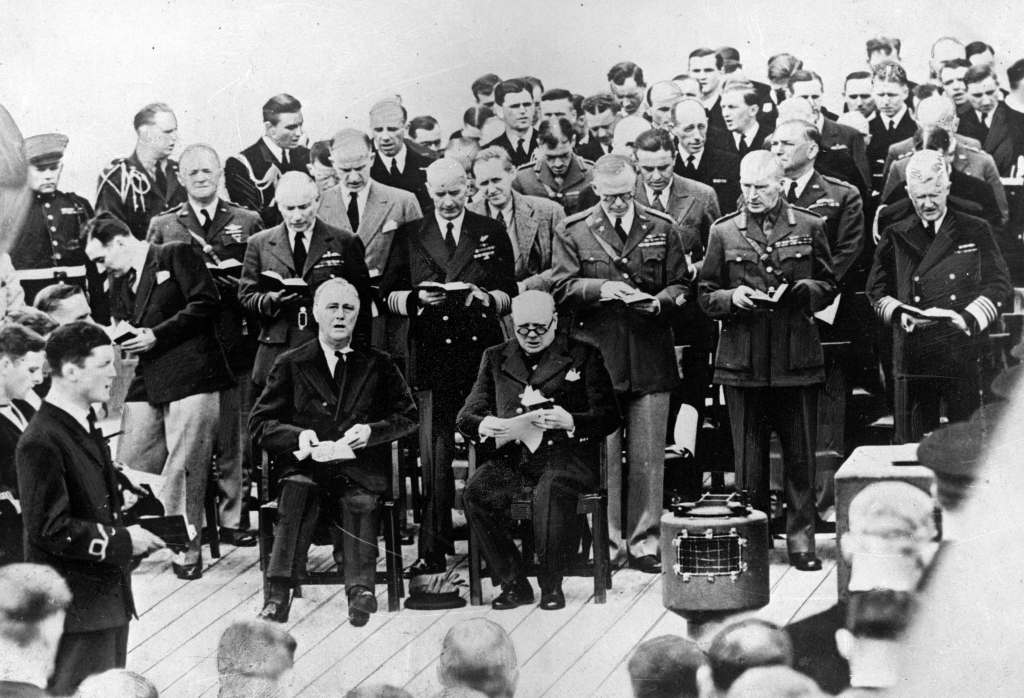
Roosevelt’s moral vision of the war received its formal expression in the Atlantic Charter, a joint declaration with British Prime Minister Winston Churchill in August 1941. The Charter became a declaration of war aims, a touchstone outlining the sort of world the allies were fighting for, and became a foundation of the postwar order.
The allies foreswore territorial conquest, affirmed the consent of the governed, affirmed free trade and economic cooperation and the freedom of the seas, called for general disarmament to a level that would make aggressive warfare impossible, and looked forward to a durable and lasting peace “which will afford assurance that all the men in all the lands may live out their lives in freedom from fear and want.”
The charter is the founding document and constitution of what is clunkily called the “liberal international order,” but is more accurately called the free world. It was later incorporated into the Charter of the United Nations—but the real animating spirit of the charter found life in the North Atlantic Treaty Organization (NATO), an alliance of free democracies that has anchored world order for eight decades.
Most Americans today have only the dimmest understanding that for most of human history, most people were poor, unfree, and miserable. The emergence of a free world order—with democracy and rights, capitalism and free trade, international cooperation and collective security—is the greatest thing that has ever happened in (secular) history.
It happened because of the convergence of American power with American ideals. We did not beat the fascists with the power of American ideals; we beat the fascists because we had bigger guns. But so did the Soviets, and the Soviets did not write the Atlantic Charter, did not talk about Four Freedoms, and did not create a free world order in the aftermath.
Global ambitions and national identity.
Armed idealism is usually a straight road to zealotry, crusading, and tyranny. But consider: The same ideals that led America to assemble the mightiest army in world history, to build and use nuclear weapons, are the same ideals that led America to annex no territory, to voluntarily demobilize its military, and to go home. As Colin Powell often said decades later, “The only land we ever asked for was enough land to bury our dead.”
Of course, there was a measure of hypocrisy in preaching a gospel of liberty while overseeing Jim Crow at home. But rather than letting our imperfections hobble our aspirations for the world, the causal arrow went the other way: We let our global ambitions reshape our national identity. Black veterans came home and demanded rights, white veterans came home readier to grant them, and Americans stung by the horror of white supremacy’s atrocities abroad were more prepared to acknowledge them at home. Sometimes foreign policy leads, rather than follows, our national mission.
If there was ever a moment when one nation had the means to conquer the world, it was the United States of America in 1945. That we did not is an underrated tribute to American virtue, a national reenactment of George Washington’s resignation at the height of his power. And it happened because of American beliefs in limited government and republican liberty; in a neighborhood of nations that look out for each other; in freedom of speech and religion, freedom from want and fear; in consent of the governed, free trade, freedom of the seas, and international comity. These are America’s greatest legacy and, through the Second World War, our greatest bequest to the world.