Now would be a good time to put an end to the charade that the annual State of the Union address is a solemn occasion of civic ceremony. Although there have been moments in which the speech has seemed to serve such a function, it has always been primarily a vehicle of presidential and partisan boosterism.
Members of Congress and the Supreme Court have long been dragooned into playing along with the ruse. They should not continue to do so. They should stay home and let the president deliver his speech to a half-empty room of his most partisan supporters.
The Constitution does not call for or require the State of the Union address. Rather, it specifies that the president will “from time to time give to Congress Information on the State of the Union, and recommend to their Consideration such Measures as he shall judge necessary and expedient.” The provision is now viewed as pointing to the “legislative role” of the president, but the concern of the constitutional drafters was to ensure that the legislature was adequately informed of new developments and the need for any federal policy response. The executive was expected to have information in its hands that Congress might want or need, and the constitutional directive to the president was to make sure that the information was passed on in a timely way to the branch that should deliberate on any policy response.
Presidents historically satisfied that constitutional duty in one of two ways. First, they sent to Congress an annual message. The annual message was a long, boring written report reviewing where things stood with the government and what policies the various departments might like to see adopted. In a time when Congress was out of session for months at a time, the annual message served to catch the members up on what they had missed when they arrived back in the nation’s capital. The regular and comprehensive annual message was supplanted by special messages, which were likewise written reports with information and policy recommendations but focused on a particular topic and without a regular schedule.
The Federalist presidents took the opportunity to deliver their message in person, but the Jeffersonians abandoned the practice. In Thomas Jefferson’s view, a personal appearance by the president in the congressional chamber, and the pomp and circumstance that surrounded it, had too much of a whiff of monarchy about it. John Adams had, after all, proposed that the president be formally addressed as “His Highness the President of the United States and Protector of Their Liberties.” Moreover, Jefferson thought the Federalist practice had already shown itself to be a vehicle of partisan animosity. The two legislative chambers had traditionally produced a formal answer to the presidential address, and those messages to the president had generated “bloody conflicts” over tone and content. Rather than force Congress into exposing “party division” in crafting a formal reply to the president, better to just let Congress get on with its work. The president had an aide deliver his message. A clerk read it into the record. Lawmakers could ignore it or take it up as they wished.
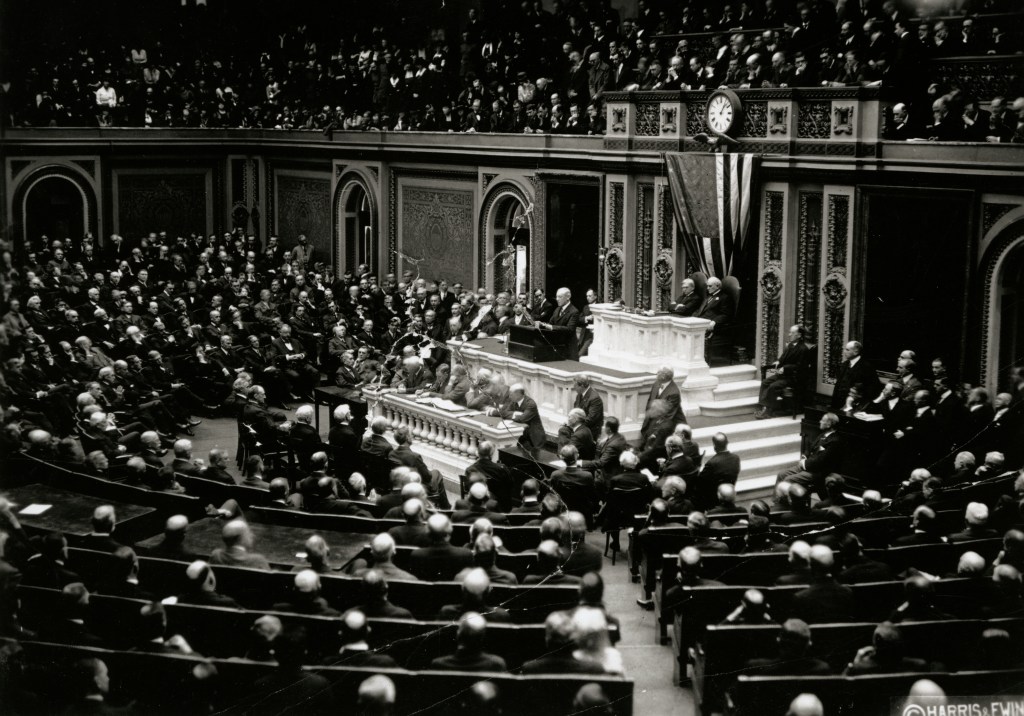
Jefferson’s precedent stuck for more than 100 years. It was changed by Woodrow Wilson. Wilson was no fan of the constitutional separation of powers, and he thought that “cooperation” rather than “checks” should be the order of the day. As a professor, Wilson had complained that the government was “leaderless” and the president “argues and urges” but “cannot command.” Years later, as president, Wilson hoped to provide the leadership that Congress had been missing.
Wilson broke dramatically with tradition and went to a joint session of Congress to deliver his State of the Union address. No more written annual message that could be ignored. Wilson’s goal was to use the spectacle of the presidential appearance to overawe the Congress and appeal over the heads of the assembled members to the public beyond them. Wilson thought Jefferson had made a grave error in abandoning the possibility of addressing “Congress in person, as the sovereign in England may do.” The annual message was a lost opportunity. The State of the Union could allow the president to “lead the houses without dictating to them.”
Wilson did not want a civic ceremony. That was what the inaugural address was for. The presidential inauguration was a time for healing old wounds and bringing the nation together. The State of the Union could be something different. It could be a presidential pep rally. Wilson’s experiment proved to be a “great personal triumph,” with his “brief address” being greeted with “tumultuous applause” as Democrats congratulated themselves on the president’s “masterly political sagacity.” Republicans thought such a partisan show could not last since it would prove embarrassing when boos rain down on a president rather than cheers, but those Republicans seemed to underestimate the pressure for decorum that would tame partisan opposition to the president.
Wilson’s innovation stuck because it was useful. Presidents got to highlight their agenda and rally public opinion behind them. The value to presidents of the annual speech became even greater with the advent of radio and television, which could bring the spectacle directly to the public. Even as presidents have honed their skills at delivering punchy, partisan applause lines, members of the other two branches of government have meekly agreed to serve as the president’s props and to help dignify the proceedings by their presence.
Famously, the justices found themselves in an awkward position at the 2010 State of the Union address delivered by President Barack Obama. Obama used the occasion to directly criticize the assembled members of the court for their recent decision in Citizens United v. the Federal Election Commission. Cameras caught Justice Samuel Alito mouthing “not true” as the president characterized the case.
Chief Justice John Roberts later complained to a law school class.
The image of having the members of one branch of government [the Congress] standing up, literally surrounding the Supreme Court, cheering and hollering, while the court, according to the requirements of protocol, has to sit there expressionless, I think is very troubling. … To the extent the State of the Union has degenerated into a political pep rally, I’m not sure why we’re there.
The stage is set for Tuesday’s State of the Union address to devolve into a similar spectacle—or worse. President Donald Trump’s initial response to the Supreme Court’s tariff ruling last week may provide a preview: He launched into one of his patented rants. The justices who ruled against him were “unpatriotic and disloyal,” “a disgrace,” “swayed by foreign interests,” “fools and lapdogs,” “an embarrassment to their families.” Apparently much like Vice President Mike Pence in 2020, who did not have the “courage” to install the defeated incumbent back in the White House, the court’s majority did not have the “courage” to support Trump’s tariff extravaganza. He repeated his suggestion that perhaps it is time after all to pack the Supreme Court with new justices.
Who knows what Trump might choose to say in this State of the Union address, just days removed from this signature loss in the Supreme Court and with a long track record of losses in the lower courts. Will the justices be required to “sit there expressionless” as the president’s “cheering and hollering” supporters surround them and the president himself looks down on them and calls them fools and perhaps announces his own court-packing plan?
Now would be a good time for the Wilsonian experiment to come to an end. It seems like it is only a matter of time before the Republican prediction from back in 1913 comes true and a president is greeted with a cacophony of boos. Instead of Democrat House Speaker Nancy Pelosi waiting until the end of a Trump presidential address to show her disdain by ripping up his speech, a future House speaker might take the opportunity to show even less restraint while sitting on camera behind the president. Rather than a single member of Congress shouting “liar” at President Joe Biden during his speech, a partisan majority might decide to shout down the president with jeers and boos. After the midterm elections, an emboldened new Democratic congressional majority might simply refuse to invite President Trump to the chambers to deliver a speech at all. He can, after all, deliver a speech from the White House lawn any time he wants.
Trump, like Woodrow Wilson before him, hopes to benefit politically from delivering the State of the Union address. He wants the spotlight. He wants to force the members of the court and Congress to formally greet him with smiles and handshakes as he makes his grand entrance and exit from the chamber. He wants the presidential pep rally.
There is no reason to give it to him. Members of the court and the Congress can just stay home or engage in their own preferred direct counterprogramming. Other members can treat the State of the Union as what it is. It is not a civic ceremony for bringing the country together. It is a platform for elevating the president as the leader of his party and for pressuring the other branches of government into doing the president’s bidding. Trump can have his rallies. There is no obligation for anyone to attend one.