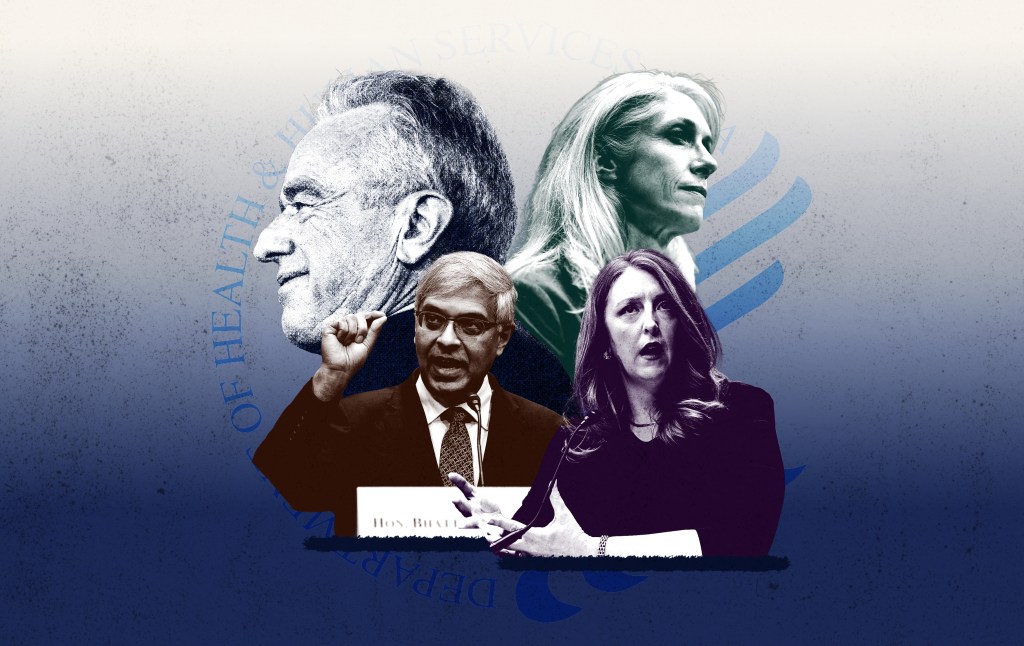
Last week, the Centers for Disease Control and Prevention hit the 210-day statutory limit for temporary leadership, leaving the agency without an acting director.
Installing a CDC director requires Senate confirmation, but all that’s necessary to remove the time limit on an interim leader is to simply select a nominee for the permanent role. The White House could announce a new director pick at any time, but it has failed to do so in the nearly seven months since Health and Human Services Secretary Robert F. Kennedy Jr. fired the agency’s last director.
The surgeon general post is also vacant. President Donald Trump nominated Dr. Casey Means nearly 11 months ago, but the Senate has yet to vote on her confirmation. As the federal government’s two most visible public health roles remain unfilled, America is seeing an ongoing surge in measles and a recent E. coli outbreak that has sickened people in three different states. Former HHS officials say the lack of leadership leaves the country vulnerable to serious public health threats.
The CDC has had, at best, a tumultuous year. The Department of Government Efficiency (DOGE) slashed whole offices, resulting in almost 20 percent of the agency’s staff being fired or quitting. In August, a gunman who believed the COVID vaccine had caused his depression attacked the CDC headquarters in Atlanta, firing nearly 500 rounds and killing one police officer. The Senate had confirmed Susan Monarez as CDC director a week before the attack, but she would last only 28 days in the position. Kennedy fired Monarez after she refused to go along with his anti-vaccine agenda.
For most of last year, officials close to Kennedy headed the agency in an acting capacity and appeared to function as proxies for the secretary. In some cases, Kennedy took unilateral actions that would typically be made by the CDC director, such as rolling back COVID-19 vaccine guidance for pregnant women and children last May.
In February, National Institutes of Health (NIH) Director Jay Bhattacharya became the CDC’s acting director following the departure of another acting director, Jim O’Neill. Some agency staff welcomed his arrival as a reprieve from the alternating hostility and neglect they saw from Kennedy. Bhattacharya also delivered a full-throated embrace of vaccination to fight the measles outbreak—something HHS leadership has largely failed to do over the last year. “I think it is vital that every kid in this country get the measles vaccine—absolutely vital,” he told CDC staff in a town hall late last month, a message he had already begun promoting publicly as acting director.
After last week’s deadline, an HHS spokesman said Bhattacharya will still oversee the CDC, but he can no longer legally perform the full range of director duties. Without an acting or permanent chief, tasks that congressional statutes explicitly reserve for the CDC director can now only be performed by the HHS secretary. These include things like adopting vaccine recommendations from the CDC’s immunization advisory committee.
“It’s proving impossible to find folks who are appropriately supportive of vaccines but who also pass the RFK litmus test.”
Dr. Jerome Adams
Former HHS officials emphasize that having Bhattacharya temporarily in charge isn’t a substitute for permanent leadership or the restoration of staff and resources slashed under Kennedy. Bhattacharya is also still the head of the NIH, another full-time job at an agency that is still missing permanent leaders for most of its institutes. “The absence of a full-time CDC director creates dangerous gaps in authority and makes Americans less safe,” Tom Frieden, CDC director during the Obama administration, told The Dispatch. “The director is responsible for leading the response to disease outbreaks, final vaccine recommendations, interacting with states, localities, Congress, and international partners, and providing strategic direction.”
Bhattacharya said the administration is planning to hire additional staff, but the CDC is still reeling from last year’s cuts and hiring freezes. On Monday, the agency suspended a range of disease testing services, including for rabies and monkeypox, that were previously available to state and local health authorities.
Dr. Jerome Adams, the surgeon general in the first Trump administration and former health commissioner of Indiana, told The Dispatch the lack of CDC leadership undermines the agency’s ability to respond to outbreaks and support state and local health departments. “We are much less able to respond to outbreaks like measles when they occur without a CDC director able to say on a moment’s notice, ‘Yes, send 10 officers to Texas right now to help respond to this measles outbreak,’” he said. “When you don’t have a director, you lose surveillance, you lose response, and you lose real-time guidance, and that hurts America’s health.”
Trump let Kennedy “go wild,” as he put it, on vaccines and the country’s public health infrastructure for nearly a year. But the midterm elections now loom large, and a vocally anti-vaccine agenda is beginning to look like a political loser to the administration. The White House has reportedly decided to rein in the secretary’s campaign against vaccines following a December survey from a Trump pollster that showed anti-vaccine policies could be a liability for Republicans in competitive House districts.
The White House elevated Chris Klomp to HHS chief counselor, a role overseeing operations across the entire department, in February and reportedly tasked him with stabilizing the agency and focusing attention on popular health care issues like drug costs and moving away from changes to vaccine policy. Klomp is also leading the CDC director search, and he said last month the administration had identified a few finalist candidates to lead the CDC. Bhattacharya told agency staff on March 25 that a director would likely be nominated within 24 hours, but more than a week later, there has been no announcement.
Political headwinds may also doom the president’s nominee to become the nation’s top doctor. Means, a wellness influencer and Kennedy ally, had a confirmation hearing in late February where she offered general statements of support for vaccines but repeatedly demurred when pressed on specifics by lawmakers. Sen. Bill Cassidy, the chair of the Senate health committee, asked Means if she would encourage mothers to give their children the measles vaccine in light of the growing outbreaks. “I’m not an individual’s doctor and every individual needs to talk to their doctor before putting a medication in their body,” Means replied.
When asked about the status of Means’ nomination last week, Cassidy told NBC News he had “no comment on Casey,” and no committee vote on her nomination is scheduled. The president suggested to reporters over the weekend that he could potentially consider a new surgeon general nominee, but the White House press secretary followed up by reiterating support for Means.
Adams sees both the CDC and surgeon general vacancies as the product of the same problem: Kennedy. Potential candidates need to have Kennedy’s blessing and connect with MAHA supporters, but they also need to distance themselves from the secretary’s anti-vaccine advocacy in order to win confirmation. Means meets the first criteria but has so far failed on the second. “It’s proving impossible to find folks who are appropriately supportive of vaccines but who also pass the RFK litmus test,” Adams said.
Beyond Means’ reticence on vaccination, Adams also argued she’s unqualified for the role because she lacks an active medical license and is not a practicing physician; Means has a medical degree from Stanford University, but she never completed her surgical residency. While the surgeon general is best known for public health guidance and advisories, the office also leads one of the country’s eight uniformed services, the Commissioned Corps of the U.S. Public Health Service, with more than 6,000 officers, all of whom are required to have valid medical licenses.
“There’s never been a surgeon general confirmed who wasn’t a physician with an active license, and even the two nurses that served in an acting capacity temporarily both still had to have their active licensure,” Adams said. “If you are someone who’s never finished your training and is not actively licensed, and you’re trying to advise, give guidance to, or admonish other clinicians, it’s going to fall woefully short.” Means has also drawn criticism from some conservative voices—such as Advancing American Freedom, a think tank founded by former Vice President Mike Pence—that have highlighted the nominee’s self-proclaimed penchant for new-age spirituality, including full moon ceremonies, consulting with spiritual mediums, and taking the hallucinogenic drug psilocybin.
In light of the controversy surrounding Means’ nomination, some libertarian commentators and the Washington Post editorial board have suggested the surgeon general’s office should be eliminated altogether, arguing the position is an outdated relic that too often serves as a platform for partisan political projects under the guise of public health. While the office produced landmark health advisories in the past, like the 1964 advisory on tobacco use, it has also taken positions on issues more tenuously related to public health, including video games, social media, and gun control.
Adams pushed back on such criticisms, arguing the office is still important for making concrete progress on public health. He pointed to an advisory he issued in 2018 during the height of the opioid crisis urging Americans to carry naloxone, an overdose reversal drug. He also cited the surgeon general and public health service corps’ roles in responding to the Ebola virus outbreak during the Obama administration.
The vacancies in public health leadership coincide with the continuing decline of public trust in federal health authorities, a years-long trend that’s only worsened under the current administration. Adams acknowledged that the reach of the public health bully pulpit has been diminished but argued that’s all the more reason why credible voices are needed. “It’s more important than ever that we have the role of the surgeon general,” he said, “because right now, nobody trusts the CDC director, very few people trust the HHS secretary.”