The Trump administration hasn’t been shy about its plans to control Venezuela’s oil industry “indefinitely” since the U.S. captured Venezuelan dictator Nicolás Maduro in early January. Venezuela sits on the world’s largest proven oil reserves, but decades under socialist rule left production wanting. Western energy companies, boxed out of Venezuela when Maduro’s predecessor nationalized the country’s oil industry, say Caracas owes them billions of dollars
“We are running the oil in Venezuela,” President Trump said on January 23.
Much has been made of the arrangement the Trump administration’s moves to rehabilitate Venezuela’s oil industry, including the decision last week to begin rolling back sanctions. Acting Venezuelan President Delcy Rodríguez subsequently signed a law opening the country’s oil sector to privatization. Yet for all the buzz, there have been only whispers about the role played by a third country: Qatar.
On January 14, the U.S. closed the first sale of Venezuelan oil. The Trump administration transferred the revenue from the $500 million deal to an offshore account in Qatar. Secretary of State Marco Rubio commented briefly on the arrangement during his January 28 hearing before the Senate Foreign Relations Committee, but he noted only that funds would eventually be transferred to an account in the United States and did not provide a timeline.
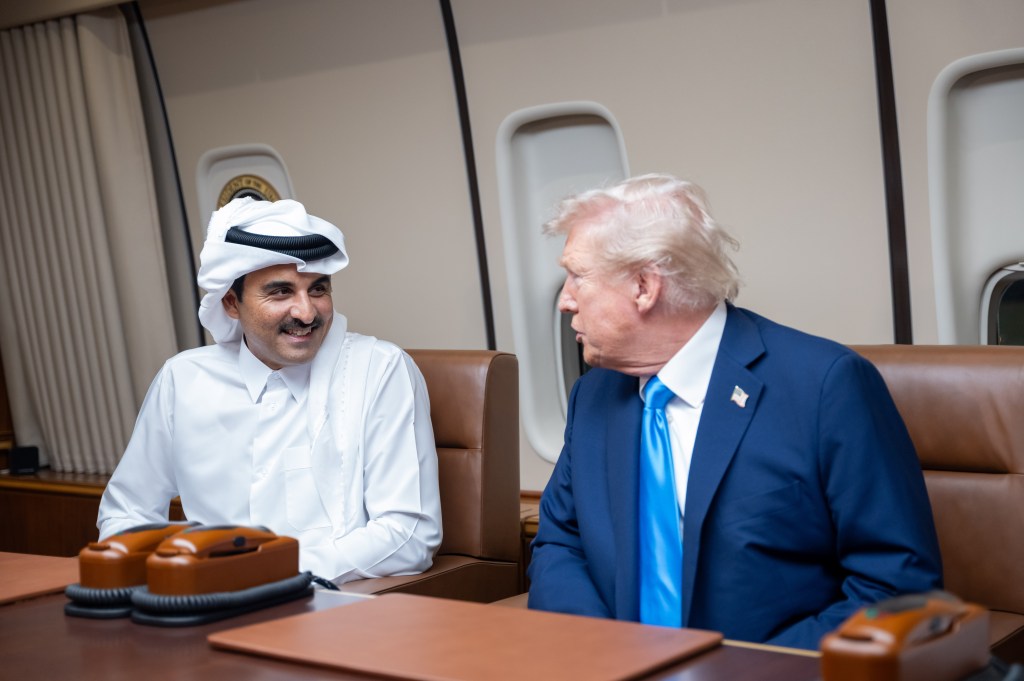
As is often true, Qatar is not a neutral player in Venezuela—nor is it aligned with Washington. Qatari Emir Sheikh Tamim bin Hamad Al-Thani welcomed Maduro to Doha in 2022, where the pair “discussed prospects for enhancing cooperation.” Al-Thani subsequently congratulated Maduro on his self-declared victory in Venezuela’s 2024 presidential elections, siding with the likes of China, Russia, and Iran. The United States recognized Venezuela’s opposition candidate as the winner and “joined many other countries in refusing to recognize Maduro as the legitimately elected president.”
In this case, Qatar had been part of Venezuela discussions for months by the time the $500 million sale went through. As the U.S. moved forces into the Caribbean last fall, Maduro allegedly encouraged Qatar to intervene. Reports then surfaced in December suggesting that the Trump administration might allow Maduro to relocate to Qatar. That plan became irrelevant when American forces captured Maduro and brought him to New York to stand trial.
Unsurprisingly, Doha issued a statement on January 3 expressing “deep concern” about the operation to apprehend Maduro and renewing its “full readiness to contribute” to a “peaceful solution.”
After Maduro’s ouster, rumors resurfaced about Qatari-mediated talks between then-Venezuelan Vice President Delcy Rodríguez, her brother Jorge, and U.S. officials that allegedly took place before Maduro’s capture. Rodriguez, who was sworn in as Venezuela’s interim president on January 5, denied reports that she and her brother worked with Washington to remove Maduro.
Whether the Rodriguez siblings were involved is of less concern. What’s significant is that the Trump administration is again involving Qatar in business that it shouldn’t. The record has yet to convince the Trump administration that Qatar is a liability. However, this failure isn’t unique to the current administration. It’s a bipartisan pathology.
In June 2023, when Joe Biden was in office, Jorge Rodriguez reportedly met with White House adviser Juan Gonzalez in Doha “to establish a direct channel of communication.” Six months later, Qatar brokered a deal that saw Caracas release 10 American citizens and extradite a fugitive Malaysian businessman wanted in the United States for defrauding the U.S. Navy. In exchange, the Biden administration granted clemency to Alex Saab, a close ally of Maduro. Qatar’s diplomatic success here can’t be contested. But it’s worth questioning whether the deal earned Qatar undeserved trust that allows Doha to reserve its seat at the negotiating table.
The Biden administration again tapped Qatar to broker a prisoner swap in September 2023, this time with Iran. The administration agreed to unfreeze $6 billion of Iranian oil revenue in exchange for five American citizens imprisoned in Iran. Washington transferred the revenues from South Korea to Qatar, foreshadowing the financial arrangement that the Trump administration is using today.
After Biden left office, Qatar remained eager to stay involved with American efforts in Venezuela. Gonzalez told the New York Times in October 2025 that Qatar was “trying to find a way to encourage a more structured dialogue or back channel,” but wasn’t “getting much traction with the Trump administration.”
Ultimately, the Trump administration chose the military route. But Qatari banks are now functioning as intermediaries between the U.S., Venezuela, and Western oil companies with claims to settle. Caracas received $300 million in proceeds from “the first $500 million” oil sale on January 21. The balance remains in Qatar.
True, the Trump administration has practical reasons for using Qatar as an offshore financial haven. In Doha, as Rubio explained, the money is beyond the reach of Venezuela’s creditors, making it possible for “the Venezuelan authorities to receive the funds they need to operate.” Prioritizing “economic and political stability in Venezuela” over immediate debt repayment will advance American interests in the Western hemisphere.
Yet this rationale still relies on Qatar’s continued immunity from Western laws and norms, which is precisely what enables Qatar to play all sides, posing as a friend of Washington and brokering deals while bolstering Maduro, providing sanctuary to Hamas, or jockeying to keep the Iranian regime afloat.
The administration has treated Qatar as an unimpeachable asset for too long. Congress should continue pressing for oversight on the Venezuelan oil revenues stowed in Qatar—a country that endorsed Maduro even as he faced narco-terrorism charges in the United States. Absent transparency, the public has reason to worry that Qatari influence, rather than American interests, is shaping U.S. policy decisions.