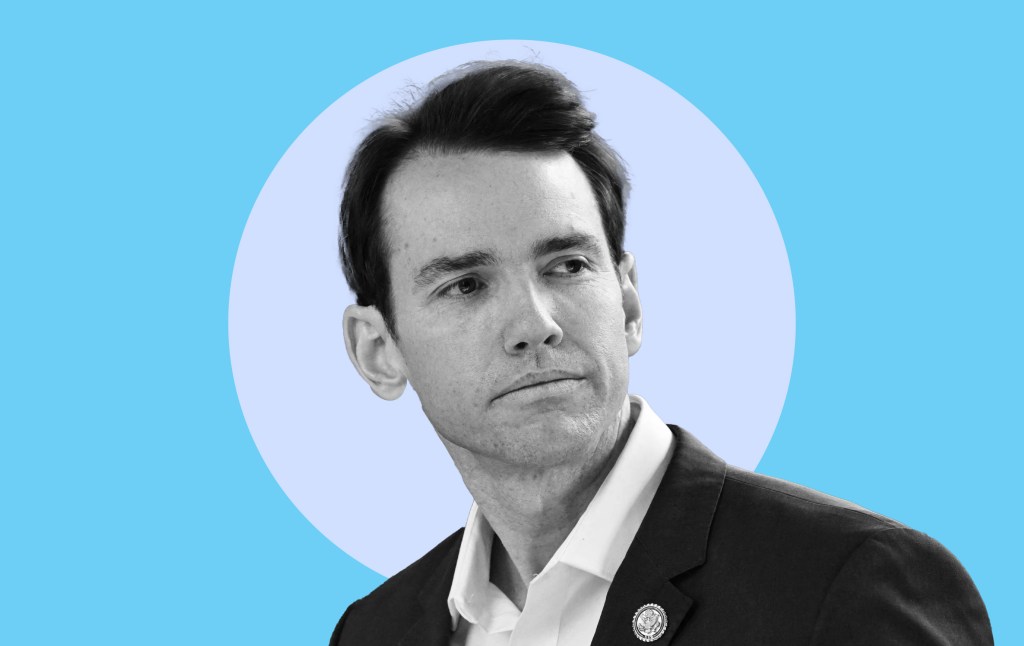
Which party would Rep. Kevin Kiley prefer to win the majority of the House of Representatives after this November’s midterm elections? The 41-year-old congressman running for a third term won’t say.
“You know, we’ll see what things look like then,” Kiley, who represents California’s 3rd District, told me when I asked him over the phone this week. “I think I’m just gonna look at it at the time, yeah. I’m obviously going to try to win my own race, and the voters will have their say everywhere.”
This is usually an easy question for partisans to answer. But things aren’t so simple for Kiley anymore. This lifelong Republican announced March 9 that he has left the GOP and is now an independent. He’s running for reelection without the party label he’s held onto through his three terms in the California state assembly, his bid for governor in the unsuccessful 2021 election to recall Democratic Gov. Gavin Newsom, and in his first two elections to the House.
Kiley has a reputation as a relative moderate in his party, but he’s also been loyal to the GOP conference in the House. Starting with the marathon 15-ballot election of Kevin McCarthy in January 2023, Kiley has consistently supported a Republican for speaker. And he still caucuses with the current GOP majority to retain his committee assignments.
“I was elected for this term as a Republican,” Kiley said. “So it just makes sense, for administrative purposes, to keep caucusing with them through the end of this term.”
But after this term, the Republican majority may be no more. President Donald Trump’s approval ratings are at an all-time low, and Republican prospects in this fall’s midterms look grimmer by the day. It’s no wonder more than 30 Republican members of the House have already announced they are retiring or running for a different office—as good an indication as any that the party in power expects to lose.
“What’s the best antidote to gerrymandering, which makes everything about partisanship? Well, maybe it’s taking partisanship out of the equation.”
Kevin Kiley
Kiley isn’t retiring but running for reelection, and doing so in a new district that’s going to be tougher to win than even his narrowly pro-Republican current district (which he won handily in both 2022 and 2024). There seemed to be no obvious tipping point triggering this momentous move by an ambitious young politician. How long, I wondered, had Kiley been thinking of ditching his party? He paused to consider the question.
“I have been troubled by the sort of endemic hyperpartisanship of D.C. through much of my tenure here,” he said. “Everyone knows things are super partisan in D.C., but it’s even worse and more deeply rooted than I had imagined.”
But it was the passage of California’s mid-decade redistricting ballot proposition last fall that Kiley said had him thinking more seriously about dropping the R. The proposition, backed by Newsom, was an explicit response to the Republican-driven redistricting in Texas that kicked off a nationwide gerrymandering war of attrition. California voters overwhelmingly supported the measure to create a new map with a Democratic bias after the new Texas map did the same for the GOP.
“I guess it was around the time that that started or began to spread that I started thinking about, ‘Okay, what’s the best way to respond? What’s the best antidote to gerrymandering, which makes everything about partisanship?’ Well, maybe it’s taking partisanship out of the equation,” Kiley said.
Of course, Kiley’s current district—which includes suburban Sacramento but also takes up much of the state’s sparsely populated border area with Nevada—was among those Republican ones redrawn to be much more Democratic. He opted not to run in a neighboring district that encompassed the rural parts of his old district but that would have pitted him against another Republican incumbent, Tom McClintock.
Instead, Kiley announced last week, he decided to run in a Sacramento-based district that included his hometown in Placer County but which is also considerably more friendly to Democrats. The decision prompted a positive statement from the House Republicans’ campaign arm. “Congressman Kevin Kiley is working to make California more affordable, more secure, and full of opportunity for every family. His leadership shows that with focus and determination, California’s best days are yet to come,” said a spokesman for the National Republican Congressional Committee.
What surprised politics watchers a few days later was that Kiley registered to run in this new district not as a Republican but with “no party preference”—hardly an unusual way to run for office in California, where blanket nonpartisan primaries allow the top two vote-getters regardless of party to advance to the general election. At that point, it was a fait accompli: On Monday Kiley announced he was no longer a Republican.
Or is he? Because he still caucuses with the House Republican conference, Kiley’s “independent” status doesn’t affect the Republican majority and the makeup of House committees, nor is Speaker Mike Johnson at any greater risk than before of losing his job. I asked what will substantially change for him now that he is an independent member of the House.
“I think that maybe for another member who had always been someone who voted the party line, maybe there’d be some very stark disjunction,” Kiley told me. “But in my case, I just think it’s an accurate reflection of the type of legislator that I aspire to be.”
On the surface, Kiley has looked like a predictably reliable Republican, but there have been hints of the independence he now claims. He supported the One Big Beautiful Bill Act that extended the Trump tax cuts, but he was also among the leading voices pushing to strip that bill of a provision to sell millions of acres of federal public land. And during last fall’s government shutdown, Kiley was a vocal critic of Johnson’s gambit to keep the House out of session to put pressure on Senate Democrats to agree to a stopgap funding bill.
“There is absolutely no reason for the House to be out of session—it’s embarrassing,” Kiley told Politico at the time.
But there have been other areas where he has voted the party line despite expressing reservations—most notably late last year regarding a Republican bill to reform federal health care programs that failed to re-up expiring health-insurance subsidies created by the Affordable Care Act. Kiley had been critical of the Republican bill and sponsored an alternative that would have temporarily extended those subsidies. But in the end, Kiley joined nearly all of his GOP colleagues in voting for the Republican bill.
The test for Kiley is whether voters in his new district will see Kiley’s label change as an expression of his true, independent nature or a cynical scheme to stay in power after falling victim to the gerrymander wars. Kiley is dismissive of the cynicism, telling me the craven thing to do would have been to run in a more Republican district and remain in the party.
“I made this decision precisely because I thought it was the right thing to do, although not necessarily the easy thing to do, to try to make our politics better rather than worse,” Kiley said.