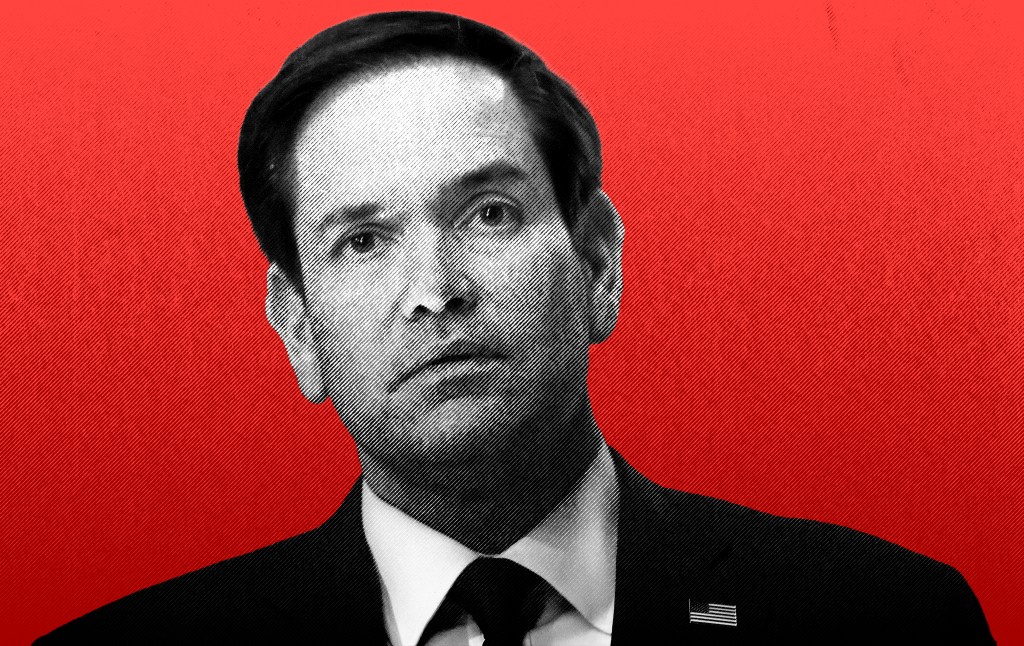
Any sensible discussion about Marco Rubio and the race for the 2028 Republican nomination begins by addressing an essential question: Would a GOP base dominated by populists who view President Donald Trump as their north star embrace the secretary of state as the nominee and enthusiastically back his candidacy?
Accounting for some possible caveats, the answer is—most likely—“yes,” key Trump allies connected to the president’s Make America Great Again movement told The Dispatch this month, as Rubio’s White House stock continued to soar in Republican circles. This crowd’s affection for Rubio is a significant development. Although nearly a decade has passed since the onetime free-market Reaganite converted to conservative populism (“common good capitalism”), the MAGA wing of the GOP was sufficiently distrustful of Rubio in 2024 that its most prominent voices pushed Trump to make Vice President J.D. Vance his running mate.
That was due partly to the secretary’s lingering hawkishness. Rubio never abandoned his preference for projecting American power abroad, fueling suspicions that he remained a so-called “neocon warmonger”—the derisive label Trump and many of his supporters attach to Republicans who take their cues from Ronald Reagan and who dominated the GOP coalition prior to the president’s 2016 nomination. Ironically, it’s Rubio’s close working relationship with Trump on military matters like the Iran War that has contributed to the populist right warming to him as the party’s possible 2028 standard bearer.
“He’s done such an impressive job, and he’s done it with such good humor—which I think really helps. He’s just come through again and again,” a conservative populist media figure and loyal Trump supporter told The Dispatch, requesting anonymity to speak candidly. “If J.D. doesn’t go for it, I think he’s the obvious choice. I think he’s the obvious veep if J.D. does go for it.”
So why is the answer “most likely” instead of definitely likely? A longtime Republican insider who has supported Trump since his first campaign explained: “Rubio is at his apex. He’s at the point where he’s making the most Republicans happy. The question is: If he moves out of this secretary of state role, where he’s simply implementing the Trump policies, what happens when he has to start speaking about all of this other stuff? Do the ghosts of the past come out?”
Rubio, 54, and Trump, 79, have traveled far since the 2016 campaign for the Republican nomination.
On the trail, Trump belittled Rubio as “Little Marco” while Rubio warned that Trump was stoking anger and violence that threatened to unravel American society. But Trump’s victory caused Rubio, then a senator from Florida, to rethink his approach to domestic policy. And during the president’s first term, Rubio’s staunch defense of Trump amid the federal investigation into allegations he colluded with Russia in his race against Hillary Clinton helped paper over their persistent disagreements over America’s role in the world.
“Marco did something really good,” Trump told me in May 2021. “He went up, in my estimation, so much.” Fast forward past the 2024 campaign, during which Trump came close to choosing Rubio over Vance for the Republican ticket, and their personal and working relationship appears genuinely collegial and synergistic. That’s apparent, at least, from watching the secretary effusively heap praise on the president in televised Cabinet meetings as the commander in chief goes around the room soliciting progress reports from his department heads.
From August 26: “You were elected as the president of working Americans, and that’s why this Labor Day is so meaningful.” Also, referring to himself and White House diplomatic envoy Steve Witkoff: “We both work for the peacemaker in chief. Think about it. How fortunate we are to have a president who’s made peace a priority?” December 2: “It’s also an honor to be involved in, and be a witness to, what I believe is the most transformational year in American foreign policy since the end of the Second World War—at least.”
And from just last Thursday: “The most important job any president has is to keep the American people safe. And every president says it, but we have a president that means it and does something about it.”
Rubio’s loyalty is paying dividends with Republican voters, many of whom often place fidelity to Trump above any particular policy agenda. Indeed, the secretary finished a healthy second to Vance in this past weekend’s straw poll of grassroots conservatives who attended the annual Conservative Political Action Conference.
Traditional polling also shows Rubio on the rise.
In a previously unreported survey conducted in March by the GOP polling firm Deep Root Analytics and shared with The Dispatch, the secretary narrowly trailed the vice president in a 2028 sweepstakes that, granted, seems unlikely to unfold. Rubio has vowed not to challenge Vance should he run. But the secretary’s performance in this poll, which gauges whom Republican voters would consider for the nomination in a hypothetical primary, was impressive. He far outpaced many prominent Republicans mentioned as possible contenders—though not all. Among the survey’s findings:
- Sixty-nine percent of all primary voters said they would consider backing Rubio in a primary, just ahead of Donald Trump Jr.’s 66 percent (82 percent said they would consider Vance).
- Among voters who identify as “MAGA GOP” or “Nationalist Conservative,” roughly one-third of the primary electorate in this poll, Rubio would be considered by 80 percent of them, although he trailed Trump Jr.’s 85 percent (Vance was at 93 percent).
- In a simulated ballot test across all categories of GOP voters, Rubio garnered 18 percent (he was tied with Trump Jr.), and Vance received 27 percent.
But Rubio did hold one trump card.
According to this survey, the secretary has the highest ceiling of potential support among all candidates, Vance included. This metric is an “efficiency score,” or the percent of respondents who say they would consider voting for a candidate versus the percent who say they would “never” do so. Rubio’s score was 16.6; Vance’s was 11.6.
This is how veteran GOP strategist Brad Todd characterized the growing appreciation for Rubio inside a Republican Party remodeled and dominated by Trump: “The uniting thread to the group Trump brought to the party is populism, but its animation is strength. Marco is demonstrating he understands how to translate strength into action in a way that has appeal inside Trump’s hardcore base, and beyond it.”
Populist operatives and media personalities in Trump’s orbit interviewed for this story did not raise the bygone issue of Rubio having once supported the legalization of illegal immigrants as part of a bipartisan comprehensive immigration reform bill he helped negotiate as a senator. (The 2013 legislation cleared the Senate but died in the House.) And these political insiders agreed that the secretary’s image is strong enough with grassroots Republicans to withstand public revelations that wealthy GOP donors prefer Rubio over overtly populist alternatives—reporting already making the rounds.
That’s significant and another example of how the secretary is being viewed with fresh and adoring eyes by the GOP base as currently constituted. But no politician’s trajectory is without potential obstacles.
For Rubio, that could be the Iran War, not to mention the president’s other foreign policy endeavors that, as secretary of state, he is closely associated with. That includes a successful American military operation to change the leadership of the government in Venezuela—and the as-yet undetermined outcome of the squeeze Trump is putting on the communist regime in Cuba. There’s zero indication at this point that these conflicts are politically problematic for Rubio.
But there’s no guarantee the Iran War or the president’s other overseas initiatives won’t turn into problems.
“Up until this war, he’s done a pretty good job,” Steve Bannon, host of War Room, a podcast popular in right-wing populist circles, told The Dispatch. “But this war could overshadow everything else.” Bannon added: “A lot of people figured his strong neocon attitude and direction had really kind of pulled back. He understood this is a populist, nationalist movement. But apparently not.”