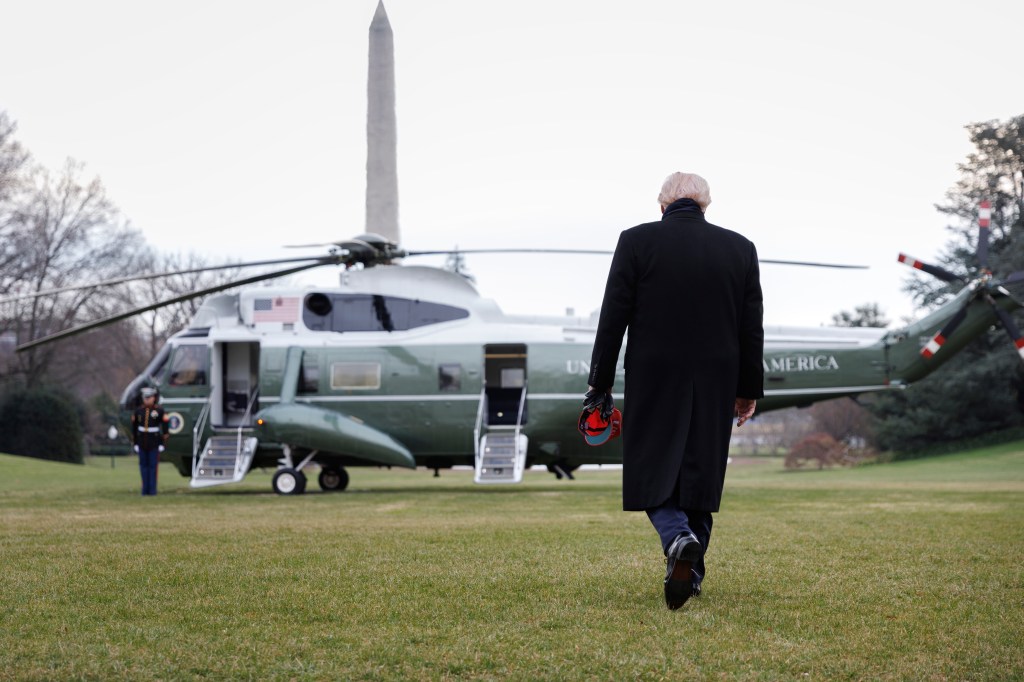
President Donald Trump’s failure to bully Republicans in the Indiana General Assembly into adopting a proposal to redraw the state’s congressional districts middecade exposed his limits as a political negotiator.
Political observers in Indiana have told The Dispatch, since the state Senate rejected redistricting legislation, that the lopsided outcome had little to do with Trump possibly showing signs of becoming a lame duck in Washington, D.C., or losing influence within his party. Rather, Republicans in the Indiana Senate revolted over the president’s strong-arm tactics. Trump might have succeeded—or at least managed to lose narrowly—had he finessed his sales pitch and empathized with lawmakers’ principled objections to the redistricting.
“The public bullying clearly backfired,” said Paul Helmke, a public affairs professor at Indiana University and former Republican mayor of Fort Wayne, Indiana. “Maybe if they’d kept it sort of that behind-the-scenes—‘we’re discussing other issues as well as redistricting’—that probably would have been a more effective approach.”
The GOP holds a supermajority of 40 votes in the 50-seat Indiana Senate. But the redistricting measure was rejected, with 31 senators voting against it and 19 for it. The rout came after two special legislative sessions and intense lobbying over several weeks by Trump, Vice President J.D. Vance and their allies—in Washington, D.C., and across the country, as well as in the Hoosier State. Some of Trump’s critics heralded the Republican resistance as proof the president has become a lame duck less than a year into his second term.
Lame duck status may yet set in for Trump, whose job approval rating in the RealClearPolitics average was 43 percent as of Monday afternoon (roughly 5 percentage points better than where the president stood at this time during his first term). The outcome of the 2026 midterm elections will be a major factor in whether Trump loses the ability to influence his party, on Capitol Hill and nationally. But it hasn’t happened yet—and it wasn’t what tripped up the president in Indiana.
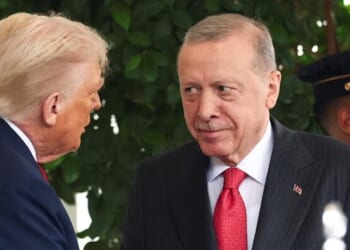
Helmke cited Trump’s profound misunderstanding of the Republican Party in Indiana, at least judging by his negotiating posture and rhetoric. That’s somewhat ironic given the president’s experience with Mike Pence, the former Indiana governor who served as his first vice president and who himself refused to be bullied by Trump into overturning the results of the 2020 election in his role presiding over congressional certification of Electoral College votes.
“The Republican Party in Indiana [is] different than the national party,” Helmke explained. Although Trump allies like Gov. Mike Braun and Sen. Jim Banks have advanced to positions of leadership over the past decade, “our tradition over the last 50 years is sort of a centrist, do-it-our-own-way, approach,” Helmke said. To wit, Sen. Todd Young is periodically critical of Trump, and popular former Gov. Mitch Daniels made clear his opposition to the middecade redistricting effort.
“I think [the White House] had a fundamental misunderstanding of what motivates these folks. A lot of these people have been around for a long time, and they thought it was wrong,” said Megan Robertson, executive director of Indiana Conservation Voters, the group that led the effort to oppose the redistricting effort. “As things progressed and got more heavy-handed—it got worse. They got less likely to cave on it.”
By contrast, Republicans in the Missouri, North Carolina, and Texas legislatures were obedient. Trump directed them to redraw their congressional maps, a constitutionally permissible but unusual occurrence, and they immediately complied. (Democrats in California responded in kind; other blue states may yet follow suit.)
Trump’s mistakes, and those of Republican insiders and allied political groups that joined him in this failed effort, were reliance on a faulty strategy and a misreading of GOP politics in-state.
The president and his allies attempted to browbeat opponents of redistricting into submission. This pressure campaign took the form of threats to withhold congressionally appropriated federal funds from Indianapolis and vows to field GOP primary challengers against resistant state lawmakers. Some of those same Indiana legislators, and their families, were swatted and faced threats of violence, necessitating police protection.
While Trump did not endorse those physical threats, they served to harden lawmakers’ resolve.
“The threats started on Day 1,” a Republican insider in Indiana who was on the receiving end of some of the pressure told The Dispatch, requesting anonymity to speak candidly. “At no point did they come here and say: ‘We’d like to talk to you about this stuff.’ It was just, we’re going to primary anybody that doesn’t get on board, we’re going to ram this through in a couple of days like Missouri did. We’re going to beat anybody that gets in the way. They immediately started with their [social media] messages.”
Indeed, as early as August 18, Charlie Kirk said in an X post: “We will support primary opponents for Republicans in the Indiana State Legislature who refuse to support the team and redraw the maps.” Months later, on the eve of the vote, Trump ratcheted up the warnings to Indiana Republicans, saying as part of a lengthy post on Truth Social: “Indiana Senate ‘Leader’ Rod Bray enjoys being the only person in the United States of America who is against Republicans picking up extra seats. … He’s either a bad guy, or a very stupid one!”
The Indiana Republican insider believes the outcome might have turned out the way the White House wanted if Trump had let Vance run point in discussions with the Indiana legislators and ordered GOP-aligned political groups—particularly the Club for Growth, Heritage Action for America, and Turning Point USA—to stand down. “Vance was very thoughtful and not threatening. [Lawmakers] appreciated it,” this source said. “Why they didn’t stick with that strategy is insane.”
There was also the matter of political self-interest.
Moving ahead with redistricting, projected to net Republicans two additional congressional seats in Indiana, might have helped the GOP maintain its threadbare majority in the House of Representatives in the 2026 midterms.
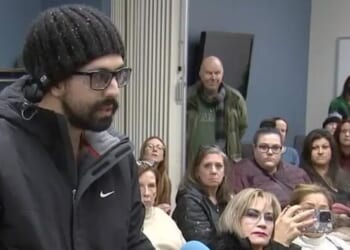
But some Republicans in the General Assembly worried about a voter backlash that could cost them their supermajority in the statehouse, political observers told The Dispatch. Meanwhile, although Republican voters in the Hoosier State are largely supportive of Trump, that support did not lead them to pressure Indiana legislators to submit to the president’s redistricting demands. For instance, state Sen. Greg Goode, a Republican who was undecided on redistricting, held a November 1 town hall to hear from constituents and none of the voters who voiced their opinion on the matter during the event urged him to support it, according to the Indianapolis Star.
“If you look at the state Senate districts, where there are slightly more competitive districts, or where there are, perhaps, quote-unquote, more moderate members, this was a really unpopular vote,” Gregory Shufeldt, associate professor of political science at Indianapolis University, told The Dispatch.