Even for a president known for his disregard for norms and scathing attacks on his enemies, it was a bridge too far.
After news broke last week that acclaimed film director Rob Reiner and his wife had been stabbed to death in their home, President Donald Trump reacted in a way that was unsurprising only in the degree of its callousness. In a post on his Truth Social platform, Trump said the death of Reiner, a longtime Democratic activist and strong critic of the president, was “due to the anger he caused others through his massive, unyielding, and incurable affliction with a mind crippling disease known as TRUMP DERANGEMENT SYNDROME.”
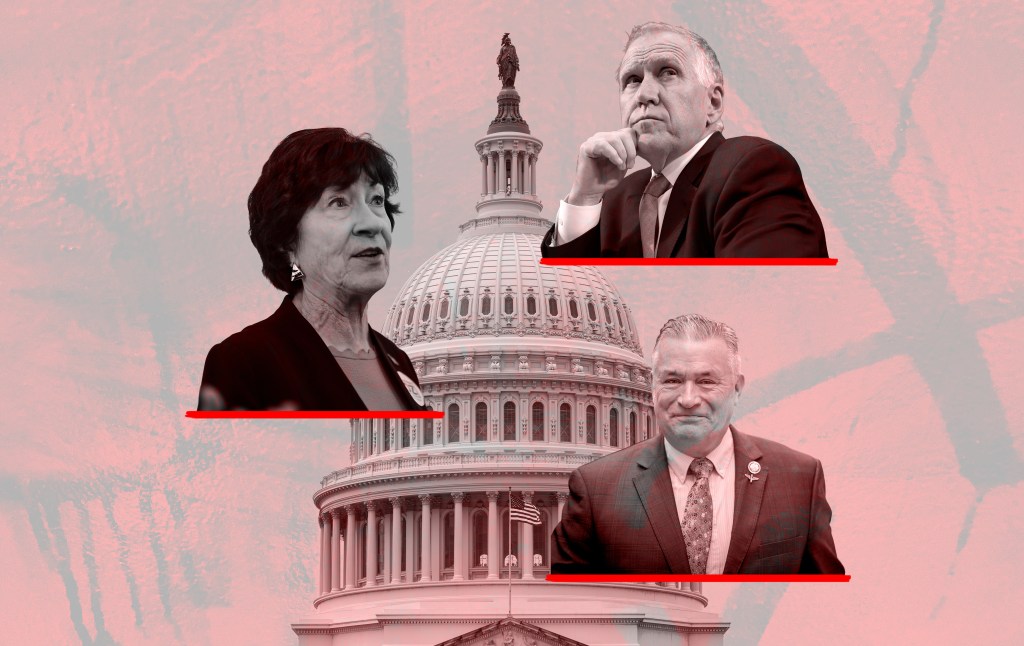
That the president would denounce someone whose death police say came at the hands of the couple’s son was one reason why several congressional Republicans went out of their way to condemn the president’s post. They included Reps. Mike Lawler of New York, Stephanie Bice of Oklahoma, and Don Bacon of Nebraska. Bacon, in particular, said the president’s issues with regard to decency could be a breaking point for Republicans in the future. “Most people know that was beneath the president,” he told The Dispatch.
There’s not much congressional Republicans can do about a distasteful comment from the White House other than condemn it. But Trump’s actions in his second term have repeatedly tested the limits of Republicans in Congress, pushing the bounds of executive authority and contradicting the professed beliefs of large swaths of the caucus. In response, Republicans have offered varying degrees of pushback, sometimes putting up no resistance at all and at other times expressing concern but not giving substantive opposition. Only on rare occasions have Republicans in Congress told Trump “no” or moved to block his actions.
This deference to Trump is unsurprising, given that the president has not been afraid to threaten dissenting members of his party with a primary challenge. In the 2022 cycle, Trump-backed challengers succeeded in ousting multiple Republican members of the House of Representatives who voted to impeach the president following the January 6 Capitol riot. After Sen. Thom Tillis of North Carolina voted against advancing the One Big Beautiful Bill Act, Trump publicly declared that he would meet with primary candidates, and Tillis soon announced his retirement. Most recently, Trump has announced his intentions to back challengers to GOP members of the Indiana state Senate who voted against the state’s push to give Republicans a more favorable congressional map.
Despite that history, congressional Republicans in recent months have shown more of a willingness to criticize Trump and buck his wishes—a trend that has coincided with a decline in his job approval ratings. Nevertheless, the country has yet to see the congressional GOP take a stand against Trump on an issue that is especially high-profile or of serious importance to his agenda as Republicans have worked to leverage their governing trifecta.
‘Supporting the president.’
The Constitution gives Congress the power to levy tariffs, but the legislature has deferred more and more to the president on trade in the past few decades, with Republicans keeping in line with that trend this year. Throughout his political career, the issue Trump has shown is the most near and dear to his heart, apart from immigration, is trade. His most expansive utilization of presidential authority on tariffs came on April 2, when he levied tariffs of 10 percent or higher on almost every country in the world. Such a liberal use of import duties contradicts Republican orthodoxy, which for decades has favored free trade.
The following day, Republican Sen. Chuck Grassley of Iowa and Democratic Sen. Maria Cantwell of Washington introduced a bill that would give Congress more authority over tariffs the president proposes. But neither that bill nor its companion legislation in the House have advanced out of their committees.
Some senators have made use of privileges that the law affords them to force votes on resolutions that would repeal some of Trump’s tariffs. In October, the chamber passed three such pieces of legislation, which would repeal the global duties, as well as those on Canada and Brazil. On all three resolutions, Republican Sens. Lisa Murkowski of Alaska, Susan Collins of Maine, and Mitch McConnell and Rand Paul of Kentucky voted with Democrats to kill the tariffs. Tillis joined them in voting against the Brazil tariffs.
That legislation’s passage is not a sign of a widespread GOP rebellion, though. As the Cook Political Report’s Amy Walter noted, the defectors consisted of a group of three senators who have consistently broken with Trump since his first term—Murkowski, Collins, and Paul—and two senators, McConnell and Tillis, set to retire next year. Senators who depend on Trump’s support for reelection did not contradict him.
What’s more, the votes are merely symbolic. Even if such legislation were to pass both Houses of Congress, Trump would likely veto it. Leadership in the House has proven unwilling even to take up such legislation, and in fact have taken away their members’ power to do so, at least for the time being. In the spring, Speaker Mike Johnson began adding language to procedural motions, which the House has to vote on to bring legislation to the floor, that blocked consideration of resolutions regarding tariffs. Republican members were disincentivized to vote against those motions since they allowed for votes on pivotal bills—that were unrelated to tariffs—such as a stopgap spending measure to prevent a government shutdown and the framework for what would become the One Big Beautiful Bill Act. Though there was a small revolt in the fall when Johnson tried to put such language into a procedural vote for a collection of less pivotal bills, resolutions to repeal Trump’s tariffs are blacklisted until the end of January.
Johnson has said Trump needs “the space” to negotiate trade agreements and that he thinks the president has the authority to levy the tariffs that he has this year. Other Republican lawmakers have made similar arguments, saying that Trump is leveraging the tariffs to get better trade deals with other countries. “I think we need to give the president the opportunity to be able to carry out his strategy to level the playing field on tariffs,” Sen. Pete Ricketts of Nebraska told The Dispatch earlier this year after Trump temporarily suspended many of his sweeping global tariffs. “… We’ve just got to keep supporting the president.”
Expressing concerns.
As Trump has contradicted traditional Republican beliefs on foreign policy and defense, congressional Republicans have occasionally made their disagreements known or expressed concerns, but they haven’t taken much action to oppose him.
While the most recent case of this is the administration’s strikes on boats in the Caribbean suspected of carrying drugs, Republicans throughout the year have criticized the president for his actions in the war in Ukraine, without doing much substantively to push him in the direction they want. Since Russia’s 2022 invasion, many, if not most, Republicans, especially in the Senate, have been supportive of President Volodymyr Zelensky’s country, both in rhetoric and in giving military aid. In his efforts to end the war, Trump has given mixed signals about whether he views Russia or Ukraine as at fault and which country he sees as resisting a peace deal. He has both called Zelensky a “Dictator without Elections” and told Russian President Vladimir Putin to “STOP!” bombing civilian areas in Ukraine. Following the “dictator” comment, Republicans made it clear they believed Putin was the real dictator.
In his dithering, Trump has not gone as far as many congressional Republicans would like in pressuring Putin to end the war. The Senate has waffled on a bill that would push Trump to put additional sanctions on Russia. It has the support of 85 senators, including Majority Leader John Thune, and House Speaker Johnson has told The Dispatch there is “a big appetite” among Republicans in both chambers for “tough sanctions on Russia.”
Despite that hunger, Republicans have not advanced the bill from committee. The Senate’s willingness to consider it has often been dependent on how Trump feels about the war at a particular time. In mid-October, Trump suggested he would give Tomahawk missiles to Ukraine, which would allow it to strike targets deep inside Russia. Days later, Thune said it was time to move on the sanctions bill. But then Trump had a call with Putin and a reportedly tense meeting with Zelensky, indicating the president was seeing things Russia’s way. After that, Thune indicated the bill was on hold; but then Trump seemed to sour on Putin, cancelling a planned meeting with him. And that left the bill in limbo once again. In November, Trump gave the bill his blessing, and the bill’s sponsor, Sen. Lindsey Graham of South Carolina said the Senate would move on it, but Congress left town for Christmas last week without advancing it.
Telling Trump ‘no.’
There have been times when Senate Republicans have stood in the way of Trump’s agenda, choosing to honor deeply held traditions in the world’s greatest deliberative body over Trump’s wishes. Democrats have used the Senate’s “Blue Slip” tradition—which effectively allows senators to veto judicial nominees in their home states—to block certain U.S. attorney nominees, such as Alina Habba, whom Trump nominated to a post in New Jersey after she served as his personal lawyer.
The president has called on Grassley, the Senate Judiciary Committee chairman, throughout the year to scrap the practice, but the 92-year-old Iowa senator has not budged, getting support from senators such as Tillis and Graham, the latter of whom is typically deferential to the president.
Over a month into the longest government shutdown in American history, which began this fall after Senate Democrats blocked a stopgap spending measure, denying it the requisite 60 votes to reach final passage, Trump called on Republicans to scrap the filibuster. He argued that Democrats would do so anyway the next time they gained power, so the GOP might as well kill it first and put in place a host of policy priorities such as voter ID and a ban on mail-in ballots.
Since the ratification of the Constitution, the Senate’s tradition of unlimited, or at least prolonged, debate—currently enforced by the 60-vote threshold—has prevented Congress from enacting rapid policy changes based on the whims of fickle majorities. In the 21st century, the filibuster has withstood efforts from both parties to kill it.
Though some Senate Republicans said they were open to at least changing filibuster rules, most decided that the positives of keeping it in place outweighed the temporary legislative benefits they would get from killing it.
Substantive opposition.
But there is a difference between standing behind traditions that have been in place for more than a hundred years and proactively stopping presidential action. The few times since Trump was elected to a second term in which congressional Republicans have actively opposed the president haven’t been when particularly essential parts of Trump’s agenda have been at stake.
Prior to Trump taking office, enough Senate Republicans worked behind the scenes to stonewall his nomination of former Florida Rep. Matt Gaetz as attorney general. But the energy from that 2024 act of defiance has not carried over to 2025. Republicans approved Trump’s other controversial Cabinet-level nominees, such as Defense Secretary Pete Hegseth, Health Secretary Robert F. Kennedy Jr., and Director of National Intelligence Tulsi Gabbard.
They have, however, blocked some controversial nominees to lower-level positions. Trump tapped longtime ally Ed Martin to be the U.S. attorney for Washington, D.C. His track record, which included a defense of January 6 rioters, put off GOP senators, most importantly Tillis. His opposition denied Martin a majority on the Senate Judiciary Committee, stopping his nomination from advancing to the floor. “They have to follow their heart and they have to follow their mind,” Trump said after he pulled Martin’s nomination. Likewise, Republican senators also blocked Trump’s nomination of Paul Ingrassia to lead the U.S. Office of Special Counsel. After Politico published a report that surfaced racist texts from Ingrassia, which included him saying he had a “Nazi streak,” several Republican senators, including hardline conservative Sens. Ron Johnson of Wisconsin and Rick Scott of Florida, signaled that they opposed him. Ingrassia later withdrew his name.
Early in Trump’s term, the Elon Musk-led Department of Government Efficiency (DOGE) ran roughshod through executive agencies, attempting to downsize employment rolls and cut spending. As the effort went on, a handful of Republican lawmakers tried to protect their affected constituents.
Sen. Shelley Moore Capito of West Virginia secured two victories on that front. In April, the Department of Health and Human Services (HHS) laid off 200 employees at the National Institute for Occupational Safety and Health, which helps oversee the safety of local coal miners, in Morgantown, West Virginia. Capito, who chairs the Senate Appropriations subcommittee that oversees funding for HHS, lobbied for the administration to reverse course, getting some of them reinstated. Months later, the administration withheld billions of dollars of funding for education programs that Congress had already appropriated. Capito led 10 GOP senators in a successful effort to get the money released. “We had 10 people—10 Republicans—on our letter,” she told The Dispatch at the time. “That was my letter. I think that was a lot of pressure.”
Over the summer, the administration tried to codify many of its DOGE cuts through a package of rescissions, allowing Congress to circumvent the filibuster to rescind money it had already appropriated. The measure originally contained $9.4 billion of cuts to foreign aid and public broadcasting, including $900 million to global health programs that likely would have affected the President’s Emergency Plan for AIDS Relief, or PEPFAR. Members of both parties have praised the program for its success in fighting HIV and AIDS abroad. Sen. Susan Collins, who chairs the Senate Appropriations Committee, was the lead opponent of those cuts, and enough GOP senators objected to them for the White House to promise that PEPFAR would not be affected in order to pass the rescissions package. In the end, the removal of the PEPFAR cuts trimmed the rescissions package total to $9 billion and allowed it to pass through Congress.
As the year went on, Republicans’ willingness to break with Trump grew. And the president’s popularity fell. He started his term with a positive job approval, according to the RealClearPolitics polling average, but in March it officially became negative, and the current gap between Americans who approve and disapprove of his performance sits at around 10 points.
2026 will see an election in which, if historical midterm trends continue, the GOP will not do well. Republicans’ slim three-seat majority in the House is at risk in a midterm cycle during the term of an unpopular president. Although the Senate map makes it unlikely that Democrats will win the chamber, they could very well eat into Republicans’ majority. Vulnerable Republicans walking the fine line between avoiding primary challenges and winning the November general election will especially be tested on how willing they are to break with the president, lest they lose their seats to Democrats who will have no hesitation in contradicting Trump’s wishes.