Life, Liberty, Property #130: Will Economic Improvement Affect the Midterm Vote?
Forwardthis issue to your friends and urge them to subscribe.
Read all Life, Liberty, Property articles here, and full issues here and here.
IN THIS ISSUE:
Will Economic Improvement Affect the Midterm Vote?
Video of the Week: World Prosperity Forum Day 1: Foundations of Freedom — Charting a Prosperity-Focused Agenda
Indiana’s First Medicaid Eligibility Sweep a Big Success
IT’S BACK! SAVE THE DATE. SPRING 2026.
Will Economic Improvement Affect the Midterm Vote?
The U.S. economy is doing well, particularly in view of the movement away from government employment to private-sector jobs and toward new hires going to native-born Americans instead of all going to immigrants (legal and otherwise). Americans’ widely expressed concerns about the economy reflect three major factors: one, stubborn economic distortions caused by longtime government policies; two, the lingering effects of acute Biden-presidency price inflation; and, three, warped and dishonest media reports.
Inflation is still moderating, much to the benefit of those of middle incomes and below, given that the price rises were worst in necessities and other items most affecting the quality of life for the non-wealthy. The 12-month increase in the Consumer Price Index in December was 2.7 percent, lower than expected. The core inflation rate (which excludes erratic food and fuel costs) was 2.6 percent.
The average monthly inflation rate during the Biden administration was 5 percent, nearly double the current rate, with the CPI rising by 21.5 percent over the four years. Real, inflation-adjusted average weekly earnings in private-sector jobs decreased by 4 percent. Home prices rose by 37.4 percent, sparking a housing affordability crisis. Publicly held federal debt increased by one-third, igniting the price inflation.
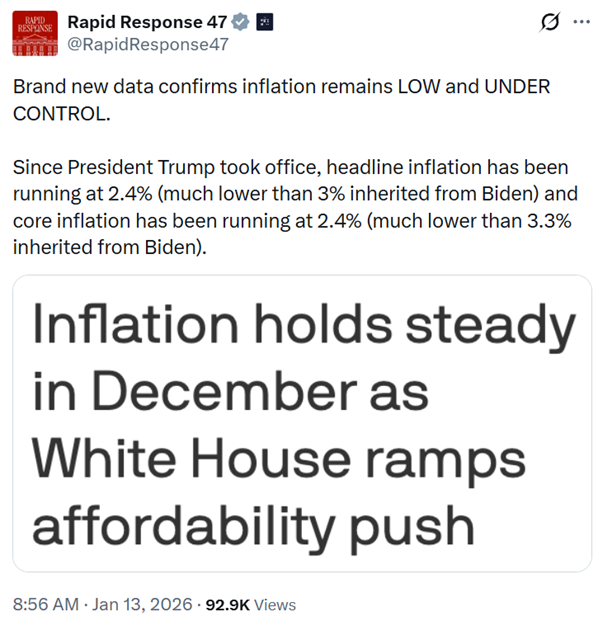
That has changed dramatically. Overall, “Since President Trump took office, headline inflation has been running at 2.4% (much lower than 3% inherited from Biden) and core inflation has been running at 2.4% (much lower than 3.3% inherited from Biden),” the White House stated on Tuesday:
The cost of food is still rising, though at a slowing rate, and the price of eggs has decreased by about 21 percent, while gasoline prices continue to fall.
Employment numbers are confirming a positive movement from part-time work to full-time employment and from the government into the productive private sector. Trading Economics reports:
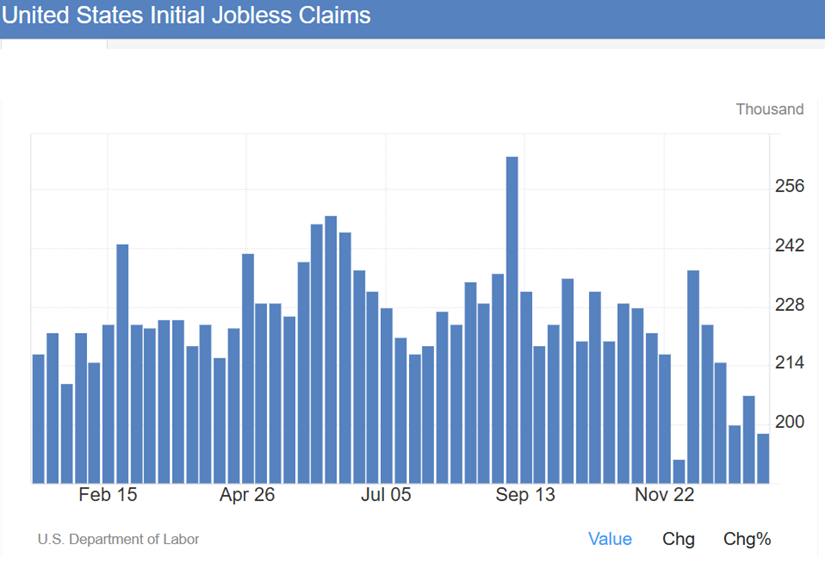
Initial jobless claims in the US fell by 9,000 from the previous week to 198,000 on the week ending January 10th, contrasting with market expectations of an increase to 215,000, to mark the second-lowest reading in two years. … In the meantime, initial unemployment claims from federal employees, which have been under scrutiny as markets measure the impact of the US government shutdown, rose by 170 to 646.
Job growth has been stagnant overall as beneficial government shrinkage continues. However, the movement from part-time work to full-time employment is a highly positive trend, the Unleash Prosperity Hotline notes:
It is true that job growth has slowed in 2025, but as we’ve shouted many times, that’s mostly a supply of workers problem, not a demand problem. There are 7.2 million job openings.
The household survey showed the number of people employed jumped by 232,000—more than four times the increase in payrolls. The explanation for this difference is a very positive development in the labor market: full time employment was up as part time work declined. …
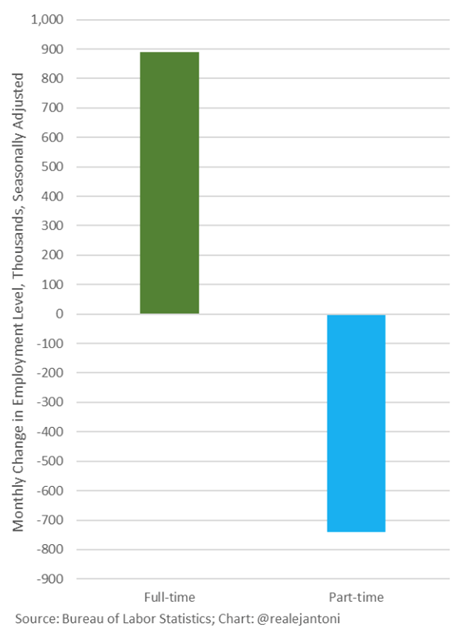
In December, the number of part-time jobs declined by 740,000, while full-time employment shot up by 890,000:
This is an important positive trend in employment, the Hotline notes: “People exchanged multiple part-time gigs for single full-time jobs in December. That doesn’t show up in the aggregate figures, but it’s a real improvement.” Workers are finding better jobs that pay more, the Hotline reports:
Further evidence of that was the so-called U-6 unemployment rate, which includes discouraged and underemployed workers, fell in December a significant three-tenths of a percentage point. More people were able to get the kinds of jobs they wanted, like good-paying, full-time work with benefits.
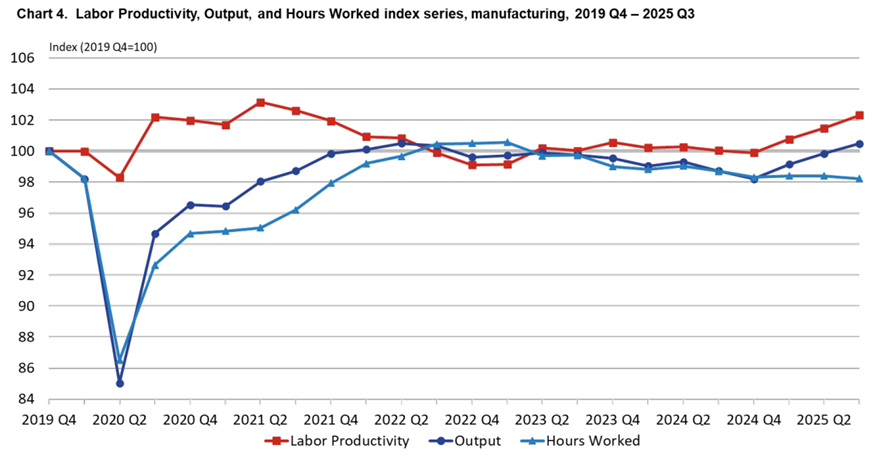
Labor productivity in the nonfarm business sector increased by 4.9 percent in the third quarter, with output increasing by 5.4 percent and hours worked rising by 0.5 percent. Manufacturing-sector labor productivity and output are rising markedly after declining during the Biden administration:
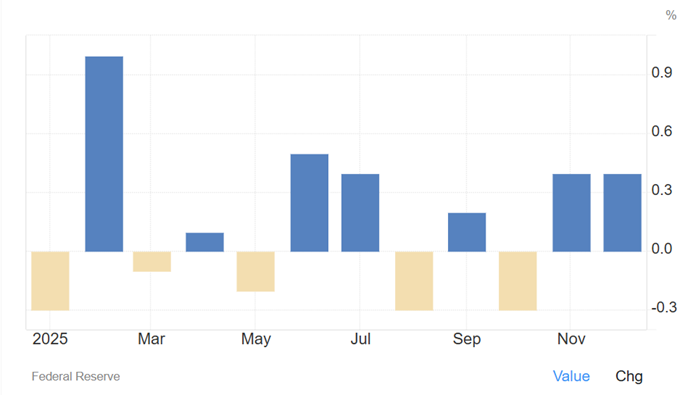
Industrial production in the United States rose 0.4% month-over-month in December, the same as in November and above market expectations of 0.1%. Manufacturing output increased 0.2%, beating forecasts for a 0.2% drop. …
In line with the positive employment news, consumers are spending more. Retail sales beat expectations significantly, rising by 0.6 percent in November, the latest month for which data is available. Economist Robert Genetski, Ph.D., expects a further increase in December will report an annual gain of nearly 5 percent.
With all that in mind, the Federal Reserve Bank of Atlanta raised its estimate of fourth-quarter annualized real Gross Domestic Product growth to an impressive 5.3 percent.
Continued improvement in employment and private-sector productivity are the real solution to the affordability crisis. In addition, mortgage interest rates are down to their lowest in three years.
With all this good news, the regime media are desperately trying to spin it to cast doubt on the (conclusively proven) value of market-empowering reforms. The Media Research Center’s Newsbusters site reports on a typical example:
The Bureau of Labor Statistics released a report January 13 finding that core consumer prices—which excludes volatile food and energy prices—increased less than expected at 2.6 percent year-over-year in December. The all-items index increased 2.7 percent on an annual basis, in line with expectations.
It’s a welcome report for sure, as it provides more evidence that the Trump tariffs did NOT have the disastrous effect on inflation that CNN and others were swearing up and down would materialize in the past year.
But CNN, true to form, immediately tried to make a relatively good report out to be a bad one in a January 13 X post: “US inflation remained at 2.7% in December, underscoring persistent cost of living challenges.”
But as Daily Wire senior editor Cabot Phillips pointed out, this just stinks of hypocrisy. When inflation came in at a whopping 6 percent in February 2023 under President Joe Biden, which was just a few ticks down from the January 2023 6.4 percent number, CNN tried to spin that report positively: “US inflation is still high, but it’s falling. Last month’s Consumer Price Index measured 6%, down from January’s 6.4%.”
But now? “Persistent cost of living challenges.” It’s true that Americans are still feeling Bidenflation, so another 2.7 percent is more of the same. What’s sick is that Democrat-friendly networks want Democrats to win on “affordability.”
Both CNN stories were written by the same author, CNN Business Senior Writer Alicia Wallace, underscoring the obvious bias, Newsbusters notes.
While just under a year’s worth of economic reforms and mild efforts to hold the line on inflation-producing federal spending are showing measurable progress, the previous four years did major damage to the private, productive sectors of the U.S. economy. It will take some time for the public to feel the full benefit of the results of the policy change they voted for in 2024.
Poll numbers indicate impatience among the public, “with a majority of Americans saying Trump is focused on the wrong priorities and doing too little to address cost of living,” as CNN reports. The public’s view of the economy has not improved much in the past year, as the lingering effects of Biden inflation and regulatory strangulation have yet to dissipate. The majority of those CNN polled reflected the media’s spin that the president has not done enough to reverse the economic destruction of the prior four years:
Views of economic conditions have remained stable—and largely negative—for the past two years, with about 3 in 10 rating the economy positively. What’s changed in the latest poll is the increased pessimism about the future: Just over 4 in 10 expect the economy to be good a year from now, down from 56% just before Trump was sworn in last January.
A 55% majority say that Trump’s policies have worsened economic conditions in the country, with just 32% saying they’ve made an improvement. Most, 64%, say he hasn’t gone far enough in trying to reduce the price of everyday goods. Even within the GOP, about half say that he should be doing more, including 42% among Republicans and Republican-leaners who describe themselves as members of the “Make America Great Again” movement.
Trump and the congressional Republicans feel great urgency about appearing to do more to fix the economy, though the only thing that will really unleash American prosperity is a full retrenchment of the enormous federal welfare state that presidents Barack Obama and Joe Biden did so much to expand and which Trump failed to reduce during his first term.
Democrats understandably view the economic stagnation that they themselves caused as a terrific political opportunity and are hopeful of returning to majority rule in Congress, with a chance to impeach Trump multiple times and block any further much-needed reforms to shrink the government.
The smart course for the Republicans would be to push ahead with major reforms to gut the welfare-warfare state and cut federal spending and regulation dramatically. That would accelerate the economic improvements we are already seeing. It would also make the recent reforms permanent, given that a Democrat congressional majority would not be able to reverse them, given Trump’s veto power. All that would benefit the American people greatly.
The wise course for the Democrats would be to sit back, clamp their mouths shut, and let the Republicans fumble around, do nothing useful, and force the public to reject the GOP in this November’s elections.
Many decades of American politics have taught us what is most likely to happen: neither party will do the smart thing, much less the right thing.
Day 1 will open the World Prosperity Forum with a powerful introduction to the ideas and principles that shape global prosperity. Broadcasting live from Zurich, the Forum will bring together international leaders, policy experts, and advocates to examine how freedom, markets, and innovation create lasting opportunity.
The day will begin with opening remarks from Jim Lakely, who will frame the global economic debate and outline the Forum’s mission: advancing prosperity through liberty rather than centralized control.
Key sessions will explore how individual freedom drives economic growth, offering expert perspectives on governance, policy trends, and the growing influence of global institutions on national decision-making. Speakers will also examine modern challenges to prosperity, including ESG frameworks, regulatory expansion, and geopolitical pressures facing democratic societies.
Day 1 will conclude with an engaging panel discussion, setting the intellectual foundation for the days ahead and inviting viewers to think critically about the future of global prosperity.
Indiana’s First Medicaid Eligibility Sweep a Big Success
The state of Indiana has already reaped hundreds of millions of dollars of taxpayer savings through the government’s first Medicaid eligibility verifications, Gov. Mike Braun told Newsmax:
The Republican governor said in an interview on Newsmax’s “America Right Now” that Indiana’s Medicaid enrollment is down 11% since he took office, and he described the reforms as focused on what he called “low-hanging fruit” in eligibility enforcement.
“Big difference is, when I was in the U.S. Senate for six years, we talked about it,” Braun said. “It was amazing the waste and abuse and fraud there.”
The Wall Street Journal has reported that, due to reforms in Indiana, the state government is projected to save $466 million in Medicaid spending over the next two years.
The One Big Beautiful Bill Act requires states to confirm recipients’ eligibility every six months and improve their verification procedures.
Indiana administrators found more than 10,000 state residents were enrolled in Medicaid when they should be on Medicare, individuals from other states were receiving benefits from Indiana, and many people were double-dipping by receiving benefits in multiple states. The vast majority of these wasted dollars go to insurance companies to pay for Medicaid policies for people who do not qualify.
Following the new Medicaid rules, such as the ban on auto-renewal of recipients, will undoubtedly expose much more waste, fraud, and abuse in Indiana and other states that comply with the law, as Braun indicated.
Other states’ officials who have been presiding over massive fraud cannot have been ignorant of the problem, Braun told Newsmax:
Braun said fraud at that scale would be impossible for a governor to miss.
“No way,” he said. “We were noticing it in the tens and hundreds of millions. There’s no way you can miss $9 billion worth of fraud going on.”
CMS data show the states improperly spent $80.6 billion on Medicaid in 2022, and a staggering $98 billion in 2021, with the vast majority of the improper payments attributed to lack of eligibility. The amount of improper payments decreased to an estimated $31.1 billion in 2024 as states began to cycle ineligible people off the program after the federal government lifted its Covid-era ban on disqualifications. Preventing the automatic renewal of recipients is an essential step in the verification process.
Evidence from multiple states confirms robust eligibility verification significantly decreases Medicaid fraud and abuse. After the Illinois Department of Healthcare and Family Services launched the Illinois Medicaid Redetermination Project in 2012, the Prairie State removed 400,000 ineligible recipients and saved an estimated $350 million per year.
Governments should not give taxpayer money to people who do not qualify for it: in addition to stealing from the taxpayers, such payments divert resources from the truly needy and jeopardize Medicaid’s already-shaky fiscal viability, putting eligible recipients in danger of harsh future cuts to their physician access and medical treatment.
‘The CSDDD is the greatest threat to America’s sovereignty since the fall of the Soviet Union.’
Contact Us
The Heartland Institute 1933 North Meacham Road, Suite 559 Schaumburg, IL 60173 p: 312/377-4000 f: 312/277-4122 e: [email protected] Website: Heartland.org