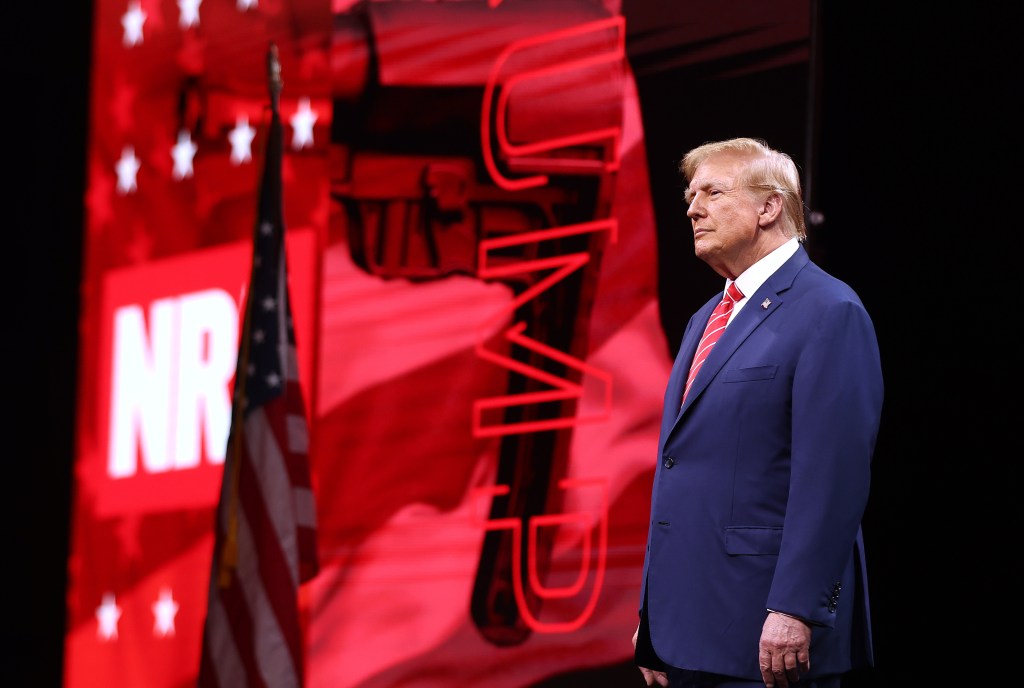
For years, gun rights activists counted President Donald Trump as one of their strongest allies in Washington. Now, some say they feel betrayed.
Recent policy moves and statements from Trump and his administration have left gun rights activists questioning Trump’s support of unrestricted Second Amendment rights. Political scholars predict that wavering support may have consequences for Republicans in the upcoming midterm elections.
“At this point, other than platitudes and throwing a few bones and meaningless efforts that frankly have not done very much at all to advance the cause, I think that they’re clearly focused on other things,” Brandon Combs, president and founder of the Firearms Policy Coalition (FPC) said. “I don’t see why anybody would take them seriously until they start acting like they care.”
When Minnesota nurse Alex Pretti was shot and killed by a Customs and Border Protection agent in late January, he had a legally registered concealed weapon with him. Trump told the press after the shooting, “You can’t have guns. You can’t walk in with guns.”
The remark angered several gun rights groups. In an FPC statement following the events in Minnesota, they said, “The mere presence of a firearm does not erase a person’s rights, does not turn lawful conduct into wrongdoing, and does not make someone fair game to be arrested or killed for the government’s convenience.”
Others in the administration, including FBI Director Kash Patel, then-Homeland Security Secretary Kristi Noem, Treasury Secretary Scott Bessent, and Gregory Bovino, a senior Border Patrol official, all said Pretti should not have been carrying a gun.
“The problem with the statements that were made by a handful of individuals in the administration after Mr. Pretti’s shooting was that they were overly broad, to the point of being constitutionally and legally inaccurate,” William Sack, director of legal operations at the Second Amendment Foundation, said in an interview.
The National Rifle Association, which spent more than $45 million to support Trump’s three presidential campaigns, took to social media to denounce the Pretti shooting.
“The NRA unequivocally believes that all law-abiding citizens have a right to keep and bear arms anywhere they have a legal right to be,” the organization posted on X.
Due to Trump’s history of campaigning on unrestricted Second Amendment rights, many gun rights activists felt taken aback by his comments.
“I think gun owners are reasonably concerned that a reportedly pro Second Amendment president and administration would come out with such absurd statements as they did after that shooting,” Combs said.
But that wasn’t the first time Trump has taken the side of restricting gun access in his second term.
In September, Trump’s Department of Justice reportedly considered declaring trans people mentally ill to strip them of their Second Amendment rights. This came in the wake of the August 27 shooting at Annunciation Catholic School in Minneapolis that killed two children and injured 21 others. The shooter, who committed suicide at the scene, was transgender.
In February, the Supreme Court heard oral arguments for U.S. v. Hemani, which examined whether or not prohibiting “unlawful users” of controlled substances, including marijuana, from possessing firearms violates the Second Amendment. The federal government lawyer took the side of restriction.
Political science professor Robert Spitzer from SUNY Cortland said the case highlighted a fracture between the administration and gun rights activists.
“The administration found itself in the opposition arguing in favor of the federal law that says if you know you’re a drug user, you can’t have guns,” Spitzer said. “This is sort of like the shooting of Pretti in Minneapolis as well, where you have this apparent clash between administration policy and what the gun rights people would like to see.”
Sack, whose organization filed an amicus brief supporting the defendant in the case, Ali Hemani, acknowledged that the broader conservative base has mixed feelings about illegal drugs and said they are not advocating for illegal drug use.
“What we believe the Constitution substantiates is that the government can only take away your Second Amendment rights if you’ve been shown through due process to be dangerous. Using illegal drugs in all instances does not make you dangerous,” Sack said.
“There are certainly, objectively, some places where they have indeed made some sort of positive move. But at this point, I would say the overwhelming number has been the exact opposite of positive,” Combs said of the Trump administration.
Some expressed concern that the growing divide between the Trump administration and gun rights activists might impact the upcoming midterm elections.
Spitzer said that while he does not predict that many voters will abandon Trump, the current discourse may drain enthusiasm and affect voter turnout.
“They’re not going to vote for Democrats all of a sudden. But I think the degree of enthusiasm for Trump, for MAGA, for his supporters is going to be less and that helps the opposing side, the Democrats … where the voter base as we’ve seen so far is highly motivated,” Spitzer said.
Combs expressed increasing frustration with Trump’s actions in his second term and said the administration hasn’t upheld its promise to protect the Second Amendment.
“Has Trump been better than Biden on these things? Sure. But is that really the bar? Are we just talking about stepping over a bar that’s that low?” Combs said. “I thought that they actually cared.”
In a Pew Research poll in the lead-up to the 2024 election, 85 percent of Trump supporters said it is important to protect the rights of Americans to own guns. As of early 2026, the Firearms Policy Coalition released several complaints against the Trump administration’s actions in federal court.
One of the repeated claims is that while the administration has been active in state-level gun rights cases, it has continued to defend federal gun restrictions in court. Specifically, the FPC called on Trump to direct his Department of Justice to end its defense of federal gun control laws and to begin using the full power of the executive branch to actively protect and advance the Second Amendment rights of the American people.
“Where is the administration fighting for pro Second Amendment bills, I mean really fighting for them?” said Combs. “I’m not talking about a sound bite every three months, I’m saying where are they doing something that’s moving the ball, because the only thing that I care about is touchdowns. I wanna see some wins.”
When asked if he believes this frustration could manifest into negative effects in the midterms, Combs said, “I don’t know why it would help. If you’re asking gun owners why they would show up, this is a big issue … What exactly do we have to show up for?”
However, not all scholars believe this will have much impact on Election Day.
Adam Winkler, a law professor at UCLA specializing in constitutional law and gun policy, said he believes the gun rights community very much remains in Trump’s camp.
While acknowledging that the administration has taken positions in the Supreme Court defending gun laws that have angered some in the gun rights community, Winkler said he doesn’t think that the administration’s position comes anywhere near enough to convince pro-gun voters that they should vote for Democrats. He said this is because the issues they are angry about are “so minor and inconsequential compared to the things he’s done for them.”
Winkler said one of the reasons he doesn’t believe this issue will affect the midterms is that there aren’t enough single-issue voters on gun rights to make a difference.
Additionally, he said, “I don’t think it’s that significant in light of the fact that they’re not going to vote for a Democrat, and they’re not going to stay home if they think staying home is going to lead to a Democrat being elected.”
Winkler also noted that the Supreme Court will release decisions on the two gun law cases this summer, U.S. v. Hemani and Wolford v. Lopez, which will affect how voters view the administration’s gun policies ahead of the midterms in November.
If the three justices Trump appointed reject gun restrictions on a federal level, it is a positive point in the eyes of gun rights activists.
Spitzer estimated there are roughly 15 million to 18 million Americans for whom the gun issue is their most important issue. While that is not all of Republican voters, he said they make up an important core element of Trump supporters.
“It doesn’t matter if people support you if those people don’t go to vote on Election Day,” Spitzer said.