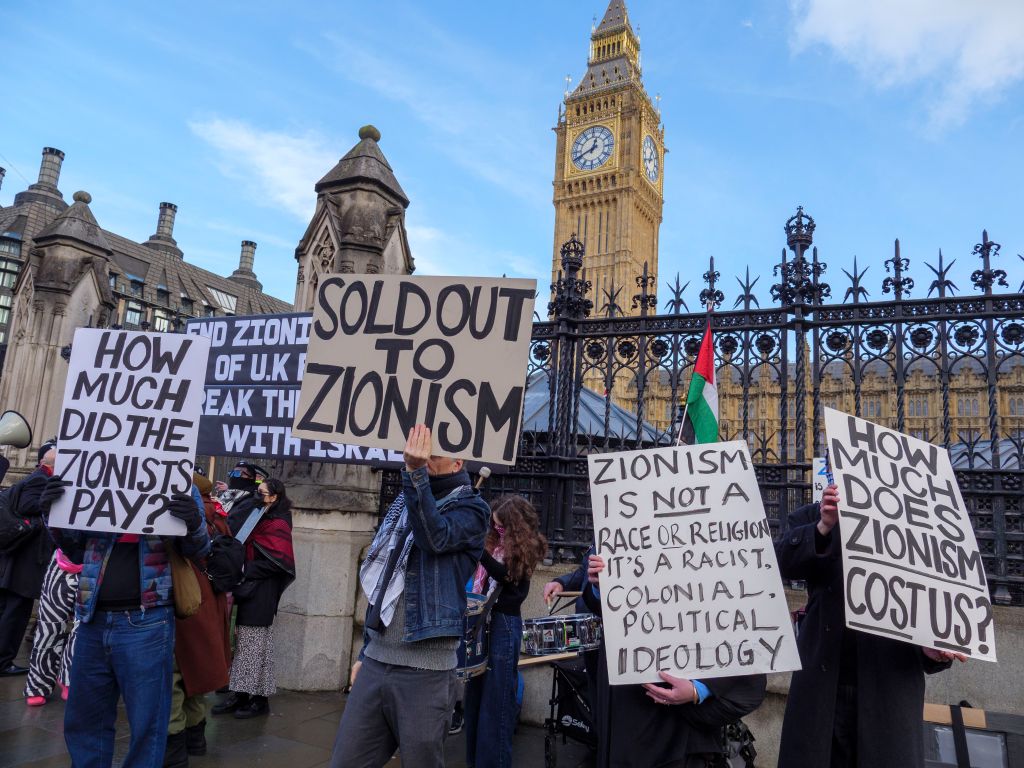
Ezra Klein, writing in the New York Times recently, argued in a defense of the anti-Israel Twitch streamer Hasan Piker that anti-Zionism is no longer a fringe movement, but a mainstream one. “Anti-Zionism is rising as a response to what Israel is doing,” Klein writes.
There’s certainly polling that indicates declining support for Israel.
In February, Gallup showed that a greater number of Americans claimed sympathy with Palestinians than with Israelis, with respondents favoring Palestinians 41 percent to 36 percent. Among Democrats, the gap was much larger: Sixty-five percent sympathized more with Palestinians, and only 17 percent sympathized more with Israelis. Among Americans aged 18 to 34, 53 percent sympathized more with Palestinians, while 23 percent sympathized more with Israelis.
Seeking to explain this, Klein writes:
The Israel that young people know is not the Israel that older people remember. It responded to the savagery of Oct. 7 by flattening Gaza in a brutal campaign that killed at least 70,000 Gazans, taking control of more than half of the territory and herding Gazans—more than two million people—into the remainder. Life there remains hellish. Israel has made hopes for a two-state solution fanciful by slicing the West Bank up into Israeli settlements and abetting constant settler violence and keeping a boot on the throat of the Palestinian Authority.
Of course, as a Palestinian myself, I have deep frustrations with the status quo and with the suffering from the war in Gaza. For example, I think it is probable that a lot of Palestinian lives could have been saved if other Middle Eastern countries had helped facilitate evacuations before the Israeli invasion of Gaza after October 7.
And Israel’s conduct of the war was marked by dishonorable episodes. Reuters verified posts from Israeli soldiers playing with women’s underwear found in Gazan homes; the Washington Post later verified more than 120 photos and videos from the war, many posted by soldiers, showing celebrations of destruction, mockery of Palestinians, and calls for Israeli resettlement of Gaza.
But I don’t agree with Klein’s attempt to mainstream anti-Zionism. As I’ve seen through witnessing the failures of Hamas and other radical groups in Palestinian society, this ideology has brought overwhelming misery to Palestinians.
So, what is anti-Zionism? Ideologically, it goes far beyond any kind of disagreement with or critique of Israeli government policies. It specifically means that the Jewish state itself is illegitimate. It means that Israel should never have been created and should be dismantled. October 7 was a practical expression of that.
The conflict over the formation and existence of a Jewish state over the top of the Palestinians, of course, started long before October 7, 2023. It started long before Israel’s founding in 1948. The violence actually started during the 1920s and 1930s, under British rule. This is a conflict between two different nationalist movements that—in the wake of the collapse of the Ottoman Empire and during the subsequent British mandate to administer the region—claimed the same piece of land.
Klein attempts to distinguish anti-Zionism from antisemitism. But the reality is—as others such as Adam Louis-Klein have argued—that anti-Zionism is a problematic idea in itself, regardless of whether or not it is equivalent to antisemitism.
What anti-Zionists try to forget is that Israel is a real country of more than 9 million people. It is recognized by 163 members of the UN. So when anti-Zionists say that Israel should be dismantled, they are asking for something totally unrealistic.
Anti-Zionists might like to think they are weakening Israel by questioning Zionism. In practice, they often strengthen the forces inside Israel most hostile to Palestinian statehood and to Palestinians themselves.
How do you persuade millions of Israeli Jews to surrender sovereignty? There are so many unanswered questions that arise from all of this. Let’s start with this: Who would control the army? Who would write the constitution? Who would guarantee Jewish safety and how? Who would guarantee Palestinian safety and how? How would episodes of revenge be prevented? How do you blend Israeli and Palestinian identity and people into a single country? How would property claims be adjudicated? What political authority would command enough trust from both peoples to carry this out?
The only answer that anti-Zionists tend to be forthcoming about is that they believe Israel should be boycotted and sanctioned until its government agrees to dissolve. But when you think through what this means, it’s not practical.
The modern world relies on Israeli technology. Israeli tech is embedded in computing, cybersecurity, agriculture, water management, navigation, medical devices, semiconductors, and within the defense industries. People who imagine Israel can be isolated into disappearance rarely grapple with this. You may dislike Israel. You may choose to boycott a hummus brand. Many people do. But the world is not going to boycott its way out of Israeli technology. And even if the world could boycott Israel, this kind of pressure would not change the simple fact that Israelis—and particularly Jewish Israelis, who make up 75 percent of the Israeli population—will not agree to dismantle their own state.
Israelis remember the suicide bombings of the Second Intifada. They remember rocket attacks that followed after Israel’s withdrawal from Gaza in 2005. They remember October 7. When anti-Zionists talk about dismantling Israel, Israelis hear a call for dismantling all of the protections that stand between them and a group of jihadists who want them dead.
Of course, not all Palestinians agree with such a thing. But no people voluntarily gives up sovereignty when they are surrounded by multiple groups who want to hurt or oppress them. Israeli Jews will not disarm because pro-Palestinian activists in London, Los Angeles, or Sydney promise them “equality.” Hamas, certainly, does not agree that Israeli Jews would be able to live as equal citizens under its regime. A Hamas conference in 2021 endorsed the notion of enslaving some Jews and mass-deporting others.
And so it doesn’t surprise me very much to see that Israeli public opinion has shifted rightwards. A recent Maariv poll of first-time Israeli voters aged 18 to 22 found that 56 percent identify as right-wing, compared with 44 percent of older Israelis; only 8 percent of those young voters identified as center-left or left-wing.
Anti-Zionists might like to think they are weakening Israel by questioning Zionism. In practice, they often strengthen the forces inside Israel most hostile to Palestinian statehood and to Palestinians themselves. Tell Israelis that the question is what to do about settlements, and there can be an argument about that. Tell them the question is what the appropriate borders are, and there can be an argument about that. Tell them the question is military occupation, and there can be an argument about that. Tell them the question is whether their country should even exist, and the argument changes completely. It boils down to a question of their own survival.
And this is not how the world usually treats states, even those whose governments have done terrible things.
Germany committed the worst crimes in modern history under its Nazi regime. But there is still a country called Germany that exists today. Serbia is another example. Serbian forces and leaders were responsible for appalling crimes during the Yugoslav wars. But there is still a country called Serbia that exists today.
Russia has committed atrocities in Ukraine. China has committed grave abuses against Uyghurs and Tibetans. Turkey has denied and repressed Kurdish national aspirations. Pakistan was born out of partition and violence. The United States was founded with slavery and settler conquest. History’s conclusion is not usually that such states have forfeited the right to national existence.
Klein looks at Netanyahu, Gaza, the West Bank settlements, and the Israeli right and sees why anti-Zionism is becoming more attractive. I look at the same things and see why anti-Zionism is such a disastrous and ruinous proposal.
The Israeli right already has its own ready-made version of rejectionism. As Klein himself points out, Netanyahu has openly opposed a Palestinian state. His coalition partners go further still: Bezalel Smotrich has called for Israel’s border with Lebanon to extend to the Litani River, while Itamar Ben-Gvir has repeatedly called for Israeli resettlement of Gaza and the “voluntary migration” of Palestinians from the Gaza Strip; at a May 2024 ultranationalist rally, he said Israel was “committed to returning to Gaza” and “committed to settling there.” Smotrich has also spoken in maximalist terms about Israeli expansion into Gaza, Lebanon, and Syria. Settlements have carved up the West Bank, and settler violence has made daily life more frightening and dangerous for Palestinians who live there, including my own family.
But the truth that everybody must face is that neither side is going to dissolve. Neither side is going to consent to their own dismantling, much less destruction.
Of course, agreeing to a compromise will not be easy. It will be extraordinarily challenging. We have tried many times before. And, I admit, we have failed many times before.
There’s a whole list of thorny challenges: Issues surrounding borders, refugees, governance of Jerusalem, security arrangements, settlements, recognition, demilitarization, water, airspace, and holy sites would all take a gargantuan effort to resolve. But negotiating all of these issues still seems like a preferable outcome compared to the alternatives. That makes me optimistic that a solution can be found.
What I also know very clearly is that anti-Zionism possesses no serious answers to any of these questions. In fact, it asks Palestinians to hold out and continue to suffer for the undoing of Israel. It tells us that the real victory is not a state of our own, but the end of the Jewish state. This is a recipe, I am afraid, for permanent conflict and suffering.