With term-limited Gov. Gavin Newsom turning his attention to a likely 2028 presidential run, the race “has been defined by who didn’t run, not by who is running,” Rob Stutzman, a political consultant and former senior communications staffer for Gov. Arnold Schwarzenegger, told TMD.
Former Vice President and Sen. Kamala Harris declared last July that she would not enter the race. Other possible headliners—like state Attorney General Rob Bonta, Sen. Alex Padilla, and Lt. Gov. Eleni Kounalakis—also decided against running.
“The voters are not necessarily in a mood to just give a rubber stamp to the status quo,” Mark Baldassare, the statewide survey director for the Public Policy Institute of California, told TMD, pointing to widely felt anxiety about affordability and the direction of the state’s economy.
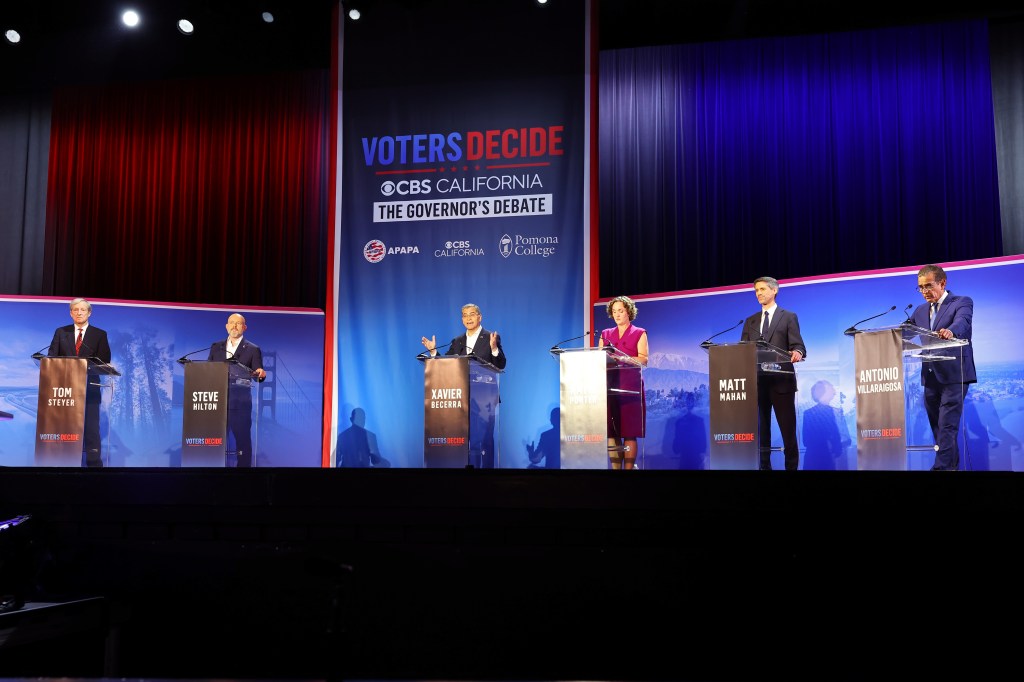
The Democrats stepping in to fill the gap are largely unknown statewide. Of the eight candidates on the debate stage, the six Democrats were:
- Former U.S. Rep. Katie Porter,
- Former state Attorney General (and former Health and Human Services Secretary) Xavier Becerra,
- San Jose Mayor Matt Mahan,
- Former Los Angeles Mayor Antonio Villaraigosa,
- Tony Thurmond, California’s school chief,
- Tom Steyer, a self-financed billionaire who ran for president in 2020 on an environmentalist platform.
Brian Brokaw, a former political adviser to Newsom and Harris, told TMD that the candidates’ relative anonymity also reflected a generational shift among California Democrats. “For a very long time, the state has been led by politicians who are brand-name,” he said. “People who’ve served in Congress and the Senate for years.” Perhaps the most well-known California Democrat outside of Harris is Rep. Nancy Pelosi, who has been in Congress since 1987. A runner-up might have been Dianne Feinstein, who represented California in the U.S. Senate for more than three decades before she died in 2023.
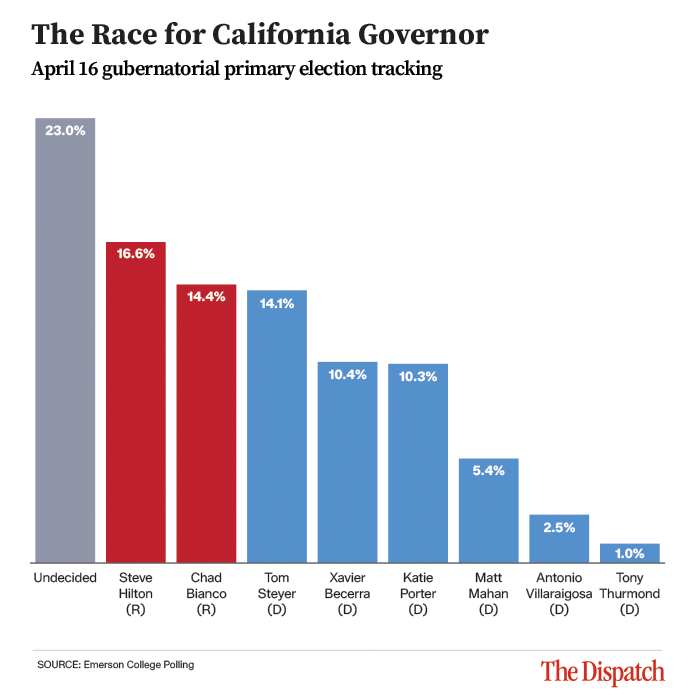
The California GOP is fielding a much smaller slate. Two candidates, hardly household names themselves, are effectively tied in the polls: Hilton, who previously served as a political adviser to former British Prime Minister David Cameron, and Chad Bianco, the sheriff of Southern California’s Riverside County. In the latest Emerson poll, Hilton attracted 17 percent of likely voters, and Bianco 14 percent—within the margin of error.
If Hilton and Bianco continue to split the California GOP electorate—which accounts for about 25 percent of the state’s voters—the math could ruin Democrats. With their own field this splintered, 15 percent each might be enough for both Republicans to grab the runoff slots.
“It’s possible, I just think it’s unlikely,” Stutzman said, noting that for the box-out to happen, at least four Democrats would likely need to stay in the race and split the vote. Also, President Donald Trump’s endorsement of Hilton is expected to consolidate Republican support behind him and ease Democrats’ lockout risk.
By contrast, the current Democratic front-runner—Farallon Capital founder Tom Steyer, one of the most prolific political donors in American history—is running squarely against the president. Steyer has promised to jail ICE agents who commit crimes, referring to the agency as a “violent extremist group.” He has endorsed a proposed one-off wealth tax (for more on the wealth tax, read yesterday’s TMD) and has advocated a windfall tax on oil companies. Steyer has had some success—reflected in his rising poll numbers and an endorsement from the state teachers’ union—and so far has spent more than $140 million of his own money in the governor’s race.
(In 2020, he spent more than $250 million during a presidential campaign in which he failed to crack 5 percent nationally.)
His campaign has framed him as the most progressive, anti-Trump candidate. But on the debate stage Tuesday night, it was unclear how much the Democratic candidates actually disagreed. When asked about the best way to address the effects of Republican-led cuts to healthcare subsidies, Steyer, Porter, and Becerra all said they would support a single-payer healthcare system for Californians. All candidates pledged to use state resources to push back on federal immigration sweeps, and most backed some form of price intervention in homeowners’ insurance. Becerra called for a price freeze.
“There was an opportunity for a more pointed, philosophical discussion among Democrats that didn’t really emerge,” Ken Miller, a political scientist at Claremont-McKenna College and an expert on California politics, told TMD.
Just before the event, Thurmond released a video telling Trump to “f—ck off.” Becerra—who has picked up the most from Swalwell’s exit—said on stage, “The first thing we have to do is stop Steve Hilton’s daddy.”
“All [Democratic] candidates are on the left side of this fundamental dividing line in American politics,” Thad Kousser, a political scientist at the University of California, San Diego, told TMD.
The only exception to the progressive caucus is Mahan, who developed a reputation as a relative moderate during his time as San Jose’s mayor, and has noted that Newsom campaigned on single-payer healthcare only to discard the idea after determining that it would require almost doubling the state budget. In interviews, Mahan has called for Democrats to abandon anti-Trump posturing and focus on fixing California’s governance failures, declaring that “California’s failure is the best ammunition that Trump has ever had.” But he’s also failed to crack 5 percent in opinion polls.
All the candidates do agree on one thing: The state is in bad shape, especially on affordability. California’s median home price is more than $850,000, outstripping every state but Hawaii. The average Californian homeowner spends 43 percent of their income on housing, with renters not far behind. Adjusted for the cost of living, California is tied with Louisiana for the highest poverty rate in the nation, and rising oil prices are pushing energy costs even higher.
California’s homeless population—while growing at a slower rate than the rest of the country—hit record levels last year, despite the state spending $24 billion to combat homelessness since 2019. Every candidate—other than Porter—offered an unqualified yes when asked by a moderator if they would support involuntary commitment to mental health and drug treatment for people living on the streets.
But Miller noted that Newsom ran on the same issues, promising to build 3.5 million housing units and to solve the homelessness crisis when he was elected in 2018. But his pro-housing bills have run aground on lawsuits filed under California’s environmental review statute and on restrictive local zoning. By the end of 2023, just 650,000 homes had been permitted, according to an investigation by the San Francisco Chronicle. There’s also no sign that Newsom’s policies have meaningfully reduced the state’s homeless population.
“We haven’t had close races to pay attention to in our state since 2010”—when Jerry Brown narrowly defeated Meg Whitman—Kousser said, noting that California has since had “coronations upon coronations of politicians.”
Asked by TMD if the race will become more policy-specific, Brokaw was pessimistic: “I wouldn’t hold my breath.”