Authored by Bojan Stojkovski via Interesting Engineering,
A Chinese research team has successfully tested a wireless power transfer system that beams energy from the ground to a drone in flight using microwaves.
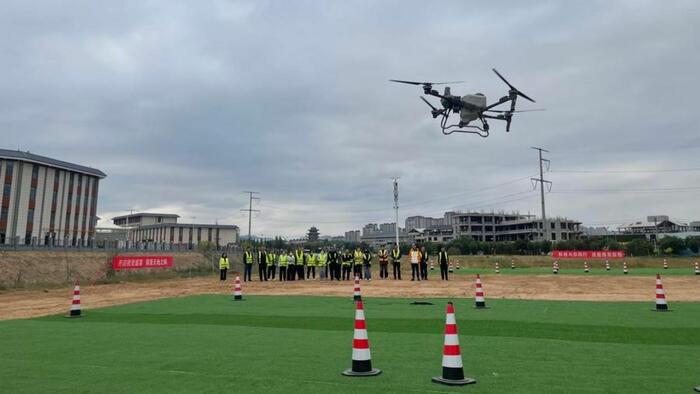
The setup relies on a mobile emitter that directs energy to an antenna array mounted beneath the aircraft, enabling continuous power delivery without physical connections. Notably, the experiment maintained stable transmission even while both the drone and the ground unit were moving, marking a step beyond static demonstrations.

Analysts have compared the concept to a “land-based aircraft carrier”, where an armoured vehicle could act as both a launch platform and an energy hub, sustaining drone operations in a manner similar to how naval carriers support aircraft at sea.
New system keeps drones flying for over three hours
The concept could significantly expand how long drones remain in the air, supporting continuous surveillance, strike missions, and electronic warfare without frequent landings. The results, published in the peer-reviewed journal Aeronautical Science & Technology, come from a research team at Xidian University, an institution closely associated with defense-related technologies.
During trials, the vehicle-mounted system sustained fixed-wing drones in flight for up to 3.1 hours while operating at an altitude of about 49 feet, demonstrating stable power delivery under real-world conditions, the South China Morning Post reported.
According to project lead Song Liwei, one of the main technical hurdles was keeping the microwave emitter precisely aligned with the drone while both were in motion. The team addressed this by combining GPS positioning, a real-time tracking mechanism, and onboard flight control systems to continuously correct the beam’s direction. This coordination allowed stable energy transfer despite movement and environmental variability.
As unmanned systems have become increasingly central to modern ground warfare, militaries and defense researchers have intensified efforts to develop wireless charging and in-flight power delivery technologies. Now, the goal is to reduce dependence on landing cycles and extend the operational endurance of drone fleets in contested environments.
US, China race to develop in-flight drone charging systems
Beyond extending flight endurance, the technology could also reshape drone design by reducing reliance on large onboard batteries, thereby freeing up space and weight for heavier payloads and additional sensors. In practical terms, this would allow smaller platforms to perform more complex missions without sacrificing range or endurance.
In the US, the Defense Advanced Research Projects Agency (DARPA) has already backed multiple efforts investigating wireless energy transfer, including radio-frequency and laser-based systems. Furthermore, private companies are also demonstrating laser-based charging concepts, highlighting a parallel push toward airborne energy delivery systems.
Compared with other wireless energy approaches, laser-based systems offer higher precision and longer transmission ranges, but they are vulnerable to disruption from environmental factors such as fog, dust, and atmospheric turbulence. They can also create detectable infrared signatures, which may reveal a drone’s position to adversaries.
Microwave-based transmission takes a different trade-off, as it is generally more robust in poor weather conditions and less affected by line-of-sight degradation. In addition, a single microwave emitter could potentially supply energy to multiple drones at once, which makes the approach more suitable for dense operational environments or contested battlefields where resilience and scalability are critical.