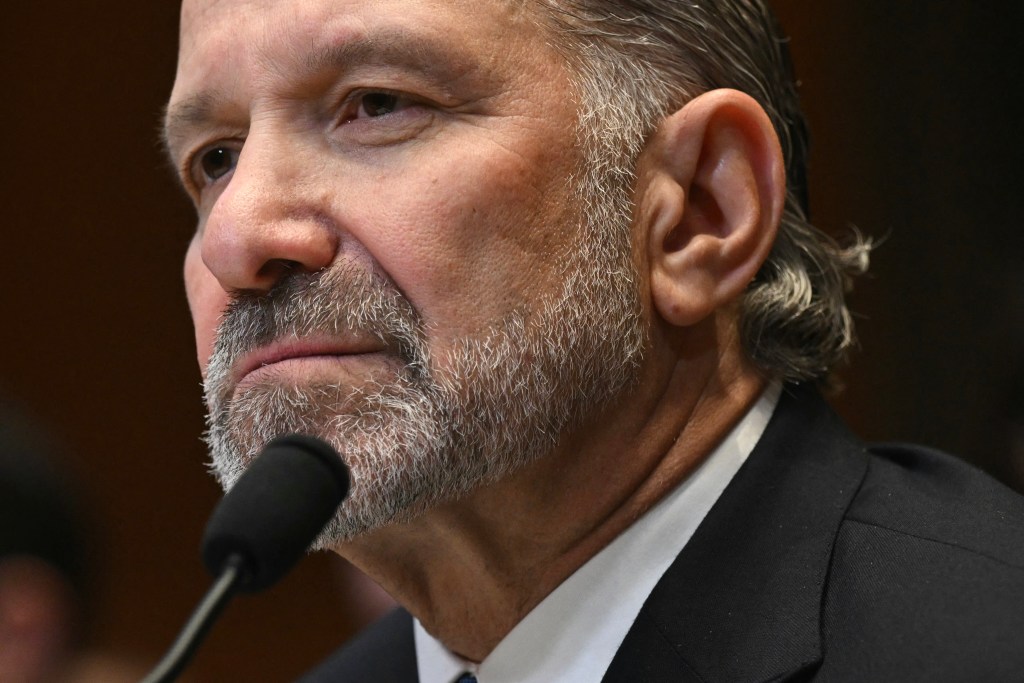
Commerce Secretary Howard Lutnick found himself on the defensive in a House Appropriations Committee meeting last week. During a discussion about the administration’s trade policies, Rep. Madeleine Dean of Pennsylvania pressed him on whether his former investment firm—now run by his sons—stood to profit from a tariff regime imposed by President Donald Trump that Lutnick championed.
“You and the president illegally imposed the highest tariffs on the American people since the Great Depression, and your sons figured out how to profit from the high tariffs by buying up refund rights, pennies on the dollar, just as you were out there cheerleading the tariffs,” Dean told Lutnick last week. “As a result, federal taxpayers like my constituents may now owe your family tens or hundreds of millions of dollars. I wonder if President Trump is concerned about you and your family profiteering off the illegal tariffs.”
“You know that that is false. Here’s reporting. I’d like to put it in the record,” Lutnick responded, brandishing a printed version of a February 20, 2026, article in Semafor titled “Howard Lutnick’s old firm did not, in fact, profit from Supreme Court tariff ruling.” Dean pushed back, telling Lutnick, “I hope you recognize how fundamentally wrong and corrupt this is. I hope you take accountability and have the decency to resign before you are fired.”
Dean’s accusations may have been forceful, but they’re nothing new. Lutnick—and the investment group he used to lead, Cantor Fitzgerald—have been fending off such allegations regarding tariffs the administration imposed under the International Emergency Economic Powers Act (IEEPA) since they first surfaced in a July 2025 story in Wired. It reported that Cantor’s banking subsidiary was “creating a way for investors to bet that President Donald Trump’s signature tariffs [would] be struck down in court.” The reporting cited a letter seen by Wired in which a representative for Cantor wrote that the firm had the capacity to trade several hundred million worth of a financial product that would give investors the rights to tariff refunds should the IEEPA tariffs be found unlawful and that it had “already put a trade through representing about ~$10 million of IEEPA Rights.”
However, it’s unclear whether Cantor Fitzgerald has actually been involved in such trades. The firm did not respond to a request for comment from The Dispatch.
While Lutnick resigned from his positions as chairman and CEO of Cantor and divested his ownership in the firm upon being confirmed as commerce secretary, he is still connected through his sons, Brandon, who serves as chairman, and Kyle, who serves as the firm’s executive vice chairman. Howard Lutnick’s direct equity in the firm was also transferred to trusts benefiting Brandon, Kyle, and his other two children. Thus, even without the elder Lutnick maintaining a direct financial interest in Cantor, it would pose a substantial conflict of interest if the firm stood to profit from a tariff policy that he had significant influence over.
Cantor stood to benefit from Trump’s IEEPA tariffs, according to Wired’s reporting, through a form of litigation finance often called a “claims trade.” In this particular trade, an importer might choose to sell its legal claim to a tariff refund, should a refund happen, in exchange for an upfront payment. For example, if a company paid $10 million in IEEPA tariffs to U.S. Customs and Border Protection, it would be eligible for a refund on those tariffs should the Supreme Court determine that Trump’s use of IEEPA was unconstitutional. Instead of waiting on an uncertain court decision, however, the company might choose to cut its losses immediately by selling its rights to a potential future refund to another party, like a hedge fund, in exchange for $2 million or $3 million. Claims trades like these are not unusual, and the market for IEEPA refund claims itself grew substantially in 2025 and early 2026, before the Supreme Court’s February 20 decision declaring the tariffs outside the law’s scope. Cantor itself has facilitated similar trades in the past, such as on claims during the 2022 collapse of crypto exchange FTX. Acting as middlemen to facilitate complex trades like these is the job of firms, like Cantor, that are involved in investment banking.
Regardless, Cantor Fitzgerald has consistently denied that it was involved in claims trades on IEEPA refunds. In the Wired article, Cantor spokeswoman Erica Chase said that “Cantor is not in the business of positioning any risk or taking views in litigation claims including tariffs.” Department of Commerce press secretary Kristen Eichamer added that “Secretary Lutnick knows nothing about this decision because he has no insight or strategic control over Cantor Fitzgerald.” The Department of Commerce did not immediately respond to a request for further comment.
In August 2025, roughly a month after Wired’s report and one day after Democratic Sens. Ron Wyden of Oregon and Elizabeth Warren of Massachusetts sent a letter to Lutnick demanding details on the “tariff refund agreements,” Bloomberg reported that while Cantor had internal discussions about whether to facilitate trades on such products, it ultimately decided against it prior to executing any trades. According to several anonymous sources cited by Bloomberg, Cantor had “received a client inquiry about possibly facilitating such trades, which are done by larger Wall Street banks, and some staff discussed with potential clients about arranging them before the idea was rejected.”
Dean’s specific claim that Cantor could be owed tens or hundreds of millions of dollars now that Trump’s IEEPA tariffs have been ruled unlawful is also dubious. Even if Cantor did facilitate trades on tariff refund claims, the firm almost certainly would have done so as an intermediary, not as a principal investor. Cantor’s role, like that of other Wall Street firms in this market—such as Jefferies Financial Group, Stifel Financial Corp., and Oppenheimer Holdings—would have been to arrange trades between importers selling claims and hedge funds buying them—earning a commission rather than placing the bet itself. Sources who spoke to Bloomberg made this distinction, telling the outlet that Cantor does not take directional positions on brokered trades and only earns a commission when it matches buyers and sellers. Therefore, even if Cantor did facilitate trading in the tariff refund claims market (a charge Cantor has denied), the firm wouldn’t itself be entitled to the refunds on tariffs.
On the same February day that the Supreme Court ruled that IEEPA does not authorize the president to impose tariffs, Semafor corroborated Bloomberg’s account. The story, citing a senior banker familiar with the matter, reported that Cantor had considered facilitating trades on tariff refund agreements, “but decided against it after weighing the political sensitivities.” The piece also claimed that a salesman representing Cantor had erroneously “believed that the firm was likely to greenlight the business, then went out looking for the other side of the trade.”
The explanation—that an employee responsible for marketing investment products to clients got ahead of the firm and pitched a product that the firm had considered, but not actually approved—is plausible. However, for that salesperson to go so far as to claim in writing that a trade had already cleared—all without approval for the product from senior bankers—has drawn skepticism.
One of those skeptics has been Maryland Rep. Jamie Raskin, the ranking Democrat on the House Judiciary Committee, who, a week after the Semafor report, sent a letter to Howard Lutnick and Brandon Lutnick demanding that both the Commerce Department and Cantor provide all documents, communications, and information related to tariff refund trades. “Now that the Supreme Court has finally rejected President Trump’s brazen and unlawful power grab, the firm reportedly stands to make extraordinary profits of millions of dollars at the expense of American taxpayers,” Raskin wrote. “This arrangement raises significant ethical, legal, and policy questions that demand a full public accounting.” The letter demanded that all materials be provided to the House Judiciary Committee by March 9, but there has been no public confirmation from the Commerce Department, Cantor Fitzgerald, or the Judiciary Committee that those materials were provided. The House Judiciary Committee did not respond to The Dispatch when asked whether the requested records had been received. Representatives from Sen. Warren and Sen. Wyden’s offices, who together made a similar records request last year, also did not respond to a request for comment from The Dispatch.
Until those records are made available, either by Cantor or an investigatory body, it will be impossible for the public to know for certain whether Cantor’s account is fully truthful. Thus far, neither side has produced the trade confirmations, counterparty, or settlement records that would resolve the controversy.