In its first year, the Trump administration shifted significant prosecutorial and investigative resources within the Department of Justice toward issues like immigration and violent crime and away from other enforcement areas. Prosecutions of immigration cases tripled in the first six months of the administration, and around 1-in-5 FBI agents were diverted to work on immigration.
That left other enforcement areas with fewer investigators, prosecutors, and, most importantly, time.
One area that looked particularly ready to take a hit was the prosecution of white-collar crime, and specifically enforcement of the Foreign Corrupt Practices Act (FCPA)—a longstanding federal foreign bribery statute designed to combat global corporate corruption, and one of the DOJ’s most powerful white-collar enforcement tools. For decades, the FCPA has shaped how multinational American companies operate abroad and served as an ethical shield for businesses against corrupt demands. Under President Donald Trump, it is also a law the federal government is increasingly choosing to deprioritize.
Since Donald Trump returned to the White House early last year, his administration has signaled regularly that the FCPA, used for decades to go after companies like Goldman Sachs, Siemens, and Airbus for paying illegal bribes to foreign officials in exchange for favorable business deals, was falling out of favor. Shortly after his inauguration, Trump signed an executive order that froze new and existing FCPA enforcement actions for 180 days and asked then-Attorney General Pam Bondi to review all existing FCPA matters and issue new enforcement guidelines. Since then, the DOJ’s FCPA Unit has shrunk by a third, and the Securities Exchange Commission’s own FCPA unit dissolved entirely. Just last week, acting Attorney General Todd Blanche announced a new National Fraud Enforcement Division that notably did not include the DOJ’s FCPA unit at all.
Changes have not only affected the prosecutors who try FCPA cases, but the FBI agents and investigators who build them. “If prosecutors are the quarterbacks, then the FBI agents are like the linemen. You can have the best hotshot quarterback in the world, but if you don’t have a left tackle, it doesn’t make a f–king difference,” one former assistant U.S. attorney, who was not authorized to speak on the record, told The Dispatch. “[The administration] is starving the [DOJ] of staffing in the areas they don’t like, and that’s very intentional.”
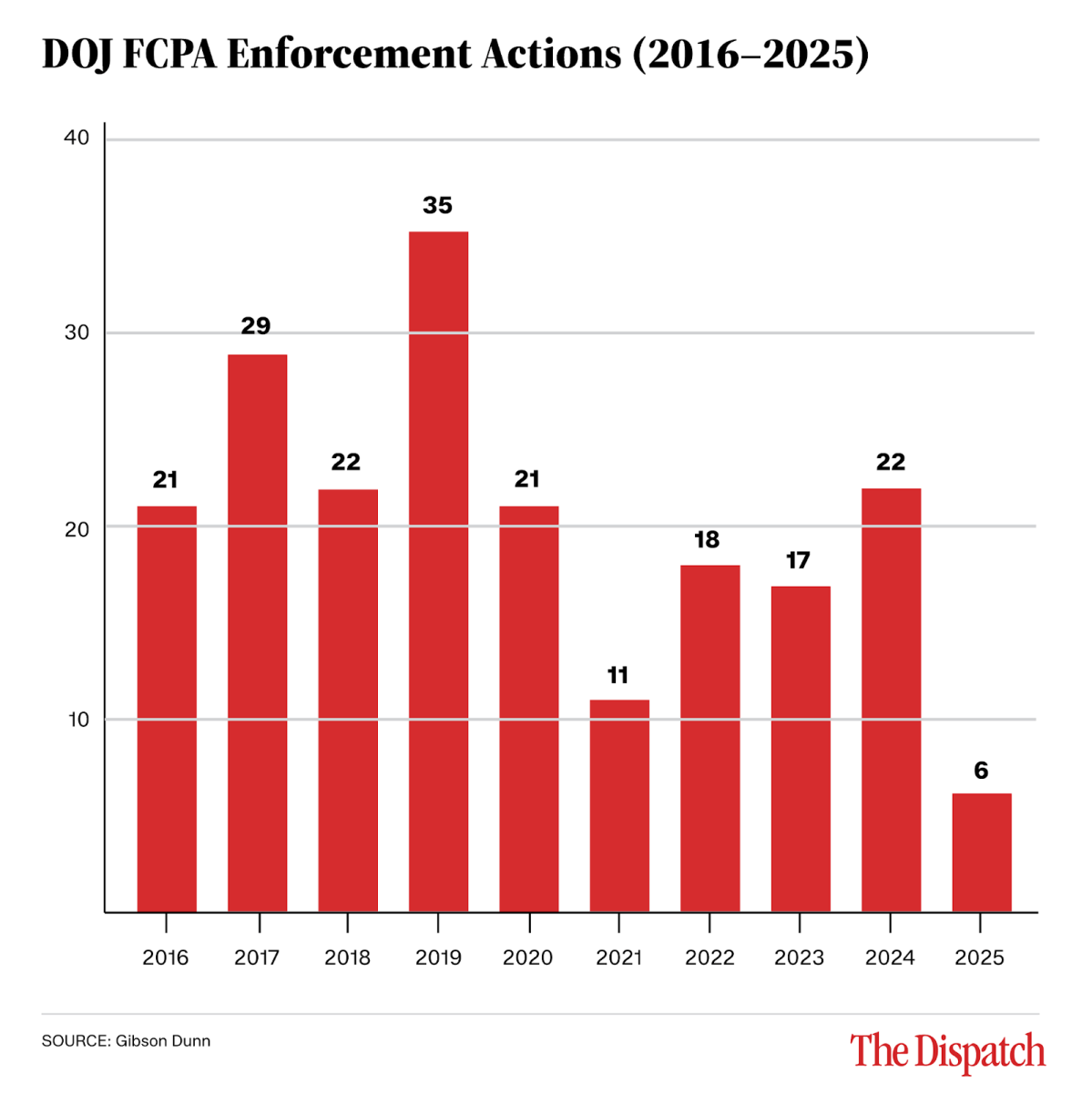
Prosecutors are still filing FCPA cases and still winning convictions at trial. But the volume of FCPA enforcement actions has also cratered, and around half of the DOJ’s ongoing investigations were dropped last year. The DOJ made only six core FCPA enforcement actions in 2025, a decline of more than 70 percent from the 22 it made in 2024 and the lowest single-year total since 2006. And, while the DOJ’s FCPA unit did make its first corporate indictment in 15 years—a rarity given most corporate enforcements end in some form of settlement agreement or declination. That indictment, however—which came against Smartmatic, a voting technology firm that some Trump allies have claimed helped rig the 2020 presidential election against Trump—has been labeled by some as a political prosecution by the administration.
“You have to acknowledge that enforcement is less than it was in prior years,” Alex Kramer, who served as an assistant chief in the DOJ’s FCPA unit from 2022 until February 2025, told The Dispatch. Of the six enforcement actions brought by the DOJ last year, three came against individuals and three against corporations. And several deferred prosecution agreements were terminated early. However, the DOJ also proceeded with four of the five individual FCPA trials that were scheduled for 2025, successfully convicting in each. In the first quarter of 2026, the DOJ also brought one additional corporate enforcement action and indicted three individuals.
Part of the drop in FCPA enforcement actions is a necessary result of DOJ manpower being redirected elsewhere. The FCPA unit had 32 attorneys in 2024 but was down to 22 by the end of 2025, though some independent estimates claim it has shrunk even further. Some of those attorneys went to other parts of the DOJ, but others left the government entirely for jobs in the private sector. The sharp uptick in immigration enforcement by the DOJ has also required prosecutors who might otherwise be working on more complex cases—such as resource-heavy white-collar investigations—to focus their work elsewhere. In its first month in office, for example, the Trump administration said that it would be pulling line prosecutors from all 93 U.S. attorneys’ offices to beef up the DOJ’s border enforcement priorities. “In any organization with finite resources, establishing new priorities has the effect of diverting time spent on other areas,” Jason McCullough, a former assistant U.S. attorney in the District of Columbia office, told The Dispatch. “That is a function of there being only 24 hours in a day.”
Resources upstream of the DOJ’s white-collar attorneys have also dwindled, further constraining enforcement capacity. Cases typically originate with law enforcement and investigators like the FBI. “Those upstream resources create the case, they run the investigation, and—in cooperation with the prosecutors—they start the case and do all the lifting before you get to court,” the former assistant U.S. attorney said. Two of the FBI’s groups dedicated to investigating influence and corruption, however—its Foreign Influence Task Force and a field office dedicated to public corruption issues—were disbanded last year. The DOJ also shuttered its own in-house anti-kleptocracy team, and the headcount of the department’s Public Integrity Section, which handles federal corruption cases against elected officials and government employees, was reduced from approximately 30 attorneys during the Biden administration to “fewer than five” by May 2025, according to the Washington Post.
Alongside its resource constraints, the DOJ is also wrestling with a new set of guidelines on FCPA enforcement. On June 9, 2025—119 days into the administration’s 180-day FCPA enforcement hiatus—then-Deputy Attorney General Todd Blanche issued a memo outlining new priorities for FCPA enforcement. He set out four new factors that prosecutors should consider when investigating and prosecuting such cases: 1) whether the alleged conduct is related to the operations or members of a cartel or transnational criminal organization, 2) whether the misconduct harms the economic interests of U.S. companies, 3) whether the misconduct poses a threat to U.S. national security, and 4) whether the misconduct involves serious corrupt intent, as opposed to routine business practices. The guidelines also require sign-off from the assistant attorney general for the criminal division or a more senior DOJ official on every FCPA matter, taking those decisions out of the hands of career prosecutors and placing them in the hands of political appointees.
Not all of the information pertaining to particular dropped cases or new investigations is public, meaning it is difficult to determine how the DOJ’s new FCPA guidelines have already or will affect enforcement decisions. However, longtime observers of FCPA enforcement patterns are skeptical that Blanche’s four new factors, despite the seemingly lofty ambitions of the executive order that inspired them, have made themselves felt on the ground. “I don’t know that there’s been any meaningful change in FCPA enforcement,” Mike Koehler, a law professor and expert on FCPA enforcement, told The Dispatch. “It’s the same sort of enforcement theories and same sort of resolution vehicles.” One former attorney in the DOJ’s FCPA unit, who was granted anonymity to speak candidly, agreed. “FCPA enforcement itself has gone back to normal [since the end of the pause] in terms of the types of cases they’re looking at,” he said. “It’s not the sea change—like really focused on this whole idea of cartels and terrorism—that I think a lot of us expected.”
Kramer believes that Blanche’s new guidelines are likely to play a clearer role in initiating new investigations than the decisions to drop or resolve ongoing cases that already existed when the new administration entered office. “Investigations can take a long time, and the Blanche memo, in large part, was talking about which type of investigations are going to be approved moving forward,” he said. “I think we’re likely to see [the new guidelines] play out in the future much more than we’ve already seen.” Koehler, however, who has tracked changes in FCPA enforcement theories for decades, is less certain that the new guidelines will actually affect enforcement patterns. “I’m not saying that the policy memos don’t suggest different things,” Koehler said. “But DOJ policy memos over the last 15 to 20 years frequently suggest different things that never come to fruition.”
The DOJ is also facing its own broader wave of uncertainty following Trump’s firing of Bondi earlier this month. Trump named Blanche as acting attorney general until a replacement is nominated and confirmed, though who—and when—that nomination might happen is uncertain. Last week, Blanche issued a memo outlining the creation of a new National Fraud Enforcement Division designed to “zealously investigate and prosecute those who steal or fraudulently misuse taxpayer dollars.” The new division—initially announced by Vice President J.D. Vance in January—will be led by Assistant Attorney General Colin McDonald and include the DOJ’s Criminal Division’s Tax Section, Health Care Fraud Unit, and Market, Government, and Consumer Fraud Unit. Notably, the new division does not include the DOJ’s FCPA attorneys, of which the consequences of—and reasoning for—are still unclear.
The FCPA Unit, however, is also adjusting to a leadership change. In December, Tysen Duva was appointed as the new assistant attorney general for the DOJ’s Criminal Division, which oversees the department’s Fraud Section and FCPA Unit. Whether he will further shift the DOJ’s approach to white-collar enforcement is an open question, but Duva made his mixed feelings toward the FCPA clear in his answers to a Senate Judiciary Committee questionnaire last year. “As President Trump rightly noted, FCPA enforcement in recent years [has] extended beyond its original intent, burdening American companies and harming our national interest,” he wrote.
But while FCPA enforcement may be out of favor under the Trump administration, a Wild West for corporate bribery is still a long way off. Even with a narrower scope and diminished capacity, the DOJ’s career white-collar prosecutors seem ready and willing to enforce the FCPA. “[When companies ask] ‘Is the FCPA gone? Can we turn the dial back on that?’ I think the answer is absolutely no,” Kramer, who now defends corporate clients, said. “For the most part, companies who are engaging in this space have had long-standing anti-corruption policies and procedures in place and aren’t looking to necessarily roll that back in its entirety because of any one administration’s prioritizations, because they realize it might become a priority again in the future.” The Trump administration, after all, isn’t the first administration to move resources in and out of white-collar enforcement, and it’s unlikely to be the last. “Every administration is going to have a shift,” the former attorney in the DOJ’s FCPA unit said. “This one just seems to be more dramatic than most.”