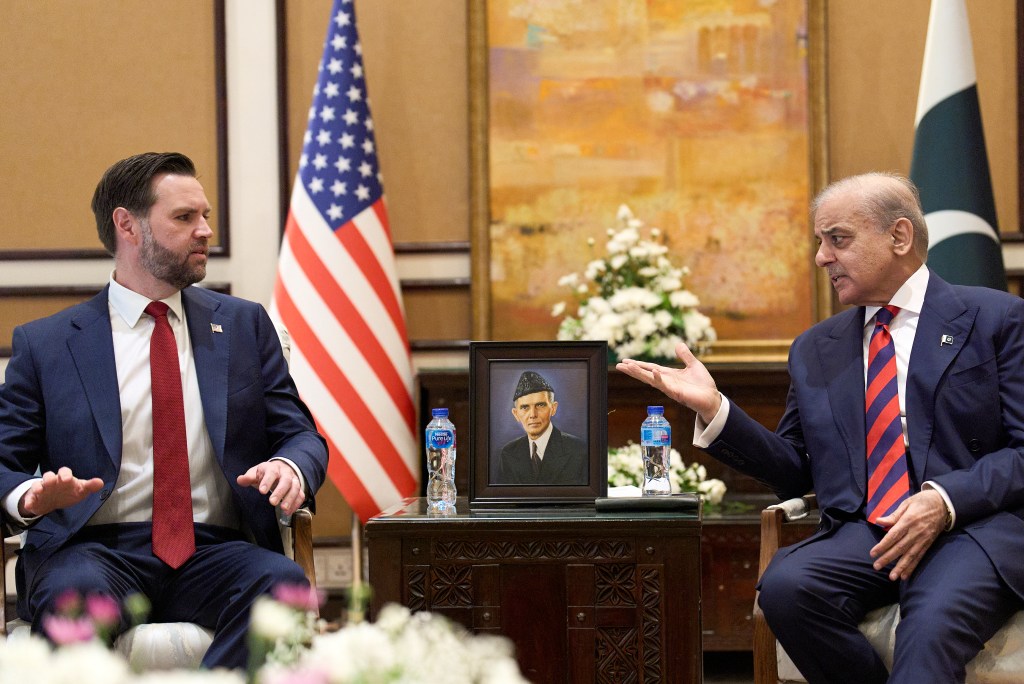
The much vaunted U.S.-Iran peace talks over the weekend ended with Vice President J.D. Vance announcing that “The Iranians were [not] willing to accept our terms” and no deal was reached. “It’s time for [America] to decide whether it can earn our trust or not,” Iranian Parliament Speaker Mohammad Bagher Ghalibaf commented. “IRAN WILL NEVER HAVE A NUCLEAR WEAPON!” President Donald Trump responded, later adding that “The United States [will] Blockade Ships Entering or Exiting Iranian Ports.”
There is a well-established principle in conflict resolution that a negotiated settlement can happen only when there is a mutually hurting stalemate that makes the conflict ripe for settlement. This framework suggests that both sides must hurt enough before they will choose compromise over continuing the fight.
With this in mind, the failure of negotiations is not surprising. Looking at the weekend through a negotiator’s lens, both sides appeared to have a negative Zone of Possible Agreement (ZOPA) going into the summit. That is to say, if there is no overlap between negotiators’ agreeable outcomes—say, the minimum the U.S. will accept (like the cessation of Iranian nuclear aspirations) is more than the maximum Iran is willing to give up (like five years without nuclear activity)—then there is no ZOPA for a negotiated settlement.
Right now, the war is painful for both Iran and America—but not equally and not painful enough for either side to budge on the core question of Iran’s nuclear program. But this isn’t a normal negotiation scenario. Donald Trump is eager to end the war and move on to the next big thing, but the president’s personal interests don’t fully align with America’s interests, and Iran does not appear to share the same desires. Instead of a textbook systems analysis, that difference fundamentally changes the calculus for understanding these negotiations.
To understand why, let’s take a look at each side’s position.
For Iran, the status quo is damaging—much of its leadership is dead, and its military is significantly degraded. But the conflict is currently manageable, and the regime is still intact—and in fact may (counterintuitively) be in its most survivable position in months. Because of this, it is not likely that Iran is motivated to reach a settlement.
While Iranian security forces were unable to extinguish recent pro-independence rallies, American and Israeli bombs effectively pushed them into the shadows and even prompted some pro-regime rallies. As the last four years in Russia have demonstrated, authoritarian regimes use war as an effective tool for domestic control. As long as Iran fights the Great Satan, it can consolidate domestic power. A peace treaty would end the struggle against the “other,” and make the regime freshly vulnerable to anti-government uprisings.
Iran has held a role as a regional power for years but, despite angering neighbors with retaliatory attacks, it has never held stronger geopolitical leverage on a global scale than it does now. Before the war, Iran did not control the Strait of Hormuz; it has now all but solidified its de facto control of the strait and is likely generating substantial revenue from sanction-proof transit fees. With other potential Western allies sitting on the sidelines until the conflict ends, Iran’s hold on the strait is secure for the time being.
In addition to the political will, Iran has the asymmetric military capabilities to continue inflicting pain and imposing costs on the U.S. and Israel. While its conventional military platforms are degraded, it still has enough missiles, drones, and maritime mines available to wreak havoc in the air, on the sea, and on land. Even with production facilities damaged—but probably not destroyed—Iran’s asymmetric advantages are likely here to stay.
Iran has also benefited economically from elevated oil prices, with 20 percent of the world’s oil frozen in place for six weeks. Not only did it already have a premium market with China, but in another example of Trump and America’s interests diverging, Trump suspending sanctions on Iranian oil has only given the regime a greater advantage.
Iran’s recent demand that all sanctions be lifted is more likely a bargaining chip than an actual core interest. Given this regime’s past experiences with Trump, sanctions, and agreements, the regime would likely be leery of truly rejoining the global economy. Lifting sanctions would provide short-term economic relief, but reintegrating would give the U.S. more long-term leverage and would make Iran more susceptible to future coercion. Though not ideal, Iran has realized that being economically isolated—and insulated—is not the worst outcome after experiencing the sucker punch of this war at the hands of an adversary who revels in his madman reputation.
From this position of relative economic, geopolitical, and domestic strength, the regime’s resolve on its nuclear program has only hardened. Conventional military and economic deterrence via the strait has proven inadequate to provide for Iran’s security; the last six weeks have demonstrated that no amount of negotiating or traditional deterrence can ensure Iran’s security or status as a regional hegemon. Iran’s steps toward a nuclear weapon have surely been hampered, but not totally obliterated—and their desire and need for the bomb has likely never been greater.
The 2011 NATO-backed overthrow of Libyan dictator Muammar Gaddafi showed that, when a regime gives up its pursuit of a nuclear program, it becomes vulnerable to foreign intervention, and without nuclear deterrence, it’s a short road to regime decapitation. With this lesson in mind, the Iranian regime will have a very high pain tolerance for maintaining its ability to pursue nuclear weapons as its best hope of guaranteeing its future. The ceasefire and negotiations are likely empty theater to buy time to recover and refit, or perhaps they are a calculated effort to give Trump a fig leaf with which to save face and end the conflict.
The question for Iran is whether it has enough incentive to negotiate; for America, the question is different.
For the U.S., the war has been expensive and reputationally damaging, but relatively painless and generally sustainable so far.
Because Congress has not effectively exercised any oversight and most Americans aren’t experiencing this war beyond higher gas prices, it theoretically could take years before the U.S. experiences enough pain to wholeheartedly pursue a negotiated settlement.
While we say we don’t like forever wars, the last 25 years have shown that sunk costs and national pride can be enough to drive continued conflict. As long as a forgotten war stays out of sight and out of mind, we’re pretty good at spilling blood and treasure in the Middle East with little accountability and even less hope of success.
Whether it was years spent fighting for regime change and democratization in Iraq or vengeance and nation-building in Afghanistan, past experience shows that America can sustain military campaigns for a long time with the right justification.
But this time, it’s hard to say what American interests are being served by the war in Iran. There have been numerous conflicting statements as to what our goals and objectives actually are—regime change, Making Iran Great Again, freedom for Iranians, nuclear disarmament, military domination, pre-emptive defense, and more. To further confound the issue, there is even a possibility that this campaign was simply in support of Israeli goals.
While America’s interests in Iran are not clearly defined, that is almost inconsequential because it’s likely that Trump’s personal interests don’t align with those of the country he leads.
Early in the campaign, it became apparent that Trump’s main interest in striking Iran was less about grand strategy and more about replicating his Western Hemisphere successes and burnishing his cachet as a strongman in the Eastern Hemisphere. Increasingly, his primary goal is ending it quickly.
By all accounts, Trump intended this to be a short adventure—“four weeks or less” or “whatever the time is, it’s OK,” but definitely not a forever war. Indeed, if there is any coherent thread in his approach to foreign policy, it seems to be quick engagements that match his attention span. Remember the 51st state of Canada, Greenland, tariffs, Ukraine-Russia peace, drug boat strikes, Venezuela? While he will occasionally revisit issues every few months, it is hard to find an effort that has captured his focus for six straight weeks.
It turns out that the man who returned to power promising to “cut your energy prices in half” and “immediately bring prices down” is particularly sensitive to climbing fuel prices, panicked markets, and dropping approval ratings. As Trump once surmised, sinking poll numbers make presidents desperate and likely to strike Iran.
With a dealmaker identity grounded in an “I alone can fix it” mythos, Trump often seems to prioritize simply getting any deal done over calculating the consequences of said deal. His 2020 peace agreement with the Taliban showed that sometimes he just wants to get things over with—regardless of the long-term impacts to America or American credibility.
Given this penchant, it certainly appears that Trump’s primary interest in Iran is simply moving on. Depending on the day, Trump’s ZOPA ranges from nothing less than complete disarmament and “UNCONDITIONAL SURRENDER!” to not even caring if there is a deal. Instead of a feather in his cap, Iran is quickly becoming an Afghanistan-sized albatross around his neck—and it’s a distraction he cannot afford, especially with the impending midterms looming.
Knowing that the incumbent’s party historically faces steep odds, Trump is loath to give any further boost to Democrats. Heading a divided government would be humiliating. As if passing into the ultimate lame duck twilight of his presidency wasn’t bad enough, spending two more years fighting through investigations and impeachments would be the ultimate ignominy.
With neither the U.S. nor Iran nearing unbearable levels of pain worth compromising core issues, the likelihood of an agreement this early would normally be low; a strict systems analysis would indicate that this conflict is likely to muddle on until both sides hurt enough to make the conflict ripe for a negotiated settlement.
But America isn’t the actor here—Trump is. And for him, the calculus is entirely different. The war is becoming too personally costly.
Because Trump’s personal interests don’t align or fit the framework, the outcome of this conflict is even more unpredictable than usual. Will the end of the ceasefire bring another earnest attempt at negotiations, a ceasefire extension, a return to airstrikes, or a drastic escalation of force? Will there be a lopsided settlement that the White House press office aggressively spins as a resounding win for America? Or will Trump just claim that the ceasefire was the victory, the war has already been won, or the nuclear sites were already completely and totally obliterated again, and move on?
With Trump’s interests diverging from the nation’s, the path forward depends entirely on what he decides to do—or post on Truth Social—next.
And that is precisely the problem.