U.S. and Israeli forces conducted nearly 900 strikes against Iranian targets in the first 12 hours of Operation Epic Fury. Russia, meanwhile, has begun launching over 4,000 Iranian-made Shahed drones per month against Ukraine, up from roughly 800 per month just a year earlier. In May 2025, Pakistan fired over 600 drones at India during the four-day conflict between the two countries last year. Within the three conflicts over three theaters, one pattern emerges: the importance of volume.
For 30 years, Western defense establishments operated on a particular logic: the future of warfare belonged to precision, stealth, and network dominance. Massed firepower was passé. Artillery was a relic of the past world wars. The “Revolution in Military Affairs,” validated by the Gulf War’s surgical air campaigns, had rendered volume irrelevant. Stealth and precision would rule the future.
However, the three recent conflicts have delivered a pointed challenge to that consensus. Especially as wars and conflicts in general become drawn out, and the battlefield assumes the characteristics of a war of attrition. In such a scenario, the force that can sustain the volume of cheap drones, munitions, and layered air defenses ultimately gains an edge in combat.
And threaded through all of this is a new variable: artificial intelligence (AI), which is rapidly democratizing precision and handing mid-tier powers capabilities that once required superpower budgets. Hence, the new grammar of winning is cheap, mass-produced, and focused on missile and drone attacks and air defense.
The Ukraine War and the Return of Mass
One of the defining weapons of the Ukraine War is the Shahed, an Iranian-designed unmanned combat aerial vehicle standoff loitering munition that costs an estimated $35,000 per unit, carries a 40-kilogram warhead, and hits its target less than 10 percent of the time. However, it does not need to be accurate. It only needs to exist in sufficient numbers to exhaust defenses, terrorize populations, and impose unsustainable cost-exchange ratios on defenders firing $3 million interceptor missiles to kill a $35,000 drone.
Russia understood this logic early. By mid-2025, it was launching over 4,000 Shaheds per month against Ukraine, producing them domestically at scale using Chinese components. The effect was devastating, not through the lethality of individual strikes, but through sustained attrition of Ukraine’s air defenses, infrastructure, and civilian morale.
The United States has also been paying attention. The Low-Cost Unmanned Combat Attack System (LUCAS) is Washington’s direct answer to the Shahed model: a cheap, expendable loitering munition. At the high end of the spectrum, the U.S. Army’s new Precision Strike Missile (PrSM), which was used for the first time by the United States during the ongoing air strikes on Iran, validates the standoff weapons lesson. During Operation Sindoor, India’s air-launched BrahMos supersonic cruise missiles struck targets deep inside Pakistan.
The munitions lesson runs deeper than drones and highlights the continuing importance of what many would dismissively deem as “legacy” systems.
Ukraine’s war became, at its core, an artillery war, a type of combat thought to have been left in the dustbin of history, one that brutally exposed how critical stockpiles have become. When artillery ammunition ran scarce in early 2024, Ukrainian forces turned to FPV kamikaze drones as a cheap precision substitute for shells. Drones account for an estimated 70 percent of battlefield losses on both sides. The lesson here is that industrial capacity to produce munitions at wartime scale is as decisive as the weapons themselves. Countries need to sustain mass production to win the modern wars of attrition, even if they have the best-in-class weapons and weapon systems.
How AI Leveled the Battlefield
The Iran strikes marked the most consequential documented large-scale use of artificial intelligence for targeting and kill-chain compression in active conflict (Operation Lavender was the first). The operational tempo of 900 strikes in 12 hours was not achievable through conventional intelligence processing, which would have taken days or weeks.
Israeli forces integrated satellite imagery, signals intelligence, and drone feeds in real time, generating target packages at speeds no human analytical team could match. According to Israeli intelligence officers, AI was used to rapidly sift through data to identify Iranian generals, track their movements, and match targets to strike options. The result was strikes at unprecedented speeds: top IRGC commanders, nuclear scientists, and missile program leadership were eliminated within hours of the operation’s launch.
The deeper significance is not what AI enabled Israel to do, but what AI is beginning to enable everyone to do. Precision targeting has historically been a great-power monopoly, requiring decades of investment in intelligence infrastructure, analytical capacity, and cutting-edge precision-strike weapons. AI is blurring that barrier. A military with access to commercial satellite imagery, open-source intelligence tools, and modern AI processing, with cheap kamikaze drones, can now approximate targeting capabilities that once required a superpower’s budget.
This is the democratization of precision that many analysts are talking about. India’s Integrated Air Command and Control System (IACCS) during Operation Sindoor demonstrated real-time coordination among Army, Navy, and Air Force assets, enabling synchronized responses at a scale and speed rarely seen before in India.
The Iran conflict added a second dimension. Iranian actors used AI-generated deepfakes and algorithmic amplification to wage parallel narrative warfare, fabricating military successes, flooding Arabic and Persian social media, and exploiting open-source intelligence from Israeli reservists’ posts to monitor troop movements. This raises another concern and pattern: the AI battlefield is not only an analytic and targeting tool for kinetic responses, but also a tool for information warfare.
Ukraine’s Layered Air Defense
Of all the lessons from these three conflicts, the most consequential is that air defense is the variable that makes or breaks every other advantage. Offensive capability means nothing if the adversary can operate freely over your territory.
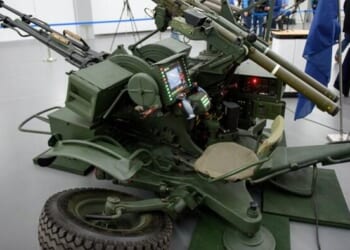
India’s layered air defense network was the decisive factor in Operation Sindoor. When Pakistan fired over 600 drones at Indian military installations across the western front, India’s integrated system, combining the S-400 (Sudarshan Chakra), Israeli-co-developed MRSAMs, and indigenous Akash batteries, neutralized between 90 and 95 percent of incoming threats. Certain older systems, such as legacy air-defense guns, have emerged as cost-effective solutions against low-flying, small, and cheap drones, validating a layered approach over a high-end-only one.
In Ukraine, the absence of sufficient layered air defense in the war’s early phases allowed Russia to strike Ukraine’s power grid and civilian infrastructure through Shahed swarms. Later, the Ukrainians started deploying their own cheap air defenses, such as the interceptor guns (which are now garnering interest by the United States and Israel in the ongoing Iran conflict). In air defenses, too, price points are becoming crucial as forces and nations become aware of the cost asymmetry of taking out cheap drones with expensive air defense systems.
The U.S.-India Opportunity: Industrial Complementarity
These conflicts and wars have exposed a structural problem in the U.S. defense industrial base that procurement reform alone cannot quickly fix: it is not built for volume. American defense primes are optimized for small numbers of exquisite, expensive systems. The Trump administration has moved quickly to address this. In January, President Donald Trump signed “Prioritizing the Warfighter in Defense Contracting,” barring major defense contractors from conducting stock buybacks or issuing dividends at the expense of production capacity, and the FY2026 National Defense Authorization Act directed more than $25 billion to rebuild munitions stockpiles.
These are necessary corrections, but rebuilding an industrial base takes years, not months. As a 2024 GAO report found, replenishing weapons drawn down for Ukraine alone required $25.9 billion and faced lead times stretching to 34 months on key components, and that was before the Iran campaign began drawing down Patriot and SM-3 interceptor inventories. My colleagues at the Heritage Foundation warned years ago that “the lack of surge capacity creates the risk that, in a protracted war, the United States would deplete its stockpiled munitions before replacements could be manufactured.” The United States can build the world’s most sophisticated drone, but it cannot easily produce 4,000 a month.
>>> The Army Is Now Relevant to the Pacific. Congress Should Budget Accordingly.
India offers part of the solution on terms that serve American interests. The Sindoor conflict battle-tested India’s growing manufacturing ecosystem for drones, loitering munitions, and indigenous air defense. India has moved from importing 70 percent to producing 65 percent of its defense capital procurement domestically, with a goal of 90 percent by the decade’s end.
Furthermore, as the post-Sindoor procurement surge demonstrated, the political will to scale rapidly is there. What India still lacks is access to the cutting edge: advanced AI targeting tools, next-generation standoff systems, electronic warfare sophistication, and sensor integration that transforms mass into precise, lethal mass.
This points toward a reframing of the U.S.-India defense relationship to one grounded in industrial and battlefield logic. The framing of the relationship as merely the United States selling platforms to India misses what these wars have actually revealed. The United States needs a manufacturing partner that can produce at volume; India needs a technology partner that can provide the precision edge, something I have written about earlier as well.
Together, that combination maps directly onto the three conflicts that have now empirically demonstrated how to win wars. Co-production of loitering munitions and drones, joint AI targeting development, shared munitions stockpiling, and deeper electronic warfare collaboration are industrial requirements validated by combat.
The wars in Ukraine, South Asia, and the Middle East did not reveal a radically new kind of conflict. They revealed that the fundamentals of war remain the same across decades. The critical importance of firepower, mass, and air superiority has not changed. What has changed is who can access them, at what cost, and at what speed. AI has leveled the playing field and handed mid-tier powers a key to capabilities once held exclusively by great powers. In this context, the U.S.-India partnership, built around the reality of India’s scale and married to America’s technological edge, makes strategic sense for both powers.
This piece originally appeared in The National Interest