ATLANTA—Politics in Georgia are getting, well, ugly.
In a new television spot, the latest salvo in an $80 million-plus air war between the top two Republican candidates for governor, Lt. Gov. Burt Jones’ campaign goes right at billionaire businessman Rick Jackson’s physical appearance.
“In politics, some makeovers are only skin deep,” says an ominous voiceover as a pair of hands with surgical gloves takes a scalpel to the photo of Jackson’s face featured on his ubiquitous flyers (some Georgia voters get multiple Jackson mailers a week).
The paper peels back the face of the 71-year-old to reveal a photo of a slightly heftier Jackson from years earlier.
The voiceover documents ways in which Jackson has supposedly had a political facelift, including a contribution from the prolific Republican donor to MAGA enemy No. 1, Liz Cheney. But the subtext about Jones’ rival’s visage is really, well, text.
“Rick Jackson: You can change the face, but you can’t erase the record,” the voiceover concludes, with the newer, svelter Jackson’s face back on the screen.
The ad isn’t the first time Jones has made fun of Jackson’s looks, as some private text messages I’ve recently obtained indicate. In an exchange with a Republican operative (who requested and was granted anonymity) in Georgia earlier this year, Jones referred to Jackson as looking “creepy,” suggested Jackson has undergone plastic surgery, and crudely mocked other GOP operatives working for his opponents.
“Tell creepy Ricky that I am praying for him,” Jones wrote.
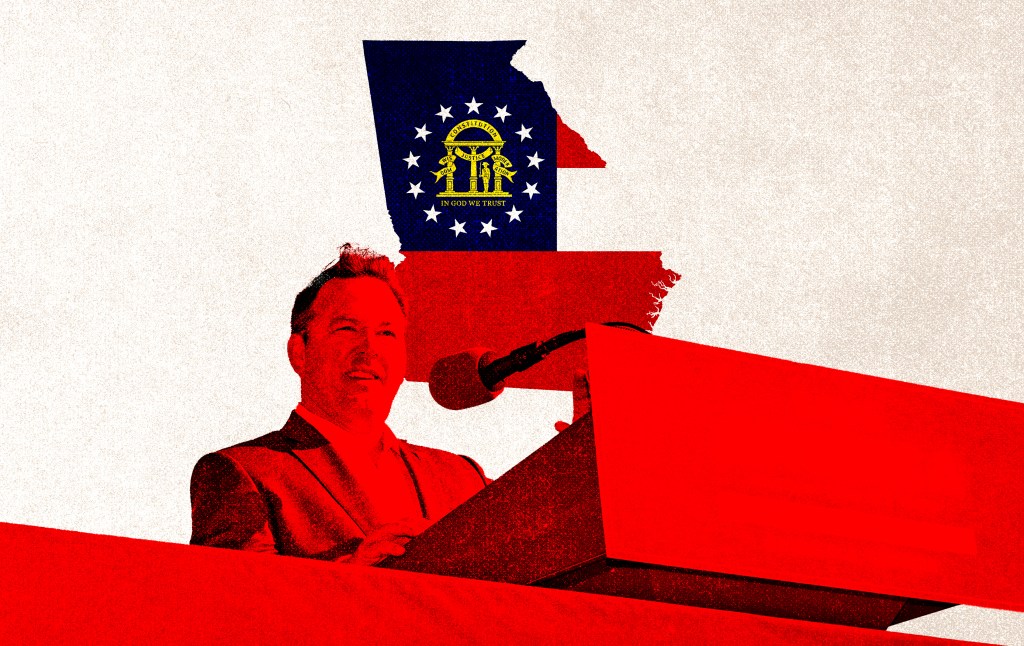
These kinds of salty text messages from Jones, the 47-year-old lieutenant governor who has been endorsed by Trump, have become the worst-kept secret in Georgia politics. Jones’ texting habits are well known among Republicans in the state, but many say they have become more frequent and unhinged in the last couple of months since the entry of Jackson, a first-time candidate who is largely self-funding, has shaken up the race for governor in this state. With a Trump endorsement in hand and plenty of money himself, Jones was long seen as the favorite for the Republican nomination and the next-in-line to succeed the popular, two-term Republican governor, Brian Kemp.
But thanks to Jackson’s huge influx of cash—at more than $47 million so far, he’s behind only Democratic billionaire and California gubernatorial candidate Tom Steyer in 2026 campaign spending nationwide—he has now supplanted Jones as the leading candidate ahead of the May 19 primary. Georgia Republicans say that ever since Jackson entered the race in February, Jones has sniped at others in private in ways that they say are unusual and unprecedented in Peach State intraparty politics.
Jones has long had a habit of sending juvenile private texts to his primary opponents, political aides, and state legislators.
In one text message late last year to another Republican rival running for governor, state Attorney General Chris Carr, Jones poked fun at Carr’s poll numbers. “12 months running and you still in single digits 😂 😂 great work!!! Keep it up 👍” reads the message, which Carr appears not to have responded to.
And in another string of messages to a different Republican operative working for Carr’s campaign, Jones sent memes mocking his opponent’s poll numbers and engagement on social media. “Let me know if you need me to come give y’all a little advice on how not to be BUSH league,” Jones wrote. “Y’all really are fun to run against.”
And then there are the text messages and phone calls to Republican state legislators who have either endorsed Jackson or are staying out of the primary entirely. Some members of the General Assembly who spoke to me about Jones’ outreach in the last few weeks say it’s often been the first time they’ve heard from Jones regarding his gubernatorial campaign, and the messages are angry or even vaguely intimidating, not persuasive or conciliatory.
“The message is, ‘I see where your loyalty lies,’” says one member of the General Assembly who has received text messages and a phone call from Jones and who asked to remain anonymous out of fear of further retaliation.
These insinuations are now out in the open. In a televised debate this week featuring all eight of the Republican candidates for governor, Jackson suggested that Jones, who as lieutenant governor is the president of the state Senate, had even “threatened legislation of members if they supported his political opponent.” Carr also said he has received questions about whether these “threats” from Jones to state legislators were real. On the debate stage, Jones denied he had held up any legislation as lieutenant governor in retaliation for endorsing a rival. “There was nobody holding anybody’s feet to the fire,” he said.
“Rick Jackson is creepy, Chris Carr is in single digits, and our opponents are bush league,” said Jones campaign spokeswoman Kayla Lott, when I asked her about the text messages. “Unlike Rick Jackson, Burt Jones’ private views aren’t different than his public views.”
Republican legislators who spoke to me say the threats to those who haven’t endorsed Jones have been more implied than explicit, but the chilling effect is real. Other members of the state Legislature who had been ready to endorse a candidate other than Jones for governor are instead holding their tongues, the aforementioned legislator told me. Jackson may be in the lead now, but it’s reasonable that state legislators with their own priorities in the General Assembly want to avoid making Jones angrier. Because there is a crowded GOP field—in addition to Jones, Jackson, and Carr, Secretary of State Brad Raffensperger is also running—the race is almost certainly headed to a runoff with no candidate likely to get a majority of the vote in next month’s primary. A bruised and battered Jones could come in second place to Jackson in the primary but secure the nomination in the runoff—and go on to be elected governor in the fall. (Though given Georgia’s increasingly purple political profile, there’s no guarantee the Republican nominee will win the general election.)
But for now, it appears Jones is on the back foot and is lashing out in anger. “I think a lot of it is he’s scared,” said the legislator. “He’s scared and concerned, and I think it shows a little bit of his character.”
“He’s burning a bridge that he’s still standing on,” said a second legislator, who also requested anonymity.
The situation is a reminder of the limits of an endorsement from Trump among some Republican primary voters. Despite Trump’s early support for Jones, which has been a prominent feature of Jones’ advertising and which the president reinforced during a speech in Georgia in February, the transitive property of political popularity has not applied. While Jones and his family have long had ties to Trump himself—Jones’ father, the founder of a successful fuel distributor and retail company, was an early supporter and donor to Trump in Georgia—his conventional path through politics, first as a state senator and now as lieutenant governor, isn’t quite in sync with Trump’s brand as a political outsider.
Indeed, that’s been an opening for Jackson to exploit. The novice candidate, who amassed a considerable fortune by starting a healthcare staffing company, has paid for an array of TV ads positioning him as not only pro-Trump but Trump-like, a billionaire who can’t be bought by a corrupt establishment.
“President Trump doesn’t play by their rules,” Jackson says in one spot. “That’s why I gave him $1 million.”
Jones’ frustration is understandable. In a party that is so uniformly pro-Trump, the candidate with the president’s backing ought to have his party’s nomination. But it’s not just that Georgia Republican voters have their own complicated relationship with Trump—they renominated and reelected both Kemp and Raffensperger in 2022 despite credible, pro-Trump primary challengers. Ironically, Trump’s dominance within a party that, after 10 years, reflects his priorities and style may have weakened the power of his endorsement as a signal to primary voters.
On the trail, Jackson touts his own admiration and proximity to Trump and his administration. At a stop earlier this month in Carrollton, he told a large crowd about a meeting he had with White House chief of staff Susie Wiles ahead of the announcement of Trump’s new drug pricing agreement and online platform known as “TrumpRx.” Distributed around the room were flyers that describe Jackson as “Trump’s partner” and feature images of both men. Someone with no knowledge of the specifics could reasonably conclude Trump has endorsed Jackson, not Jones.
That undercutting of his main strength may be what’s driving Jones to lash out at those who cross him. But unlike the president who has endorsed him, Jones seems unable to make the state party, and its voters, automatically bend to his will.
“He’s saying things and texting things that break the norms,” said one of the Republican legislators, who likened Jones’ behavior to Trump’s. “But Trump can get away with things that the rest of us cannot.”